
In summary:
- Effective zero-waste travel in Alberta is not about personal perfection, but about understanding and using the region’s specific conservation systems.
- Simple choices, like drinking tap water and using designated recycling bins, are highly effective due to robust local infrastructure.
- Minimizing your impact involves respecting invisible boundaries, from fragile alpine flora to the social fabric of local communities.
- Supporting Alberta-owned businesses strengthens the local economy, which is foundational to long-term conservation efforts.
The vision is captivating: pristine turquoise lakes, immense glaciers, and the vast, wild landscapes of Alberta’s mountain parks. For the eco-conscious traveler, however, this dream is shadowed by a nagging question: how do you experience this beauty without harming it? The struggle to avoid single-use plastics and minimize your footprint on the road is real. Standard advice often feels generic, revolving around bringing your own water bottle and snacks.
While these are good starting points, they barely scratch the surface of what it means to travel responsibly in a sensitive, world-renowned ecosystem. The reality is that Banff, Jasper, and the surrounding areas are not just wild spaces; they are carefully managed environments with unique systems for waste, wildlife, and water. True sustainable travel here goes beyond personal habits and enters the realm of systemic participation.
But what if the key to leaving no trace wasn’t just about what you packed, but about how you integrated into the local conservation ecosystem? This guide shifts the perspective. Instead of focusing on the guilt of unavoidable waste, we will explore the practical, system-level choices you can make. It’s about leveraging the infrastructure already in place to be a better steward of these incredible places.
This article provides a practical framework for your journey. We will explore everything from the safety of tap water and the logic behind bear-proof bins to the unseen damage of a single footstep off-trail, empowering you to become a temporary, but impactful, partner in preservation.
Summary: A Guide to Visiting Alberta’s Parks Without a Trace
- Tap Water Quality: Is It Safe to Drink from the Tap in Banff?
- Recycling in Parks: What Actually Goes in the Bear-Proof Bins?
- Green Key Ratings: How to Spot Truly Sustainable Hotels?
- Flight Shaming: How to Calculate and Offset Your Trip to Canada?
- Alpine Flowers: Why Stepping Off the Trail for a Photo Destroys Decades of Growth?
- How to Dig a Cathole: The Sanitary Rules for Backcountry Toilet Needs
- Living in a Postcard: How to Be a Considerate Guest in Banff Residential Areas?
- Local vs Chain: Why Supporting Alberta-Owned Businesses Matters?
Tap Water Quality: Is It Safe to Drink from the Tap in Banff?
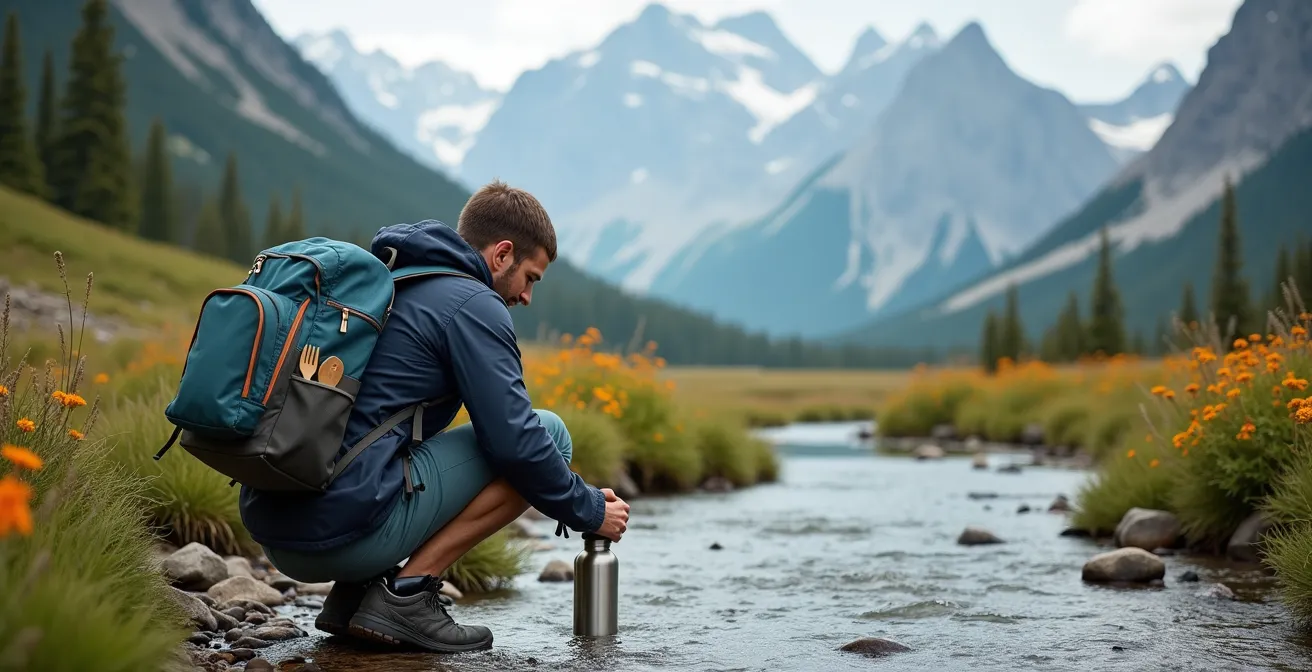
One of the first dilemmas for a zero-waste traveler is hydration. The temptation to buy bottled water can be strong, but in Banff and Canmore, it’s entirely unnecessary. The municipal tap water is not only safe but of excellent quality, sourced from deep underground wells and rigorously tested. While some may wonder about drinking directly from a glacial stream, this is highly discouraged due to the risk of parasites like Giardia. The safest, most sustainable option is always the tap.
The water is considered ‘hard,’ with an average hardness of 190 mg/L of calcium carbonate, a level that simply reflects its rich mineral content and has no negative health implications. Forget the plastic bottles. Your primary tool for sustainable hydration is a reusable bottle, which you can fill up with high-quality water at numerous public stations. The towns have made it incredibly easy to avoid plastic waste.
You can find year-round indoor filling stations at places like the Fenlands Recreation Centre, and seasonal outdoor fountains and fillers at popular spots like Central Park, along the main blocks of Banff Avenue, and at the Sundance Park pavilion. This network is a core part of the local conservation ecosystem, designed to make the sustainable choice the easy choice. Trusting the tap is your first and easiest win in reducing your footprint.
Recycling in Parks: What Actually Goes in the Bear-Proof Bins?
The iconic bear-proof bins are more than just garbage cans; they are the public face of a sophisticated waste management system designed to protect both wildlife and people. Understanding how they work is crucial. These containers use a gravity-assisted latch mechanism that is easy for humans to operate but nearly impossible for a bear to open. Using them correctly is a non-negotiable part of visiting.

But what goes inside? Alberta has one of North America’s most effective beverage container recycling programs, a system so effective that it resulted in an 83.1% container return rate in 2024. This means almost all beverage containers (plastic, glass, aluminum) can be recycled. Look for specific openings on the bins for containers. Paper, cardboard, and hard plastics also have dedicated streams. The key is to never put food waste or scented items in a recycling bin, as this contaminates the entire batch and attracts wildlife.
Case Study: Canmore’s Bear-Resistant Waste System
The town of Canmore provides a powerful example of systemic responsibility. Over several years, it eliminated curbside collection entirely, replacing it with a network of communal, bear-resistant containers for garbage, recycling, and organics. By ensuring every residence is within a short walk of these secure bins and maintaining them meticulously to prevent odors, the town has dramatically reduced human-bear conflicts. This system proves that community-wide infrastructure is more effective than relying on individual compliance alone.
Your responsibility is simple but vital: ensure the latch is securely closed every single time you use a bin. An unlatched bin is a direct threat to a bear’s life, as a bear that gets a “food reward” from human garbage often becomes a “problem bear” that must be relocated or, in the worst cases, destroyed. Properly using these bins is a direct act of wildlife conservation.
Green Key Ratings: How to Spot Truly Sustainable Hotels?
Choosing a place to stay is another major decision. Many hotels claim to be “green,” but it can be difficult to separate genuine commitment from clever marketing. The Green Key Global eco-rating program is a helpful tool used in Canada’s hotel industry. It rates properties from 1 to 5 Keys based on their environmental performance. However, a rating alone isn’t the full story.
To be a discerning traveler, you must look beyond vague claims and ask specific, practical questions. A truly sustainable hotel will be able to provide concrete answers. Don’t be afraid to inquire about their practices. For example, the Fairmont Chateau Lake Louise is known for its sustainability initiatives, but a truly committed hotel can give you specifics on waste reduction and local sourcing, not just general statements.
True sustainability is demonstrated through action, not just policy. Look for evidence of programs like active composting, the elimination of single-use plastics in rooms and restaurants, and partnerships with local food producers. A hotel proud of its efforts will have this information readily available and will display its specific Green Key rating, not just a generic “eco-friendly” sticker.
Your Checklist for Detecting Hotel Greenwashing
- Ask for specifics: “What percentage of your food is sourced from Alberta producers?” This tests their commitment to the local economy.
- Inquire about waste: “Do you have an active composting program for all food waste?” This goes beyond simple recycling.
- Check for plastic reduction: “Have you eliminated single-use plastics in your restaurants and guest rooms?” Look for bulk dispensers and non-plastic alternatives.
- Confirm certifications: “What is your specific Green Key rating level?” A rating of 3 or higher shows a significant commitment.
- Verify with examples: Look for mentions of specific, verifiable programs, like the Fairmont Jasper Park Lodge’s ORCA system which turns food waste into water.
Flight Shaming: How to Calculate and Offset Your Trip to Canada?
For most international visitors, the flight to Alberta is the single largest part of their trip’s carbon footprint. The concept of “flight shaming” has raised awareness, but it can also induce paralysis. A more constructive approach is to understand, reduce, and then mitigate your impact through a clear hierarchy of actions. Simply buying carbon offsets is often a last resort and, as research from IATA shows, only 1-3% of airline passengers voluntarily purchase them, highlighting their limited effectiveness as a standalone solution.
The most impactful step is to reduce at the source. Choose direct flights to major hubs like Calgary (YYC) or Edmonton (YEG) to avoid the extra fuel consumption of connecting flights. Once in Alberta, you can dramatically lower your impact by optimizing your ground transport. Instead of a private rental car, use shared services like the Brewster Express bus between Calgary and the mountain parks, or the excellent Roam Transit system within Banff and Canmore.
Finally, instead of (or in addition to) purchasing generic carbon offsets, consider supporting local conservation efforts directly. A donation to an organization like the Yellowstone to Yukon Conservation Initiative (Y2Y) or the Canadian Parks and Wilderness Society (CPAWS) Southern Alberta Chapter puts your money directly into preserving the landscapes you’ve come to see. This “hyper-local” approach to offsetting ensures your contribution has a tangible, on-the-ground impact within the ecosystem you are visiting.
Alpine Flowers: Why Stepping Off the Trail for a Photo Destroys Decades of Growth?
In the high-altitude alpine zones, the ground is a carpet of vibrant, delicate life. The temptation to step off the trail for that perfect photo of Indian paintbrush or moss campion is immense. However, this is where travelers can cause the most significant “invisible impact.” Alpine ecosystems are incredibly fragile, with a growing season that can be as short as a few weeks a year.
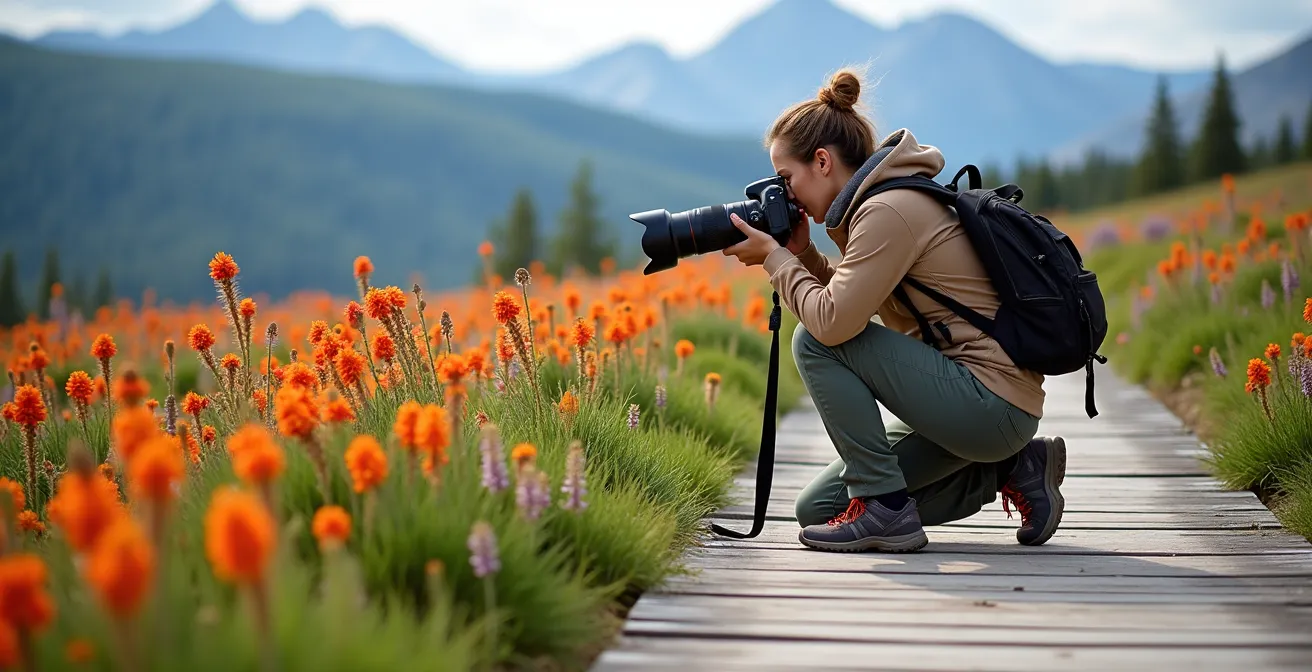
The thin topsoil in popular areas like Sunshine Meadows in Banff or Wilcox Pass in Jasper supports vegetation that grows at a glacial pace. A single footstep can compact the soil, damage root systems, and destroy plants that took decades to establish. The “leave no trace” principle is a strict rule here: the only acceptable place to walk is on designated, hardened trails, rocks, or snow.
This doesn’t mean you can’t get stunning photos. Responsible photography is part of the challenge and reward. Use a telephoto lens to compress the background and bring flowers closer without leaving the trail. Seek out established viewpoints built for this exact purpose, such as the famous Moraine Lake rockpile or the designated viewing areas around Spirit Island in Jasper. These spots are designed to handle foot traffic while offering iconic perspectives. Finally, practice responsible geotagging—avoid posting the exact location of sensitive, off-the-beaten-path areas to prevent crowds from following in your footsteps.
How to Dig a Cathole: The Sanitary Rules for Backcountry Toilet Needs
In the backcountry, away from established facilities, managing human waste properly is a critical skill for protecting water sources and the health of other hikers. The standard method is digging a “cathole.” But in the Rocky Mountains’ unique environment, there are specific rules to follow to ensure it’s done sanitarily and effectively. The goal is to access the subsoil’s microbial layer, which breaks down waste.
The location is the first critical choice. Your cathole must be at least 50 meters (about 70 steps) away from any trail, campsite, or water source like a lake or stream. This distance is crucial to prevent contamination. Once you’ve found a suitable spot with rich, dark soil, use a small trowel to dig a hole that is 15-20 cm (6-8 inches) deep. In thin mountain soil, this depth is necessary to reach the organisms that will do the decomposition work.
One of the most important—and often overlooked—rules in Alberta’s dry ecosystems is to pack out all toilet paper. Unlike in wetter climates, toilet paper decomposes extremely slowly here and can be dug up by animals. Carry a dedicated, sealed bag (like a ziplock covered in duct tape for privacy) for this purpose. In extremely sensitive or high-altitude alpine zones, on snow, or on glaciers, you are required to pack out all solid human waste using a commercial system like a WAG bag. When you’re finished, fill the cathole with the original soil and disguise it with natural materials.
The Gold Standard: WAG Bags in High-Traffic Zones
In heavily-used or fragile areas like the Lake O’Hara region in Yoho or the Berg Lake trail in Mount Robson Provincial Park, Parks Canada mandates or strongly recommends WAG bags. These portable toilet systems contain chemicals that neutralize waste and render it safe for disposal in regular trash. They represent the ultimate application of Leave No Trace principles, ensuring you remove absolutely everything you brought into the backcountry. You can purchase them at outdoor stores in Jasper or Canmore.
Living in a Postcard: How to Be a Considerate Guest in Banff Residential Areas?
It’s easy to see a town like Banff as a resort, a perfect postcard setting for a vacation. But it’s crucial to remember that it is also a real, functioning community. This is not just a social observation; it’s codified in law. Banff is one of the few places in Canada with a “need to reside” requirement, meaning that to live there, you must work there. This makes you a guest in a community of thousands of people who call this park home.
Being a considerate guest means recognizing that residential streets are not just photo backdrops. Wildlife, especially elk and deer, frequently move through these neighborhoods, and respecting their space is paramount. Drive slowly, never feed or approach an animal, and keep a safe distance at all times. The rules that apply on the trail apply in town, too.
Your behavior in your accommodation also has a direct impact on wildlife safety. The most critical rule is to never leave any food, garbage, or scented items unsecured. A cooler left on a porch or food scraps in an unlocked car can attract a bear, a scenario that often ends in the animal’s death. This is a life-or-death matter. Always use the provided bear-proof bins and report any that are full or damaged to the authorities. By keeping noise levels down, especially at dawn and dusk when animals are most active, and minimizing outdoor lighting (especially in a Dark Sky Preserve like Jasper), you contribute to a more peaceful coexistence for everyone.
Key Takeaways
- True sustainability in Alberta’s parks means actively participating in local conservation systems, not just avoiding plastic.
- Your biggest impacts can be reduced by making smart choices before you even arrive, such as booking direct flights and using shared transit.
- On the trail, the most profound impacts are often invisible, like soil compaction, so staying on designated paths is non-negotiable.
Local vs Chain: Why Supporting Alberta-Owned Businesses Matters?
Your spending is one of the most powerful tools you have. Every dollar you spend is a vote for the kind of economy you want to support. While familiar chain stores and restaurants offer convenience, choosing to support independent, Alberta-owned businesses is a direct investment in the local conservation ecosystem. Local businesses have shorter supply chains, a smaller carbon footprint, and are more likely to participate in unique community initiatives that chains often ignore.
Building a zero-waste travel kit can be done almost entirely through local shops. You can refill spices and grains from bulk bins at The Community Market in Canmore or pick up solid shampoo and conditioner bars from Rocky Mountain Soap Co. to eliminate plastic bottles. Local outdoor stores in Banff and Jasper are the best places to get specific gear like WAG bags and expert advice. When dining, look for farm-to-table restaurants that proudly list their Alberta farm suppliers on the menu.
Case Study: Canmore Cave Tours
A business like Canmore Cave Tours exemplifies this principle. As a locally owned and operated outfitter, they are not only dedicated to providing low-impact educational experiences but are also deeply integrated into the community. They maintain shorter supply chains for their gear and participate in local recycling programs that larger corporations might bypass. Supporting them means your money stays within the community, strengthening the local economic base that is essential for long-term environmental stewardship.
By consciously choosing small cafes, local outfitters for guided tours, and independent retailers, you do more than just make a purchase. You help sustain the very community that is on the front lines of protecting the parks. This economic support fosters a resilient local culture that values conservation, ensuring these wild places remain protected for generations to come.
By shifting your mindset from a visitor who consumes to a temporary steward who participates, your trip to Alberta’s parks becomes a regenerative act. Start today by planning your journey with these systemic principles in mind, ensuring your visit contributes to the preservation of this global treasure.