
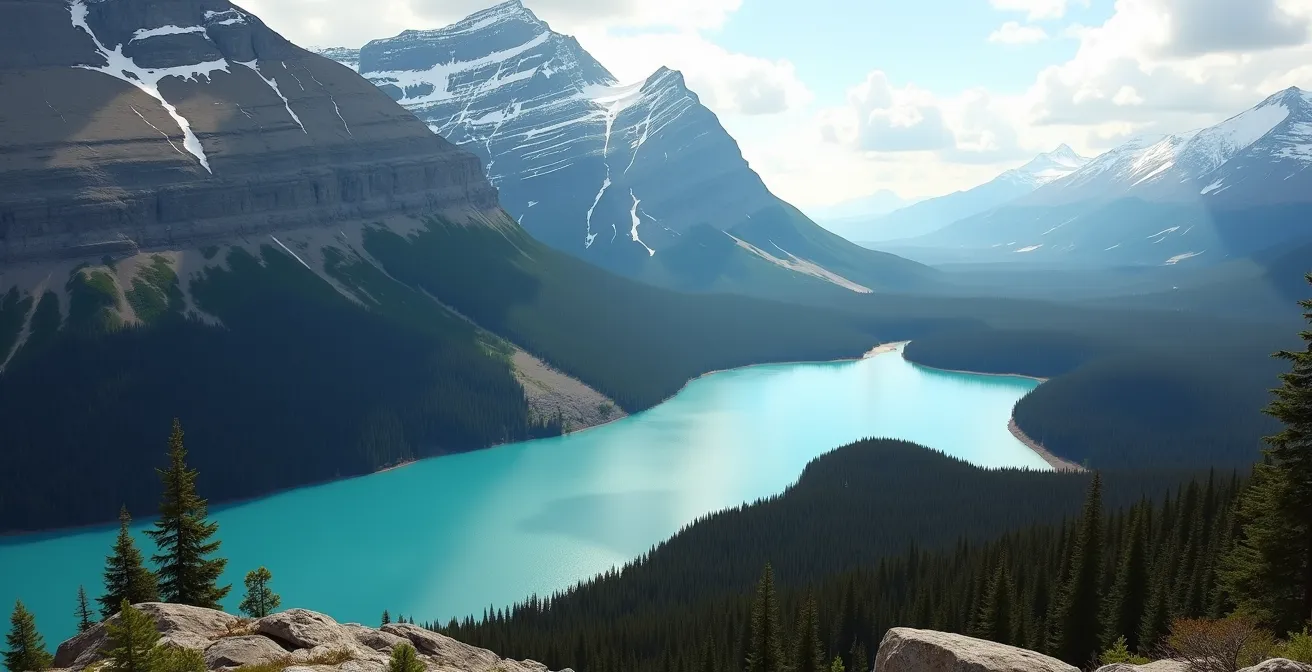
The iconic turquoise colour of Alberta’s lakes is not a static feature but a dynamic, living indicator of a glacier’s health and the physics of light itself.
- The colour is determined by the size and concentration of suspended “rock flour” particles, which scatter sunlight in a specific way.
- Timing is everything: colour vibrancy peaks with glacial melt in early summer, but this also coincides with peak crowds and safety risks like hypothermia.
Recommendation: To truly appreciate these natural wonders, plan your visit around the “glacial pulse” for the best colour, but use strategic timing and alternatives like Sherbrooke or Chephren Lake to avoid the logistical nightmares of more famous spots.
Standing on the shore of an Albertan glacial lake, the first thing that strikes you is the colour. It’s an almost impossibly vibrant turquoise or a deep, mesmerizing emerald that seems to glow from within. Many visitors hear the term “rock flour” and nod, accepting it as the simple explanation. But this is only the beginning of the story. These colours are not merely a pigment; they are the result of a complex dance between geology, physics, and the very life cycle of a glacier. They tell a story of mountains being ground to dust, of light being filtered and scattered, and of a delicate ecosystem that acts as a visible barometer for our changing climate.
To understand why Peyto Lake radiates a milky, sky-blue and nearby Emerald Lake presents a deeper green is to go beyond a simple photograph. It requires looking at these bodies of water as a limnologist would—as living systems. The true key lies not just in the presence of rock flour, but in its size, its concentration, and how it interacts with light on a microscopic level. This perspective transforms a simple question of “why is it blue?” into a much more fascinating exploration of the entire watershed, from the glacial “heartbeat” that pulses silt into the water to the logistical challenges of witnessing this spectacle among thousands of fellow admirers.
This guide will take you beneath the surface. We will explore the fundamental science of rock flour and light scattering that creates each lake’s unique hydrological fingerprint. We will then translate that science into practical advice: when to visit for the most vibrant colours, how to stay safe in lethally cold water, and how to find your own patch of turquoise tranquillity away from the infamous crowds. Finally, we’ll analyze the real value of iconic experiences, like a canoe rental on Lake Louise, to help you decide how to best invest your time and money in the Canadian Rockies.
This article provides a comprehensive look at the science and logistics behind Alberta’s famous coloured waters. The table of contents below outlines the key topics we’ll explore to help you plan your perfect trip.
Summary: The Science and Logistics of Alberta’s Glacial Lakes
- Rock Flour Science: Why Are Some Lakes Blue and Others Emerald Green?
- June or August: When is the Water Colour at Its Most Vibrant?
- Hypothermia in July: How Long Can You Safely Swim in a Glacial Lake?
- Chephren or Bow Lake: Where to Find Turquoise Water Without the Crowds?
- How to See Lake Louise Without the Parking Nightmare?
- Frozen Bubbles or Snow Cover: What Do Turquoise Lakes Look Like in January?
- Rent or Bring Your Own: Is a $140 Canoe Rental Justifiable?
- Is the $150 Canoe Rental at Lake Louise a Rip-off or a Memory?
Rock Flour Science: Why Are Some Lakes Blue and Others Emerald Green?
The secret to the otherworldly colours of Alberta’s mountain lakes is a phenomenon known as “rock flour.” This isn’t soil or mud; it’s fine-grained silt, the pulverised rock created by glaciers grinding against the bedrock beneath them. As glaciers melt, this flour is suspended in the meltwater and flows into the lakes. The colour we see is not a dye but a trick of light physics. When sunlight hits the water, most colours of the spectrum are absorbed. However, these tiny rock flour particles are the perfect size to scatter the blue and green wavelengths of light back to our eyes. This is a form of light scattering known as Mie scattering, distinct from the Rayleigh scattering that makes the sky appear blue.

The specific colour of a lake—its unique hydrological fingerprint—depends on the size and concentration of these particles. Lakes like Peyto, fed by large, active glaciers, receive a high concentration of extremely fine particles. These smaller particles are exceptional at scattering the vibrant turquoise and blue light, giving the lake its famous milky, opaque appearance. In contrast, lakes like Emerald Lake have a slightly different particle profile, or the particles may have had more time to settle. This allows more green light to be scattered, resulting in a deeper, more translucent emerald hue. Therefore, the colour is a direct reflection of the lake’s specific glacial source and depth.
This beautiful phenomenon is also a fragile one. These colours serve as an ecological barometer for glacial health. As our climate warms, glaciers are receding at an alarming rate. Research from the University of Alberta warns that as glaciers shrink, less rock flour flows into the lakes. This is causing a documented shift from the iconic milky turquoise to a clearer, more ordinary blue. In a study led by Dr. Rolf Vinebrooke, researchers found that lakes that are clear blue today, like Curator Lake in Jasper, had sediments showing they were once milky and clay-like. This is a stark reminder that the beauty we see today is directly tied to the health of the glaciers, and with projections showing that 80% of mountain glaciers in Alberta and B.C. will disappear in the next 50 years, the very colour of these lakes is threatened.
June or August: When is the Water Colour at Its Most Vibrant?
Timing your visit to a glacial lake is a delicate balance between peak colour, weather, and crowd levels. The vibrancy of the water is directly tied to the “glacial pulse”—the volume of meltwater carrying rock flour into the lake. This pulse is strongest when temperatures rise, meaning the colour intensifies as summer progresses, but other factors come into play.
The season unfolds with a predictable, yet often surprising, rhythm for lake vibrancy:
- Late May/Early June: Many lakes, especially at higher elevations, are still frozen or just beginning to thaw. While you might find solitude, the dramatic colour has not yet developed. As documented for high-elevation alpine lakes, some like those in the Lake O’Hara area can still be frozen well into June.
- Late June: This is often a sweet spot. The glacial melt is ramping up, creating an intense injection of rock flour and vibrant colour. However, you may still find ice and snow along the shorelines, creating a stunning visual contrast.
- July: This is generally considered the absolute peak for both colour and warmth. The glaciers are melting at a maximum rate, the days are long, and the turquoise is at its most brilliant. This, however, coincides with the absolute peak of tourist season.
- August: The colour remains vibrant, but a significant and growing risk emerges: wildfire smoke. Smoke from fires in B.C. or even within Alberta can drift into the parks, filling the valleys with haze that mutes the colours and obscures mountain views.
- September: As temperatures drop, the glaciers begin to freeze again. The flow of rock flour slows to a trickle, and the particles in the lakes start to settle. The colour fades, but this is offset by the spectacular golden foliage of “Larch Season,” offering a different kind of beauty.
Ultimately, the choice between June and August is a trade-off. Late June offers intense, developing colour with fewer crowds than July. August maintains good colour but carries the significant risk of smoke. For the best chance at brilliant turquoise under clear skies, early to mid-July is often the prime window, but you must be prepared for the crowds that come with it.
Hypothermia in July: How Long Can You Safely Swim in a Glacial Lake?
Even on the hottest +30°C Alberta summer day, the water in a glacial lake remains dangerously cold, typically hovering just above freezing at 4-6°C (39-43°F). The vibrant turquoise water is incredibly inviting, but immersion poses a serious and immediate risk of hypothermia. Understanding the body’s reaction to cold water is not just a safety tip; it’s a matter of life and death. Many visitors underestimate the power of this cold, assuming a hot day makes a swim refreshing. This is a critical mistake.
Experts in cold water safety, like Dr. Gordon Giesbrecht from the University of Manitoba, have developed the 1-10-1 Principle to explain what happens to your body. This is a crucial piece of knowledge for anyone even considering a dip. It states you have:
- 1 Minute to get your breathing under control. The initial shock of cold water causes an involuntary gasping reflex (cold shock response). Panicking and inhaling water is a primary cause of drowning.
- 10 Minutes of meaningful movement. During this window, you still have control over your limbs to self-rescue. After this, cold incapacitation sets in, and you will lose the ability to swim or pull yourself out of the water, even if you are a strong swimmer.
- 1 Hour before you become unconscious due to hypothermia.
This principle highlights that the immediate danger is not hypothermia itself, but the cold shock and incapacitation that lead to drowning. The 1-10-1 Principle is a stark warning that you have very little functional time in glacial water.
For this reason, authorities like Alberta Parks issue clear guidelines. As they state, a quick “polar dip” right at the shore is the only recommended activity. Anything more is gambling with your life. The official advice is blunt and essential:
Even on a +30°C Alberta summer day, the water temperature remains deadly. Anything more than a quick ‘polar dip’ near the shore is extremely risky.
– Alberta Parks, Alberta Parks Water Safety Guidelines
If you choose to take a quick dip, do it with a friend nearby, stay in shallow water, and have warm layers ready to put on immediately. Never swim alone, and never venture far from the shore.
Chephren or Bow Lake: Where to Find Turquoise Water Without the Crowds?
The iconic images of Lake Louise and Moraine Lake have made them victims of their own success, leading to overwhelming crowds and parking nightmares. However, the Canadian Rockies are dotted with hundreds of turquoise gems, many of which offer the same stunning colours with a fraction of the visitors. Finding them requires a small trade-off, usually involving a bit of hiking, but the reward is a far more serene and personal experience. The key is to look beyond the main attractions along the Icefields Parkway and Trans-Canada Highway.
For travellers looking to escape the masses, a simple effort vs. reward matrix can guide your choice. Some spectacular lakes are visible from the road, while others require a dedicated hike to a quiet shoreline.
| Lake | Effort Required | Crowd Level | Photography Tip |
|---|---|---|---|
| Bow Lake | Zero hiking (roadside) | Moderate | Best for sunrise with Crowfoot Mountain reflection |
| Chephren Lake | 7km moderate hike | Very low | Wilder aesthetic with forested shoreline |
| Peyto Lake | Short walk from parking | High in summer | Visit early morning to avoid crowds |
| Sherbrooke Lake | 3km hike | Very low | Hidden gem in Yoho National Park |
The lakes requiring a hike offer the greatest solitude. Chephren Lake, for example, is the perfect destination for those wanting to earn their view. The moderate 7km trail leads to a stunning, wild lake fed by the Chephren Glacier, with a raw beauty that feels worlds away from the curated paths of Lake Louise. Another outstanding option is Sherbrooke Lake, a true hidden gem that offers a high reward for minimal effort.
Case Study: Sherbrooke Lake – The Hidden Turquoise Gem
Located in Yoho National Park, just a short drive from Lake Louise, Sherbrooke Lake offers an accessible wilderness escape. The easy 3km trail from the Trans-Canada Highway winds through the forest before opening up to a breathtaking turquoise lake framed by Mt Ogden and Cathedral Mountain. Unlike its famous neighbours, Sherbrooke Lake sees very few visitors. It provides the quintessential glacial lake experience—the brilliant colour, the towering peaks, the peaceful shoreline—without the noise and congestion, making it an ideal choice for those seeking solitude.
While Bow Lake and the Peyto Lake viewpoint are easily accessible and thus more crowded, visiting at sunrise or sunset can provide a quieter experience. But for true peace, lacing up your hiking boots and heading to Chephren or Sherbrooke is the guaranteed path to finding your own private piece of paradise.
How to See Lake Louise Without the Parking Nightmare?
Visiting Lake Louise during peak season has become a major logistical challenge. With up to 15,000 visitors per day, the parking lots fill before sunrise, and personal vehicle access is often restricted for most of the day. Attempting to “just drive up” is a recipe for frustration and disappointment. Fortunately, Parks Canada has implemented a robust and mandatory shuttle system that, with a little planning, is the only guaranteed way to access both Lake Louise and Moraine Lake.
Forgoing the stress of parking and using the shuttle is no longer just a suggestion; it is the essential way to visit. Booking this shuttle, however, requires precision and speed, as spots are in extremely high demand. To secure your seat, a methodical approach is necessary. Following these steps will give you the best chance of success and ensure a smooth, stress-free visit to one of the world’s most beautiful locations.
Your Action Plan: Booking the Parks Canada Shuttle
- Create Your Account in Advance: Go to the Parks Canada reservation website and create an account using GCKey or a sign-in partner (like a Canadian bank login). Do not wait until booking day to do this.
- Know Your Booking Window: A portion of shuttle tickets are released in the spring for the entire season. The majority (60%) are released on a rolling 48-hour window. This means you must book at 8:00 AM Mountain Time, exactly two days before your desired visit date.
- Be Ready to Book Instantly: Log in to your account a few minutes before 8:00 AM. Have your credit card information ready. The moment the clock strikes 8:00, refresh the page and book your desired time slot. Spots for popular times can sell out in minutes.
- Have a Backup Plan: If you miss out on the Parks Canada shuttle, another excellent option is the Roam Transit Route 8X (Reservable Super Pass) from the town of Banff. This bus provides direct, scheduled service to the Lake Louise lakeshore.
- Confirm Your Passes: Remember that in addition to your shuttle ticket (which costs about $8 for an adult), you must also have a valid Parks Canada Discovery Pass for entry into Banff National Park.
While some private tour operators offer transport, the Parks Canada shuttle and Roam Transit are the most reliable and cost-effective methods. By embracing this system, you trade the uncertainty and stress of the parking lottery for a guaranteed and predictable journey, allowing you to focus on the stunning scenery, not the traffic.
Frozen Bubbles or Snow Cover: What Do Turquoise Lakes Look Like in January?
The vibrant liquid blues and greens of summer give way to a world of white and deep ice in winter. By January, the glacial lakes of the Rockies are completely transformed. The flow of rock flour has long ceased, the particles have settled, and the surface is frozen solid, typically covered by a thick blanket of snow. The turquoise is gone, hidden until the spring thaw. For most lakes like Peyto, Emerald, and Louise, the winter view is one of a vast, flat, snow-covered expanse surrounded by ice-caked mountains. Access can also be a major challenge, with the road to the Peyto Lake viewpoint often closed due to avalanche risk.
A common misconception, fuelled by viral social media photos, is that all frozen lakes in the Rockies feature the famous “frozen bubbles.” This spectacular phenomenon, where methane gas released from decaying organic matter on the lakebed gets trapped in stacking layers of ice, is a major draw for winter photographers. However, it’s crucial to know that this is highly location-specific.
The famous methane bubbles phenomenon occurs at Abraham Lake on the David Thompson Highway, not typically at Peyto, Emerald, or Louise.
– Travel Alberta, Alberta Winter Lake Guide
Abraham Lake, a man-made reservoir on a different river system, has the specific conditions of depth and organic material required for this spectacle. The high winds in its valley often sweep the ice clear of snow, making the bubbles visible. This is not the case for the natural, high-elevation glacial lakes, which are typically snow-covered. While you might find opportunities for ice skating on Lake Louise or walking on a cleared path, you will not see the turquoise colour or the famous methane bubbles.
Winter in the Rockies offers its own stark, quiet beauty. The experience is about snowshoeing through silent forests, marvelling at the sheer scale of the snow-draped peaks, and enjoying the profound peace of the off-season. It is a completely different, but equally magical, experience from a summer visit. Just be sure to set your expectations correctly: you are coming for a world of white, not blue.
Rent or Bring Your Own: Is a $140 Canoe Rental Justifiable?
The image of a canoe gliding across impossibly blue water is the quintessential Canadian Rockies dream. But with on-site rentals at popular lakes like Moraine and Emerald costing upwards of $140 per hour, many travellers face a difficult question: is the price justifiable? The answer depends entirely on your trip’s logistics, budget, and what you value most: time or money. This isn’t just an expense; it’s an investment in a specific kind of experience.
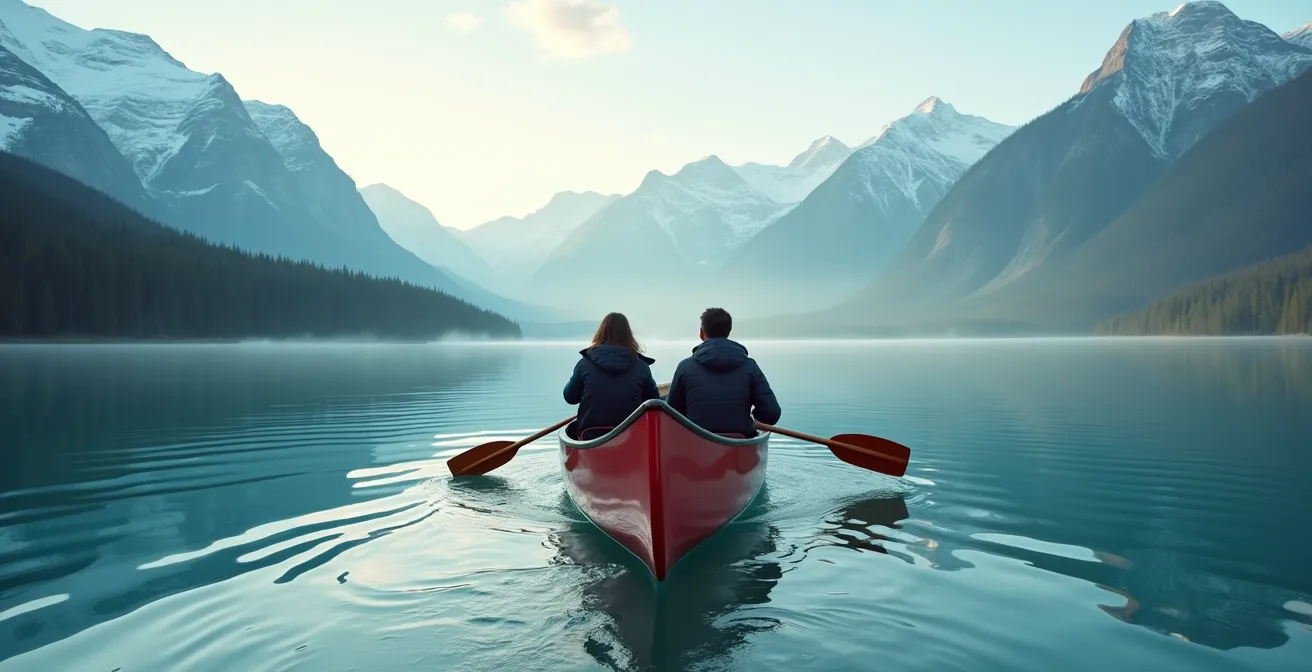
Paddling a canoe offers a perspective that is impossible to get from the shore. You are immersed in the environment, feeling the silence, seeing the light play on the water’s surface, and gazing up at the glaciers from a humbling water-level vantage point. For many, especially international tourists on a tight schedule, paying the premium for an on-site rental is a justifiable time-saver. The convenience of walking up, renting a boat for an hour, and creating a lifelong memory is worth the cost. However, for others, the price is simply too steep. A decision framework can help you determine the best option for your circumstances.
Consider these factors when making your choice:
- The Single-Lake Visit: If you only plan to paddle on one specific, iconic lake (like Emerald Lake), the on-site rental is the most time-efficient option despite the high cost.
- The Multi-Day Paddler: If you want to paddle on multiple lakes over several days, renting from an off-site location in Canmore or from the University of Calgary Outdoor Centre is far more economical. You can get a canoe for a fraction of the daily on-site price.
- The True Cost of “Bringing Your Own”: If you have your own canoe, factor in the hidden costs: the need for a roof rack, the time spent loading and unloading, and the extra fuel consumption. You will also still need a valid Parks Canada Pass for your vehicle.
- The Budget-Conscious Traveller: If the rental cost is prohibitive, don’t despair. Some of the best views of the lakes are free. Hiking to a viewpoint like the Big Beehive Lookout above Lake Louise offers a stunning aerial perspective of the lake and the tiny canoes below, which is an equally memorable experience.
Ultimately, the $140 question is one of personal value. There is no right or wrong answer. It is a choice between convenience and cost, between a bucket-list experience and a more budget-friendly adventure.
Key Takeaways
- The lake’s colour is an active process tied to glacial melt, not a static feature.
- Safety is paramount: the water is lethally cold year-round, and crowds require strategic planning like booking shuttles months or days in advance.
- Authentic, crowd-free experiences are possible by choosing less-famous lakes that often require a short hike.
Is the $150 Canoe Rental at Lake Louise a Rip-off or a Memory?
The staggering price tag for a one-hour canoe rental at the Fairmont Chateau Lake Louise—often exceeding $150—is a source of intense debate among travellers. On one hand, it can feel like an exorbitant “tourist trap.” On the other, it provides exclusive access to an experience at a global landmark. To decide if it’s a “rip-off” or a “memory,” it’s best to analyze it not as a simple boat rental, but as an admission ticket to a unique perspective on one of the world’s most famous natural vistas.
The core of the value proposition is the unparalleled view. From the water, you are paddling directly towards the majestic Victoria Glacier, surrounded by a perfect amphitheatre of snow-capped peaks. This is a view and a feeling that cannot be replicated from the crowded shoreline. When the cost is broken down per person or compared to other major tourist attractions, the price can be seen in a different light.
This value analysis helps contextualize the cost:
| Perspective | Cost Breakdown | Comparable Experience |
|---|---|---|
| Solo Paddler | $150+ per person | Premium for bucket-list experience |
| Group of 3 | $50-75 per person | Similar to Banff Gondola ($66) |
| Photography Value | Unique water-level glacier view | Impossible to replicate from shore |
| Free Alternative | $0 – Fairview Lookout hike | Aerial view of lake and canoeists |
Framing the rental this way shifts the conversation from “how much for a boat?” to “how much for this specific, iconic experience?” It becomes less of a commodity and more of a luxury purchase, similar to paying for premium access at other world-famous landmarks.
Comparison with Global Tourist Attractions
The high price is a function of supply and demand at an iconic location. Similar to paying a premium to go to the top of the Eiffel Tower or the Empire State Building, visitors are paying for the setting. The $150+ canoe rental at Lake Louise grants access to an exclusive experience within one of Canada’s most photographed landscapes. It is a fee for the privilege of paddling beneath the Victoria Glacier in a place recognized globally for its beauty, a cost that many find justifiable for a once-in-a-lifetime memory.
Ultimately, whether the rental is a rip-off or a priceless memory is a personal calculation. If your goal is to simply be on the water, cheaper options exist elsewhere. But if your dream is to paddle a red canoe across the turquoise jewel of Lake Louise, framed by its iconic glacier, then the cost may simply be the price of admission for an unforgettable moment.