
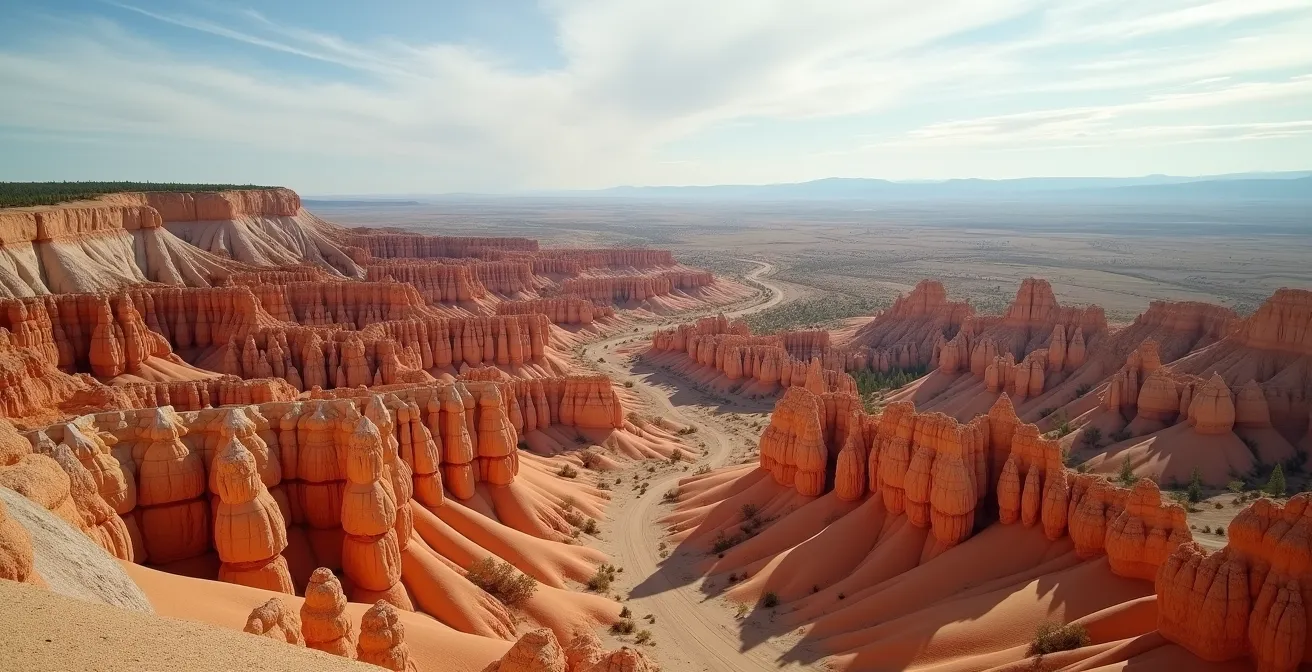
Dinosaur Provincial Park’s UNESCO status recognizes its role not merely as a place with fossils, but as the world’s most significant, undisturbed window into a complete ecosystem from the Late Cretaceous period.
- It contains an unparalleled concentration of high-quality fossils from over 50 dinosaur species within a single, accessible geological area.
- The unique badlands topography is a dynamic landscape where erosion continuously reveals new scientific evidence, making it an active outdoor laboratory.
Recommendation: To grasp its true global significance, travellers must venture beyond the public loop and book a guided interpretive tour into the park’s protected Natural Preserve.
For the traveller who has witnessed the iconic hoodoos of Drumheller and wandered the esteemed halls of the Royal Tyrrell Museum, a question naturally arises: is the two-hour drive east to Dinosaur Provincial Park truly justified? The landscape may appear similar, and the promise of “more dinosaurs” might seem redundant. This perspective, while understandable, misses the profound distinction that earned the park its place on the prestigious UNESCO World Heritage list in 1979. The designation is not a simple prize for the quantity of bones found here.
The park’s global importance transcends a mere collection of fossils. It is a formal recognition of its Outstanding Universal Value—a concept reserved for places so exceptional they matter to all of humanity. Unlike a museum where specimens are displayed out of context, Dinosaur Provincial Park preserves a near-complete, 75-million-year-old story frozen in stone. It is a singular, three-dimensional snapshot of an entire lost world, from the microscopic pollen to the colossal tyrannosaurs, all preserved with a fidelity found nowhere else on Earth.
This article will delve into the specific criteria that elevate the park to this global status. We will explore the science of how this treasure trove was created and preserved, the strict protocols in place to protect its integrity, and why experiencing this landscape is less a tourist activity and more a pilgrimage to a pivotal moment in the planet’s history. This is the fundamental reason the journey from Drumheller is not just a drive, but a journey back in time.
To fully appreciate the layers of significance that define this World Heritage Site, this guide examines the key aspects that contribute to its protected status. From the mandatory access rules to the science behind its fossil wealth, each section illuminates a different facet of the park’s global importance.
Summary: The Global Significance of Dinosaur Provincial Park’s Heritage Status
- Bus Tour or Guided Hike: What is the Only Way to See the Bone Beds?
- Mass Death: What Killed Thousands of Dinosaurs in One Spot?
- Pick It Up vs Leave It Lie: What to Do If You See a See a Fossil?
- Cottonwood Camping: How to Secure a Spot in the Badlands Oasis?
- Textures and Shadows: How to Photograph the Badlands at High Noon?
- Dinosaur Provincial Park Camping: Why You Need to Book the “Comfort Camping” Early?
- Found a Fossil? Why Moving It Ruining Its Scientific Value Forever
- Understanding the Cretaceous: Why Does Alberta Have So Many Dinosaurs?
Bus Tour or Guided Hike: What is the Only Way to See the Bone Beds?
A common misconception for first-time visitors is that the entirety of Dinosaur Provincial Park is open for public exploration. The reality is that the most scientifically significant areas—the dense fossil-bearing layers known as bone beds—are inaccessible to the general public. This restriction is not a matter of convenience; it is the primary mechanism for preserving the park’s Outstanding Universal Value. The public is welcome to explore a scenic loop with several trails and fossil displays, but this represents only a small fraction of the park’s 73-square-kilometre area.
The core of the park is designated as a Natural Preserve, a protected zone where the sensitive stratigraphic record remains undisturbed. As Alberta Parks’ official guidelines explicitly state, most of the park has mandatory guided access. Entry into this preserve is strictly limited to official interpretive programs led by park staff. This means the only way to witness the legendary bone beds is by booking a spot on an interpretive bus tour or a guided hike, which run from May to October.
These tours are not simply sightseeing excursions; they are mobile classrooms that provide crucial context to the landscape. Guides are trained experts who can reveal fossils hidden in plain sight and explain the geological story written in the canyon walls. This controlled access ensures that the delicate fossil resources are protected from trampling, erosion, and unauthorized collection, safeguarding them for future scientific study and for generations to come. It transforms a visit from a simple walk into a privileged glimpse into a protected scientific treasure.
Action Plan: Understanding Access Restrictions
- Research Tour Types: Before visiting, review the official Alberta Parks website for the different interpretive programs offered (e.g., family hikes, fossil prospecting, bus tours).
- Book in Advance: Tours are extremely popular and often sell out weeks or months ahead, especially in peak season. Secure your spot online as early as possible.
- Respect Zoning: While in the park, pay close attention to all signage. Do not venture past any barriers or into areas marked as “Preserve” or “No Public Access.”
- Question the Experts: Use the guided tour as an opportunity. Ask your guide about the research being done and the importance of the specific fossils you are seeing.
- Stick to the Path: Even in public areas, staying on designated trails minimizes your impact on the fragile badlands ecosystem and protects potential fossil finds.
Mass Death: What Killed Thousands of Dinosaurs in One Spot?
The term “bone bed” can be misleadingly sterile. In Dinosaur Provincial Park, it refers to a catastrophic and dramatic event: the death and burial of entire herds of dinosaurs. The park is world-renowned for its extensive bone beds of the horned dinosaur *Centrosaurus apertus*. These are not scattered, individual skeletons but vast, concentrated graveyards containing the remains of hundreds or even thousands of animals, all jumbled together.
This phenomenon provides scientists with an unparalleled opportunity to study population dynamics, herd behaviour, and the paleoenvironment. Research into similar sites, like the Hilda mega-bonebed in Alberta, which covers 2.3 square kilometres, reveals a likely culprit for these mass deaths. The evidence points not to a single asteroid impact or volcanic eruption, but to recurring, large-scale natural disasters. During the Late Cretaceous, this region was a low-lying coastal plain, prone to seasonal tropical storms similar to modern hurricanes.
Scientists theorize that massive herds of *Centrosaurus*, numbering in the thousands, were caught in catastrophic coastal plain flooding triggered by these storms. The immense volume of water would have drowned the animals and washed their carcasses into low-lying channels, concentrating them in tangled masses. Subsequent layers of river-borne sediment then quickly buried the remains, beginning the fossilization process and protecting them from scavengers. The Royal Tyrrell Museum’s analysis of these sites shows complex layers of trampling and different burial events, suggesting a multi-stage process over time.
This is a close-up view of the incredible density of fossils found in the park’s bone beds, where individual bones from countless animals are packed together in the sediment.

The resulting bone beds are therefore not just collections of bones, but a direct record of ancient behaviour and cataclysm. They offer a statistical sample of a population, allowing researchers to study growth series from juveniles to adults, disease, and injuries—information that a single skeleton could never provide. This is a key reason for the park’s UNESCO status: it preserves evidence of dinosaurs as living, breathing animal populations facing natural disasters.
Pick It Up vs Leave It Lie: What to Do If You See a See a Fossil?
The constant erosion in the badlands means that new fossils are continually being exposed. It is not uncommon for a visitor on a public trail to spot a fragment of bone or a piece of fossilized wood. The immediate, almost instinctual, human reaction is to pick it up, to hold a piece of ancient history in one’s hand. However, this is precisely the wrong thing to do, and it is strictly against the law.
In Alberta, all palaeontological resources are the property of the Crown and are protected under the provincial Historic Resources Act. As the park’s official rules state, “Removal or disturbance of any fossil material is prohibited.” This is not an arbitrary rule. The scientific value of a fossil is derived less from the object itself and more from its context. Information about the precise rock layer it was found in, its orientation, and what other fossils (of plants, insects, or other animals) were found around it is what allows scientists to build a complete picture of the ancient environment.
When a fossil is moved, all of that critical data is permanently lost. It becomes a simple curiosity, stripped of its scientific story. The proper protocol upon discovering a potential fossil is to leave it exactly where it is, take a photo, note the location as accurately as possible (using GPS if available), and report the find to park staff at the Visitor Centre. This allows trained palaeontologists to assess the discovery. If it is significant, they can conduct a professional excavation, meticulously documenting every piece of contextual data. The decade-long project to document a Centrosaurus in Saskatchewan demonstrates the painstaking, collaborative institutional approach required for legal and scientifically valid fossil research in Canada. Amateur collection directly undermines this vital work.
Cottonwood Camping: How to Secure a Spot in the Badlands Oasis?
While the dinosaurs are the main attraction, the park’s UNESCO designation also recognizes its “superlative natural phenomena,” a criterion that extends to its unique and beautiful landscape. The park is a stunning juxtaposition of two distinct ecosystems: the stark, arid badlands and a lush, vibrant riverside habitat. The main campground is nestled within a large grove of plains cottonwood trees along the banks of the Red Deer River, creating a green oasis in the middle of the desert-like canyon.
This riparian (riverside) zone is a critical ecosystem in its own right. The cottonwood forest provides a vital habitat for over 165 species of birds, as well as deer, coyotes, and other wildlife. It is this combination of stark badlands geology and thriving biological diversity that makes the park so unique. UNESCO specifically recognizes the park’s 26 kilometers of virtually undisturbed riparian habitat as a key feature of its Outstanding Universal Value. Camping here is an opportunity to be fully immersed in both of the park’s worlds.
The campground at Dinosaur Provincial Park is, therefore, one of the most sought-after in Alberta. Securing a spot, especially from June to September, requires planning. The booking window on the Alberta Parks reservation website typically opens in mid-winter for the entire summer season, and prime weekends can be fully booked within hours. The key is to know the exact date and time that reservations open and to be online, ready to book immediately. Setting a calendar reminder is essential. For those with flexible schedules, targeting mid-week dates or the shoulder seasons (late May, early September) can significantly increase the chances of finding an available site.
The park’s campground offers a serene escape, where the lush cottonwood canopy provides a stark and beautiful contrast to the surrounding badlands formations.
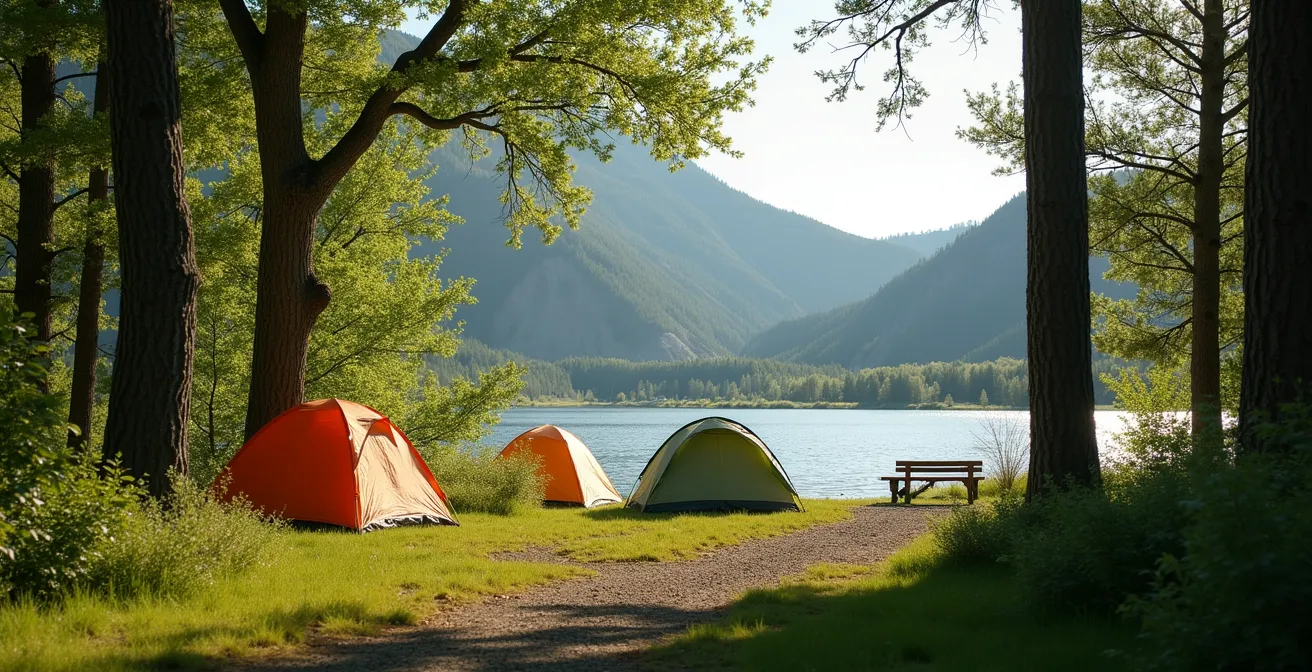
Staying overnight in the park offers a profound experience that a day trip cannot match. It allows visitors to witness the dramatic light of sunrise and sunset on the hoodoos and to hear the sounds of the prairie at night, connecting them to the timeless landscape in a much deeper way.
Textures and Shadows: How to Photograph the Badlands at High Noon?
Photographing the badlands presents a unique challenge, especially for the daytime visitor. High noon, when the sun is directly overhead, is typically considered the worst time for landscape photography. It creates harsh, flat light that eliminates shadows, robbing the landscape of its depth and texture. Yet, for many travellers on a tight schedule, this is the only time they have. The key to successful high-noon photography in Dinosaur Provincial Park is to shift your focus from grand vistas to the intimate details that define this geological wonderland.
Instead of trying to capture the entire valley, which will appear washed out, turn your lens to the micro-landscapes. The harsh overhead sun becomes an advantage when shooting for texture. Get close to the bentonite clay surfaces and capture the intricate patterns of cracks and erosion. Focus on the sharp edges where different sedimentary layers meet—the stratigraphic record written in stone. This is where the story of the park lies. Use the bright light to highlight the different colours and compositions of the sandstone, ironstone, and mudstone bands.
Another effective technique is to use a polarizing filter. This simple accessory can dramatically cut down on the glare reflecting off the shiny clay surfaces, deepening the blue of the Alberta sky and saturating the subtle colours of the rock formations. Look for opportunities to create depth by including a foreground element, like a hardy sagebrush or a small hoodoo, to lead the viewer’s eye into the scene. Pay attention to shadows, even small ones. The shadow cast by a small rock or within the hollow of an eroded channel can provide the contrast needed to give your image a sense of three-dimensionality. The goal is not to fight the harsh light, but to use it to tell a more detailed, textural story about the ancient ground beneath your feet.
Dinosaur Provincial Park Camping: Why You Need to Book the “Comfort Camping” Early?
For travellers intrigued by the prospect of an overnight stay but daunted by the logistics of traditional camping, Dinosaur Provincial Park offers an exceptional alternative: “Comfort Camping.” These are permanently erected canvas-walled tents, built on wooden platforms and fully furnished with beds, a small fridge, a fan or heater, and a private deck with a gas barbecue. It is an experience that blends the immersive nature of camping with the conveniences of a rustic cabin, and it is immensely popular.
The demand for these units is driven by a desire to experience the World Heritage Site in a more accessible way. They appeal to families with young children, international travellers, and anyone who wants to witness the magic of the badlands at dawn and dusk without investing in a full set of camping gear. Waking up inside the park, stepping onto your deck with a cup of coffee, and watching the first rays of sun illuminate the canyon is a truly memorable part of the park experience. It allows for a more relaxed and extended exploration of the trails and interpretive programs.
Because there are a limited number of these comfort camping units, they are often the very first accommodations to be booked for the entire season. The reservation system operates on the same frantic, first-come-first-served basis as the regular campsites. To secure one, prospective visitors must be prepared to book online the moment the reservation window opens in the winter. Having multiple dates in mind and being flexible can increase the odds of success. For those who miss the initial booking rush, it is worth checking the reservation site periodically for cancellations, though this requires both luck and persistence. Booking a comfort camping spot is booking a front-row seat to the geological theatre of the park.
Found a Fossil? Why Moving It Ruining Its Scientific Value Forever
To the untrained eye, a fossil is an object—a piece of bone turned to stone. To a palaeontologist, a fossil is a single word on a page of a 75-million-year-old book. Its true meaning comes from its position on that page. Moving the fossil is like tearing the word out and throwing the rest of the page away. The story is irrevocably broken. This concept, the importance of context, is the single most critical principle in palaeontology and the foundation of the park’s strict preservation rules.
The scientific discipline of taphonomy—the study of how organisms decay and become fossilized—relies entirely on this contextual data. When scientists excavate a fossil, they are not just collecting a bone. They are meticulously recording everything: its exact GPS coordinates, its depth in the sediment, the type of rock encasing it (was it sand, mud, or volcanic ash?), its orientation (was it lying flat or pointing downwards?), and its association with other fossils. Was it found near fossilized leaves, indicating a forested area? Was it surrounded by clamshells, suggesting a river channel? Were there teeth marks from a scavenger on the bone? Each of these data points is a crucial clue.
By removing a fossil from its location, you erase all of that information. A hadrosaur femur lying in a riverbed tells a story of its environment. That same femur on a mantelpiece is just a silent stone. This is why the Historic Resources Act is so stringent. The value of Dinosaur Provincial Park is not that it is a warehouse of bones, but that it is a library where the books are still on the shelves, in order. Every fossil left in situ is a piece of a puzzle waiting for an expert to interpret. By reporting a find instead of collecting it, a visitor transitions from being a tourist to being a valuable contributor to the ongoing process of scientific discovery.
Key Takeaways
- The park’s core value lies in the context of its fossils, not just the fossils themselves. This stratigraphic information is irreplaceable.
- Access to the most significant areas, the bone beds, is restricted to guided interpretive tours to protect the fragile scientific record.
- The UNESCO designation recognizes a complete ecosystem, including the unique juxtaposition of arid badlands and lush riverside habitats.
Understanding the Cretaceous: Why Does Alberta Have So Many Dinosaurs?
The incredible fossil wealth of Dinosaur Provincial Park and Alberta as a whole is no accident of history. It is the direct result of a perfect storm of geological and environmental conditions that occurred 75 million years ago during the Late Cretaceous Period. Understanding this deep history is the final key to appreciating why this specific corner of the world was designated a site of global importance. At that time, North America was a very different place.
A vast, shallow sea called the Western Interior Seaway divided the continent in two, stretching from the Arctic Ocean down to the Gulf of Mexico. Alberta’s location was on the western shore of this seaway, forming a massive coastal plain. The climate was subtropical, warm and wet, supporting lush vegetation that fueled vast populations of herbivorous dinosaurs, which in turn supported a diverse array of predators. The newly forming Rocky Mountains to the west were the source of numerous large rivers that snaked across this coastal plain, carrying enormous loads of sediment toward the seaway.
This combination created the ideal conditions for fossilization. The abundant life meant there was a constant supply of potential fossils. The frequent flooding and the sediment-rich rivers provided the perfect burial mechanism, quickly covering carcasses with layers of sand and mud, protecting them from scavenging and decay. Over millions of years, these layers built up, one on top of another, creating the thick sequence of fossil-bearing rock formations we see today, known as the Dinosaur Park Formation. The final ingredient came much more recently. The erosive power of glacial meltwater at the end of the last Ice Age, followed by the carving action of the Red Deer River, sliced through these layers, sculpting the badlands and exposing the 75-million-year-old treasures within. Dinosaur Provincial Park is, therefore, a window opened by chance into one of the richest moments of the dinosaur era.
The park is more than a destination; it is a testament to the dynamic history of our planet. To stand in the valley is to stand in an ancient riverbed, surrounded by the ghosts of giants. The journey is justified not just by what you can see, but by the profound understanding you can gain. The next logical step is to see it for yourself by planning your visit and booking an interpretive tour to step into the protected heart of this global treasure.