
In summary:
- Treaty 7 is a living agreement, not just a historical document, that defines an ongoing relationship between Indigenous Nations and Canada.
- As a visitor, your role is that of a guest. This involves learning and practicing “territorial etiquette,” such as asking for permission and using correct terminology.
- Respectful engagement means supporting Indigenous communities directly, primarily by purchasing authentic art from verified sources and seeking out Indigenous-led experiences.
- Understanding the specific Nations of Treaty 7—the Siksika, Kainai, Piikani, Tsuut’ina, and Îyârhe Nakoda—is the first step toward genuine respect.
If you’ve attended an event in Calgary, visited a museum in Banff, or even read a plaque at a national park in Southern Alberta, you have likely heard the phrase: “We acknowledge that we are on the traditional territories of the people of the Treaty 7 region.” For many visitors, this land acknowledgement is a moment of polite listening, but its true meaning can feel distant and abstract. You might ask yourself: “What is Treaty 7, and what does this acknowledgement mean for me, as a tourist here today?”
The common approach is to see the treaty as a simple historical fact—an agreement signed in 1877. This perspective, however, misses the most critical point. The true key isn’t found in memorizing dates, but in understanding a different worldview. What if the treaty wasn’t a closed chapter of history, but a living, breathing guide to your relationship with this land and its peoples right now? What if the land acknowledgement wasn’t just a statement, but an invitation to act as a respectful guest?
This guide is designed to bridge that gap. We will move beyond the formal acknowledgement to explore the practical ethics of being a visitor in Treaty 7 territory. This is about transforming a passive statement into active, mindful travel. From knowing how to engage with a cultural interpreter without feeling awkward to ensuring the money you spend on a souvenir actually supports an artist, this article provides the concrete actions that give the land acknowledgement its true power.
This article will provide a clear roadmap for visitors, outlining the history, the people, and the protocols that define respectful engagement in this unique cultural landscape. The following sections offer practical guidance on how to be a better guest in Treaty 7 territory.
Summary: A Visitor’s Guide to Mindful Travel in Treaty 7
- Blackfoot Crossing: How to Engage with Interpreters Without Being Awkward?
- Buying Art: How to Ensure Your Money Goes to the Artist?
- Who Signed Treaty 7 and Why Does It Matter Today?
- Can You Take Photos on a Reserve? Rules for Visiting Indigenous Lands
- First Nations, Métis, or Inuit: Which Term is Correct in Alberta?
- Ribbon Skirts and Photography: What is Respectful at a Cultural Site?
- Blackfoot Legends: What Do Hoodoos Represent in Indigenous Stories?
- How to Distinguish Authentic Indigenous Art from Mass-Produced Souvenirs?
Blackfoot Crossing: How to Engage with Interpreters Without Being Awkward?
One of the best ways to connect with the living culture of Treaty 7 is by visiting an Indigenous-owned and operated interpretive centre like Blackfoot Crossing Historical Park. Located on the Siksika Nation, this National Historic Site is designed to share the story of the Blackfoot people from their own perspective. But for many visitors, the idea of speaking with a cultural interpreter can cause anxiety. How do you ask questions without being intrusive or offensive?
The key is to shift your mindset from that of a consumer of information to that of a respectful guest. Interpreters are not just guides; they are cultural bearers sharing personal and community stories. They are extending a welcome into their world. Your role is to receive that welcome with grace and curiosity. Rather than rushing for facts, allow space for storytelling. The most meaningful exchanges happen when you listen for the narrative and the personal connection an interpreter shares about an object or tradition.
Start by acknowledging where you are and who you are speaking with. A simple, “Thank you for sharing this with me,” goes a long way. When it comes to questions, prioritize those that invite a story rather than a simple ‘yes’ or ‘no’. Instead of asking, “What is this?” try, “Can you tell me about the importance of this object to your community?” This approach shows you value the knowledge and the person sharing it, turning a potentially awkward interaction into a memorable and genuine human connection. This guest-host relationship is the foundation of all respectful travel in Indigenous territories.
Your Action Plan: Respectful Engagement with Cultural Bearers
- Acknowledge the Context: Before asking questions, recognize that you are a guest on sovereign Nation land (e.g., Siksika) and that interpreters are sharing their cultural heritage, not just data.
- Gather Through Listening: Inventory the stories and personal narratives shared. Focus on listening first to understand what is being offered before formulating your own questions.
- Ensure Coherence: Start with “safe” topics like the importance of the buffalo or the significance of the land. Ensure your questions are consistent with the respectful, educational tone of the site.
- Seek Memorable Stories: Ask “why” and “how” questions that invite deeper emotional and cultural context. Ask, “Can you tell me about this object’s story?” instead of “What’s this made of?” to connect with the meaning, not just the material.
- Plan Your Approach: Begin your interaction by asking for permission on the best way to engage. A simple, “I have some questions and want to be respectful. What’s the best way for me to ask them today?” establishes a collaborative and respectful dynamic.
Buying Art: How to Ensure Your Money Goes to the Artist?
Purchasing a piece of Indigenous art is a wonderful way to bring home a meaningful memory of your visit to Southern Alberta. However, the market is flooded with mass-produced items that mimic traditional styles, with none of the proceeds benefiting the artists or their communities. Supporting economic sovereignty for Indigenous creators requires a conscious and informed approach to shopping. The goal is cultural reciprocity, not just a transaction.
The first and most important rule is to buy from Indigenous-owned venues. This includes gift shops at cultural sites like Blackfoot Crossing, galleries like Moonstone Creation in Calgary, or directly from artists at powwows and markets. These are places where artists control their own sales and pricing. When you buy from these sources, you can be confident your money is directly supporting the artist and their family. Never bargain on the price of authentic art; the cost reflects immense skill, time, and cultural knowledge passed down through generations.
To verify a piece, apply “the story test.” An authentic seller will always be able to tell you the artist’s name, their Nation (e.g., Kainai, Piikani, Tsuut’ina), and the meaning or story behind the piece. If they cannot provide this information, it’s a major red flag. Authentic art has a provenance and a connection to a specific person and culture. It is this story that gives the piece its true value.
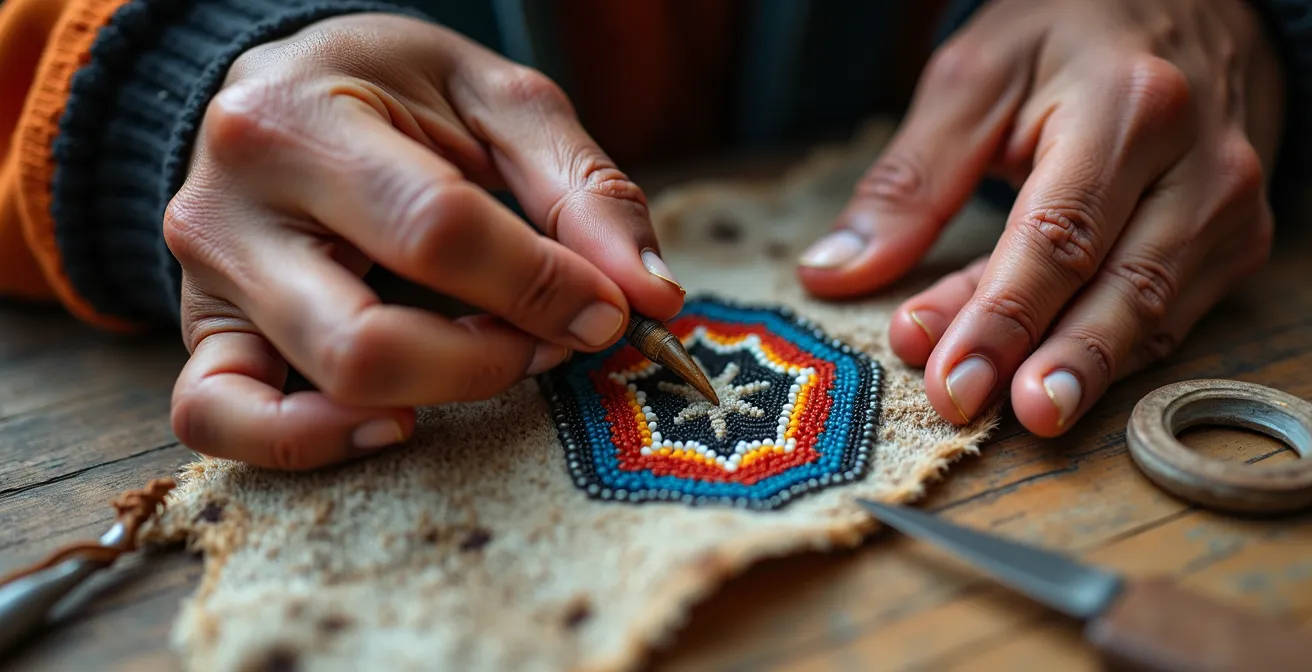
As this image shows, the beauty of authentic work lies in the human touch—the slight, perfect imperfections of hand-sewn beadwork on traditionally tanned hide. This is the texture and spirit you are investing in. By choosing to buy authentic, you move from being a simple tourist to an ally who actively participates in the preservation and celebration of Indigenous culture.
Who Signed Treaty 7 and Why Does It Matter Today?
To understand the land acknowledgement, you must first understand the treaty itself. Signed in 1877 at Blackfoot Crossing, Treaty 7 is an agreement between the British Crown (now Canada) and five sovereign First Nations. These are the Siksika (Blackfoot), Kainai (Blood), and Piikani (Peigan), who form the Blackfoot Confederacy; the Tsuut’ina (Sarcee); and the Îyârhe Nakoda, which includes the Bearspaw, Chiniki, and Wesley First Nations. The treaty covers a vast area of land—according to The Canadian Encyclopedia, Treaty 7 encompasses approximately 130,000 square kilometers of what is now southern Alberta, including the entire Rocky Mountain parks system and major cities like Calgary.
However, a critical difference in understanding exists. While the Crown viewed the treaty as a land surrender in exchange for payments and reserves, the Indigenous signatories held a profoundly different perspective. For them, it was not a sale but the formalization of a peaceful, ongoing relationship. As the Treaty 7 Elders and Tribal Council have clarified, the Indigenous perspective saw the treaties as the start of a shared future. In their foundational document, they state:
Aboriginal people saw the treaties as documentation that marked the beginning of a mutual obligation
– Treaty 7 Elders and Tribal Council, The True Spirit and Original Intent of Treaty 7
This concept of a living agreement built on mutual obligation is the heart of why Treaty 7 matters today. It’s not a closed historical event; it’s an active, continuing relationship that shapes land use, resource management, and cultural life in Calgary (known as Mohkinstsis in Blackfoot) and across the region. Initiatives like the Making Treaty 7 Cultural Society, which produces theatrical performances exploring the treaty’s meaning, are powerful demonstrations of this. They make the treaty relationship visible and tangible for all residents and visitors, reminding us that its promises and responsibilities are still very much alive.
Can You Take Photos on a Reserve? Rules for Visiting Indigenous Lands
A common question for visitors is about the etiquette of visiting a First Nation community, or “reserve.” It is crucial to understand that these are sovereign, self-governing territories with their own by-laws; they are not public parks. While some areas are open to the public, like businesses along a highway (e.g., the Grey Eagle Resort & Casino on Tsuut’ina Nation land), this welcome does not extend to all areas. Residential neighbourhoods and ceremonial grounds are private spaces and should be treated with the same respect as you would anyone’s home or place of worship.
Photography is a particularly sensitive area where a visitor’s actions can easily cross a line from appreciative to intrusive. The cardinal rule is to never photograph people without their direct and enthusiastic consent, and this is especially true for children. At public events like a powwow, listen carefully to the Master of Ceremonies (MC). They will announce when photography is permitted, such as during the Grand Entry, and when it is strictly forbidden, such as during an honour song or special ceremony. These are not suggestions; they are rules of the house you are a guest in.
If you wish to photograph an individual in their regalia, always approach them respectfully. Compliment them on their regalia first, then ask for permission to take their photo. Think of regalia not as a “costume” but as a cherished, often sacred, collection of personal and family history. When in doubt, always ask, or simply put your camera away and enjoy the moment with your own eyes. For visitors wishing to explore a Nation’s territory beyond publicly accessible businesses, the correct protocol is to contact the Nation’s Band Office beforehand to inquire about visitor guidelines.
This table offers a clear guide to general photography permissions, but remember that specific rules can vary by Nation and event.
| Location Type | Permission Required | Protocol |
|---|---|---|
| Public Business (e.g., Grey Eagle Casino) | Generally No | Follow business rules |
| Powwow Grand Entry | Usually Allowed | Listen to MC announcements |
| Powwow Honor Songs | Prohibited | Put camera away completely |
| Residential Areas | Yes, Always | Contact Band Office first |
| Ceremonial Grounds | Usually Prohibited | Sacred spaces, no photos |
| Individual in Regalia | Yes, Always | Ask person directly with respect |
First Nations, Métis, or Inuit: Which Term is Correct in Alberta?
Using the correct terminology is one of the most fundamental signs of respect. While many people use “Indigenous” as a catch-all term, being more specific demonstrates a deeper level of understanding and is always preferred. In Southern Alberta, the context of Treaty 7 is paramount. The signatories of this treaty are First Nations. Therefore, when you are on the lands of the Siksika, Kainai, Piikani, Tsuut’ina, or Stoney Nakoda, the most respectful practice is to use their specific Nation name.
Here is a hierarchy of respectful terminology for the Treaty 7 region:
- Most Respectful: Use the specific Nation’s name. The Blackfoot Confederacy (Siksikaitsitapi) includes the Siksika, Kainai, and Piikani. The other signatories are the Tsuut’ina and the Îyârhe Nakoda (Stoney Nakoda), which comprises the Bearspaw, Chiniki, and Wesley First Nations.
- Acceptable Broader Terms: If you’re referring to the confederacy, “Blackfoot” is acceptable. “Stoney Nakoda” is the correct term for the three united bands.
- General Term: “Indigenous” is the correct, inclusive umbrella term for all First Nations, Métis, and Inuit peoples in Canada. “First Nations” is also appropriate when speaking generally about the treaty signatories.
- Avoid: Outdated and offensive terms like “Indian” should never be used, except when referring to specific legal or historical documents like the “Indian Act.”
It’s also important to recognize that the Indigenous population of Southern Alberta is not limited to the Treaty 7 First Nations. The city of Calgary, for instance, sits within Métis Nation of Alberta Region 3 and has a large and vibrant urban Métis population. The Métis are a distinct Indigenous people with a separate history, culture, and relationship with the Canadian government. While the Inuit people are also one of Canada’s three recognized Indigenous peoples, their traditional homeland (Inuit Nunangat) is in the Arctic. Confusing these distinct groups erases their unique identities, so it’s vital to be precise.
Ribbon Skirts and Photography: What is Respectful at a Cultural Site?
At a powwow or cultural gathering, you will likely see women wearing beautiful, brightly coloured ribbon skirts. These are far more than decorative clothing; they are powerful symbols of identity, strength, and resilience for Indigenous women. A non-Indigenous visitor might see a beautiful photo opportunity, but it’s essential to understand the cultural significance before raising a camera. As the Making Treaty 7 Cultural Society explains, the personal meaning is paramount.
A ribbon skirt is a modern symbol of identity, resilience, and connection to Mother Earth; for some, it holds personal or family stories
– Making Treaty 7 Cultural Society, Educational Resources on Cultural Protocols
This understanding should guide your actions. A ribbon skirt is a story, not just an outfit. The respectful approach is to appreciate the person, not just the object. If you are moved by someone’s regalia, tell them. A simple, “Your skirt is absolutely beautiful,” is a wonderful way to open a respectful conversation. After making that human connection, you can then ask, “Would you be comfortable with me taking a photograph?” Accept their answer graciously, whatever it may be.

It is also critical to understand that wearing regalia, including ribbon skirts, is not for non-Indigenous people. This is considered cultural appropriation. Your role as a visitor is to be a respectful observer and supporter, not a participant in this specific cultural expression. By admiring from a respectful distance and always asking for permission, you honour the deep personal and cultural significance of items like the ribbon skirt.
Blackfoot Legends: What Do Hoodoos Represent in Indigenous Stories?
The dramatic landscapes of Southern Alberta, from the wind-carved hoodoos of the badlands to the towering peaks of the Rockies, are not just scenery. In Blackfoot worldview, the land is alive with stories and spiritual power. These are not “myths” or “legends” in the Western sense of being fictional tales; they are sacred histories that serve as living knowledge systems, carrying law, history, and a guide for how to live on the land.
A perfect example is Áísínai’pi (Writing-on-Stone Provincial Park), a UNESCO World Heritage Site in the Milk River Valley. The park is famous for its unique hoodoo formations and the largest concentration of rock art on the Great Plains. For the Blackfoot people, this is a profoundly sacred place. The hoodoos are not just geological oddities; they are understood to be the petrified forms of ancient giants, now serving as protectors of the sacred writings on the rocks. The stories associated with these formations are not mere entertainment; they function as geographical markers, cautionary tales, and spiritual teachings.
According to Parks Canada, which co-manages the site, the sacred landscape of Áísínai’pi is an inseparable combination of the physical rock formations and the spiritual stories that give them meaning. When visiting a site like this, the most respectful action a visitor can take is to join an Indigenous-led tour. On these tours, Blackfoot guides share the appropriate stories for the appropriate places, giving you a glimpse into this worldview. They explain how the land itself is a sacred text. For a visitor, understanding this connection between land and story is a profound way to deepen your appreciation for the territory you are on.
Key takeaways
- Treaty 7 is a living agreement that defines a “guest-host” relationship between visitors and the Indigenous Nations of Southern Alberta.
- Respect is demonstrated through concrete actions: using specific Nation names, asking for permission before photographing people, and seeking out Indigenous-led tourism experiences.
- Supporting Indigenous economic sovereignty by consciously choosing to buy authentic art from verified Indigenous artists and businesses is one of the most impactful things a visitor can do.
How to Distinguish Authentic Indigenous Art from Mass-Produced Souvenirs?
You’re in a gift shop in the Rockies, faced with a wall of beautiful beaded items and crafts. How can you be sure the piece you’re buying is the real deal, an authentic work that supports an Indigenous artist, and not a mass-produced knockoff? Making this distinction is a crucial part of being a responsible visitor and ally. It requires you to use your senses and ask the right questions.
The most immediate red flags are often found on the price tag or a hidden sticker. Look for labels indicating overseas manufacturing, such as “Made in China.” Authentic Indigenous art is made locally. Another major clue is the material. Mass-produced souvenirs often use plastic beads, synthetic fabrics, and acrylic parts, which feel unnaturally light and uniform. Authentic pieces are crafted from natural materials like glass beads, traditionally tanned animal hide, porcupine quills, sinew, or sweetgrass. These materials have a natural weight, texture, and slight imperfections that signal they were made by hand.
Ultimately, the best way to ensure authenticity is to trust your source. Generic tourist shops that sell a wide variety of Canadiana souvenirs are often the primary vendors of inauthentic goods. Instead, make a conscious choice to shop at powwows, artist markets, or Indigenous-owned galleries. In these venues, the seller will not only be proud to tell you about the artist but will also know their Nation and the story behind the work. This table provides a quick reference for what to look for at the point of purchase.
| Feature | Authentic Art | Mass-Produced |
|---|---|---|
| Materials | Natural: hide, quills, sinew, glass beads | Synthetic: plastic, polyester, acrylic |
| Construction | Hand-stitched with visible variations | Machine-made with perfect uniformity |
| Weight | Natural material weight | Unnaturally light |
| Price Point | Reflects hours of skilled work | Suspiciously cheap |
| Seller Knowledge | Knows artist, Nation, story | Generic or no information |
| Purchase Location | Indigenous venues, powwows | Generic souvenir shops |
By taking the time to understand the living context of Treaty 7, you elevate your experience from that of a simple tourist to that of a mindful guest. Every respectful question asked and every authentic piece of art purchased becomes a small but meaningful act of honouring the spirit of the treaty and the people whose enduring relationship with this land makes your visit possible.