
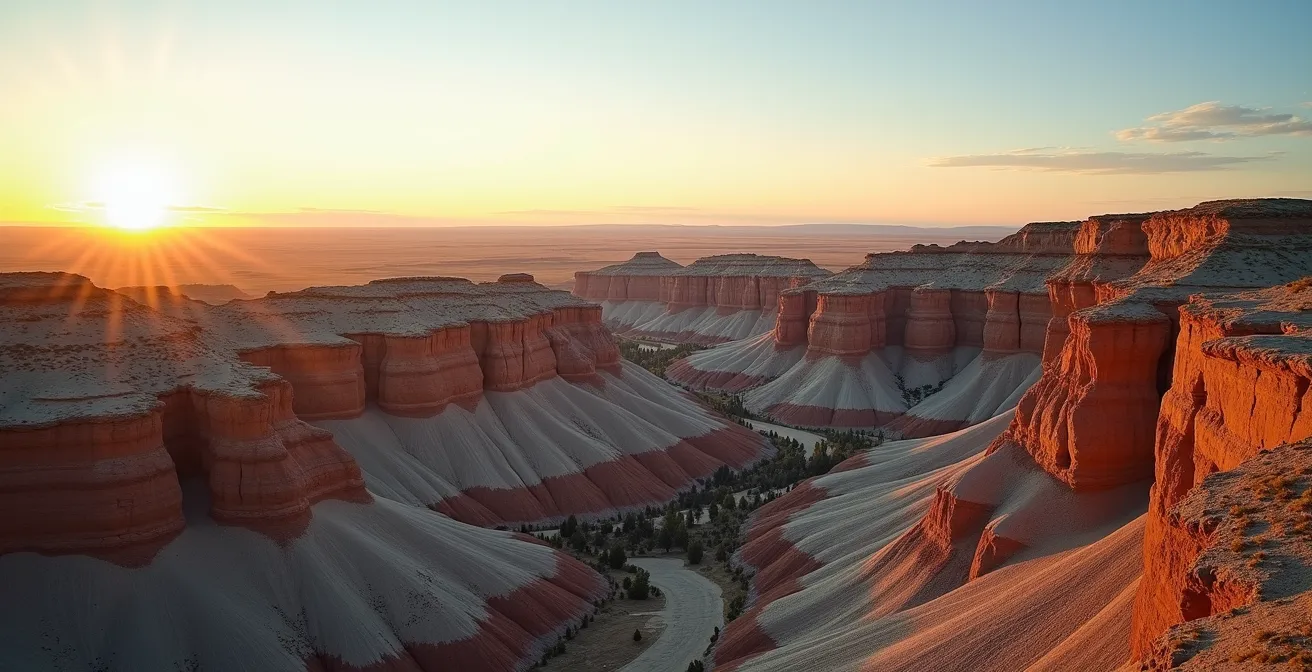
Alberta’s dinosaur bounty isn’t luck; it’s the result of a unique geological “perfect storm” that occurred roughly 75 million years ago.
- Rapid burial by rivers flowing from the young Rocky Mountains preserved skeletons before they could scatter.
- The specific chemistry and geography of the Western Interior Seaway created ideal fossilization conditions on a vast coastal plain.
- Continuous erosion in the Badlands now acts as a natural conveyor belt, revealing these perfectly preserved time capsules.
Recommendation: To truly understand the fossils, one must first learn to read the story written in Alberta’s rock layers (its stratigraphy).
Driving through the dramatic coulees and hoodoos of the Alberta Badlands, a single question often comes to mind: why here? Why is this province a global epicentre for dinosaur fossils, a place where spectacular skeletons seem to emerge right from the earth? The common answers—a warm, swampy past and a great inland sea—are true, but they only scratch the surface of a much more complex and fascinating geological story. These explanations don’t fully capture the precise sequence of events that turned Alberta into the world’s premier fossil factory.
As a sedimentary geologist, I see the answer not just in the bones themselves, but in the rocks that hold them. The unparalleled preservation of Alberta’s dinosaurs is the product of a geological trifecta: the rise of the Rocky Mountains to the west, the presence of the vast Western Interior Seaway to the east, and the dynamic coastal plain caught between them. This unique depositional environment created the perfect conditions for not only life to thrive, but for death to be immortalized. The science of how an organism is buried and fossilized, known as taphonomy, is the key to unlocking this mystery.
To truly understand why Alberta has so many dinosaurs, we must look beyond the generic “swamp” and investigate the specific mechanisms of preservation. This involves dissecting the roles of ancient predators, analyzing the prehistoric climate locked in amber, and tracing the very line of extinction in the rock record. By exploring these facets, we can piece together the story of this remarkable prehistoric ecosystem and the cutting-edge science that continues to bring it to life.
This deep dive will explore the specific geological and paleontological factors that make Alberta unique. We will examine the creatures that ruled the land and sea, the environment they lived in, the cataclysm that ended their reign, and how modern technology is revolutionizing our understanding of these ancient Albertans.
Summary: Deconstructing Alberta’s Prehistoric Past
- Who is the King? Differences Between Alberta’s Top Predators
- Not Just Dinosaurs: What Swam in the Inland Sea Covering Alberta?
- Trapped in Time: What Can Amber Tell Us About the Ancient Climate?
- Tropical Alberta: What Was the Temperature Here 75 Million Years Ago?
- The K-Pg Boundary: Where Can You See the Line of Extinction in the Rock?
- Clovis Points: How Long Have Humans Actually Walked These Valleys?
- Mass Death: What Killed Thousands of Dinosaurs in One Spot?
- New Tech, Old Bones: How CT Scans Are Revolutionizing Alberta Paleontology?
Who is the King? Differences Between Alberta’s Top Predators
While Tyrannosaurus rex dominates the popular imagination, Alberta had its own royal family of apex predators long before T. rex appeared. The two most prominent were Gorgosaurus libratus and its close relative, Albertosaurus sarcophagus. Though both were large, fearsome tyrannosaurids, they were not identical, occupying slightly different niches in the ecosystem. Albertosaurus was generally more robust and appeared later in the fossil record, while Gorgosaurus was a slightly older and more gracile build. These differences hint at distinct hunting strategies and prey preferences.
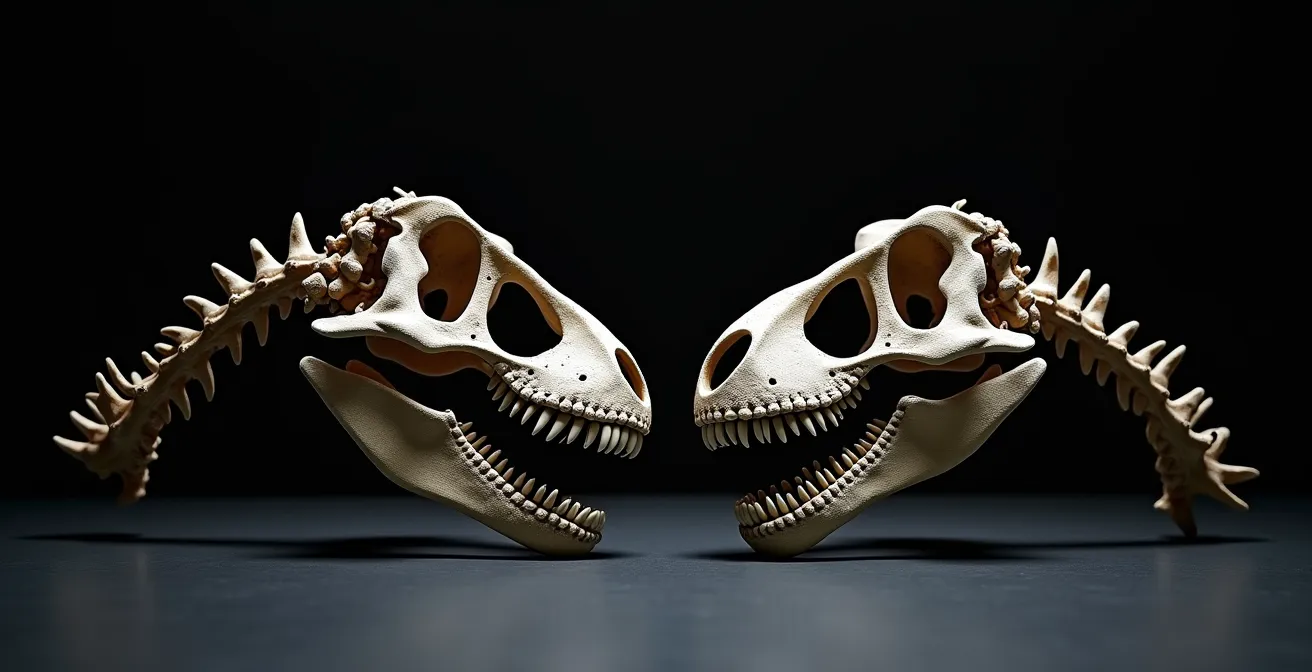
The key differences are found in the details of their anatomy. Biomechanical studies of their skulls reveal much about their feeding behaviour. Research shows that as albertosaurines grew, their bite force increased dramatically, and a mandibular length over 58 cm seems to mark a significant shift in their dietary capabilities, allowing them to tackle larger prey. However, their skulls were not built for the same extreme forces as T. rex. This structural difference has led paleontologists to re-evaluate their role as predators.
As experts François Therrien and his colleagues noted in the Canadian Journal of Earth Sciences, this subtle distinction is crucial for understanding their ecological role:
Albertosaurine feeding behaviour may have involved less bone crushing or perhaps relatively smaller prey than in Tyrannosaurus rex
– François Therrien et al., Canadian Journal of Earth Sciences
This suggests a picture of more agile hunters, perhaps preying on the abundant duck-billed hadrosaurs, rather than being pure, bone-shattering behemoths. They were the undisputed kings of their time in Alberta, but their reign was defined by a different style of predation than that of their more famous cousin.
Not Just Dinosaurs: What Swam in the Inland Sea Covering Alberta?
The landscape of Cretaceous Alberta was dominated by a massive body of water known as the Western Interior Seaway. This shallow, warm inland sea stretched from the Arctic Ocean down to the Gulf of Mexico, effectively splitting North America in two. While dinosaurs roamed the coastal plains to the west, the seaway itself teemed with a spectacular array of marine reptiles, giant fish, and invertebrates that were just as impressive. These were not dinosaurs, but a distinct and fearsome collection of sea creatures.
Among the top predators were the mosasaurs, enormous marine lizards that could reach lengths of over 15 metres. With powerful tails and jaws filled with conical teeth, they were the “T. rexes of the sea,” preying on fish, ammonites, and even other marine reptiles. Swimming alongside them were the plesiosaurs, characterized by their broad bodies, paddle-like limbs, and famously long necks in some species (like Elasmosaurus). These creatures likely used their incredible necks to ambush schools of fish from below. The shorter-necked varieties, known as pliosaurs, were more robust and powerful, built to hunt larger prey in the deeper parts of the seaway.
The waters were also filled with giant, fast-swimming predatory fish like Xiphactinus, a 5-metre-long terror known for its bulldog-like jaw and fang-like teeth. The seabed and water column were populated by countless ammonites, coiled-shell cephalopods related to modern squid and nautiluses. Their fossilized shells are now extremely common throughout Alberta, serving as crucial index fossils that help geologists date the rock layers they are found in. The presence of these marine giants provides a more complete picture of Alberta’s Cretaceous biodiversity, highlighting that the province was a hub for life both on land and in the sea.
Trapped in Time: What Can Amber Tell Us About the Ancient Climate?
While bones tell us about the giants of the Cretaceous, smaller, more delicate clues about their world are often preserved in fossilized tree resin, known as amber. Alberta is home to significant deposits of late Cretaceous amber, most famously from the area around Grassy Lake. These golden-hued time capsules offer an unparalleled, three-dimensional window into the micro-ecosystem and climate of ancient Alberta, preserving organisms that would otherwise never enter the fossil record.
When sticky resin oozed from coniferous trees like ancient relatives of sequoias, it acted as a natural trap. It ensnared insects, spiders, pollen, plant fragments, and even the occasional small lizard or feather. Once hardened and buried under layers of sediment, this resin underwent a process of polymerization over millions of years, transforming into amber. The level of preservation within is often astonishing, capturing the finest details like the hairs on a fly’s leg or the cellular structure of a leaf. For paleontologists, this is invaluable data.
The inclusions within Alberta’s amber help paint a vivid picture of a warm, humid, and temperate to subtropical environment. The presence of specific types of insects, such as certain species of termites and aphids, points to a climate much milder than today’s. Fossilized plant matter and pollen reveal a lush forest canopy, providing direct evidence of the flora that herbivorous dinosaurs would have eaten. In some rare cases, amber has even trapped proto-feathers, providing direct evidence of the evolutionary link between dinosaurs and birds and confirming the existence of feathered, non-avian dinosaurs in Alberta’s ecosystem. Each piece of amber is a miniature diorama of the Cretaceous world.
Tropical Alberta: What Was the Temperature Here 75 Million Years Ago?
The windswept, often frigid landscape of modern Alberta stands in stark contrast to its ancient past. During the Late Cretaceous Period, a time frame which the Royal Tyrrell Museum confirms lasted from about 75 to 66 million years ago in this region, Alberta was a warm, humid, and lush coastal plain. The climate was comparable to that of modern-day northern Florida or the Mississippi Delta, a far cry from the harsh Canadian winters of today. This subtropical paradise was a key reason why life, particularly large reptilian life, could flourish so successfully.
Several lines of geological and paleontological evidence support this “Tropical Alberta” hypothesis. The fossil record is rich with plants that thrive in warm, wet conditions. This includes fossils of palms, ferns, sycamores, and giant redwood-like conifers. These plants formed dense forests and swampy lowlands along the coast of the Western Interior Seaway, providing an endless food supply for the vast herds of hadrosaurs (duck-billed dinosaurs) and ceratopsians (horned dinosaurs) that dominated the landscape. The sheer size and diversity of these herbivore populations would not have been possible without such a productive, year-round growing season.
Furthermore, the nature of the dinosaurs themselves points to a warm climate. As large, cold-blooded (or, more accurately, mesothermic) reptiles, they would have thrived in an environment without extreme temperature swings or freezing winters. The presence of other reptilian life, such as crocodiles, turtles, and champsosaurs (a crocodile-like reptile), further solidifies this picture. These animals, whose modern relatives are confined to the world’s warmer regions, were abundant in Alberta’s Cretaceous rivers and estuaries. This combination of fossil flora and fauna allows paleontologists to confidently reconstruct a world that was perpetually warm, wet, and teeming with life.
The K-Pg Boundary: Where Can You See the Line of Extinction in the Rock?
The reign of the dinosaurs came to an abrupt end 66 million years ago with a cataclysmic asteroid impact. This event is marked in the geological record by a thin, distinct layer of sediment known as the Cretaceous-Paleogene (K-Pg) boundary. This line in the rock is a physical scar representing one of the most significant mass extinctions in Earth’s history, and remarkably, it is visible in several places across Alberta. For a geologist, it is one of the most profound sites one can witness: a silent, razor-thin tombstone for an entire era.
The boundary layer is characterized by an unusually high concentration of the element iridium—an element rare on Earth’s surface but common in asteroids. When the massive Chicxulub asteroid struck the Yucatán Peninsula, it vaporized, blasting a cloud of iridium-rich dust into the atmosphere. This dust settled across the globe, forming the tell-tale layer. In Alberta, the K-Pg boundary is often a thin, dark grey to black clay or coal seam, sandwiched between the lighter-coloured sandstone of the dinosaur-bearing Cretaceous formations below and the darker mudstones of the mammal-dominated Paleogene formations above.
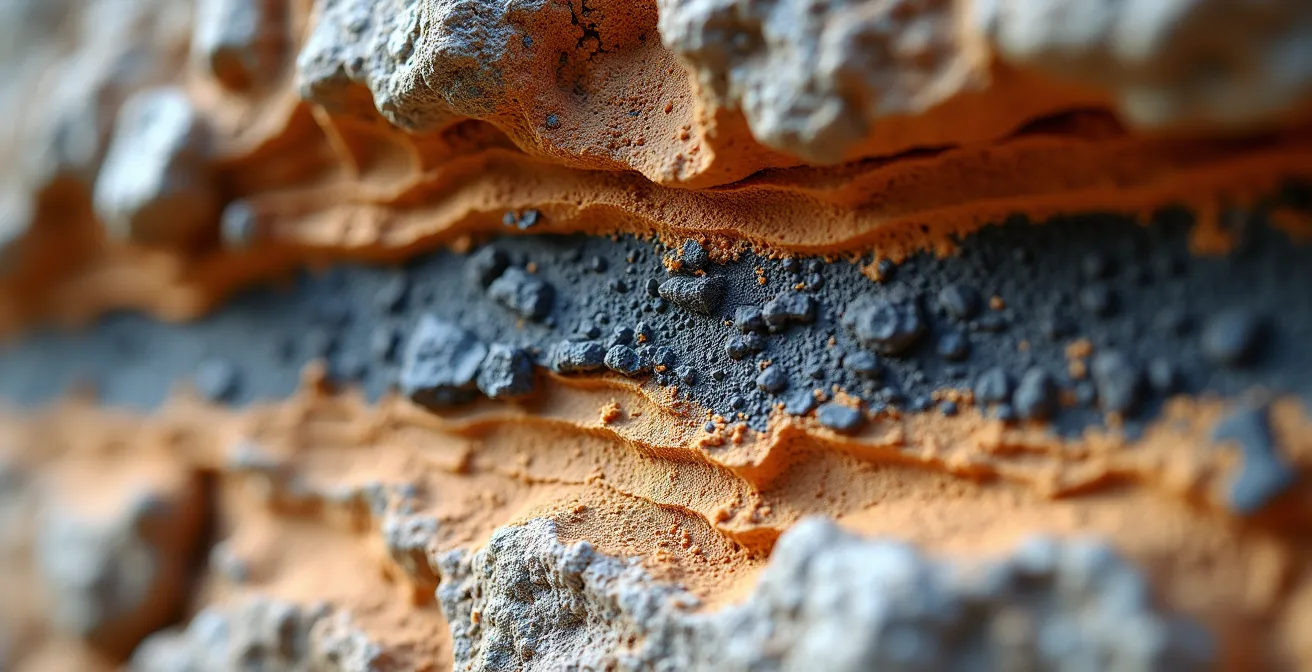
Outcrops of this boundary can be found in various locations, particularly within the Red Deer River valley and other parts of the Badlands. Spotting it requires a trained eye, but it is the ultimate expression of stratigraphy—reading history in the rock layers. Below this line, the fossil record is rich with a diversity of dinosaurs. Directly above it, they are gone, replaced by the humble beginnings of the age of mammals. Seeing this boundary firsthand is a tangible connection to the moment the world changed forever.
Action Plan: How to Spot Geological Boundaries in the Field
- Research Maps: Before heading out, consult geological survey maps of Alberta to identify formations of the correct age (e.g., the Scollard Formation) where the K-Pg boundary is known to outcrop.
- Identify Key Beds: Look for documented “marker beds” near the boundary, such as the Nevis coal seam, which is a prominent feature often associated with the K-Pg contact in central Alberta.
- Observe Colour & Texture Change: Scan exposed road cuts and eroded coulees for a distinct change in the rock. Typically, this involves looking for lighter Cretaceous sandstone giving way to darker Paleogene mudstone or siltstone.
- Locate the Contact Line: Carefully search the precise contact point for a thin (often only a few centimetres thick), dark clay layer. This is the physical remnant of the asteroid’s fallout.
- Document, Don’t Disturb: Photograph any potential finds with an object for scale (like a coin or rock hammer). Remember that in Alberta, all fossils are the property of the Crown, and collecting is illegal without a permit. Report significant sites to the Royal Tyrrell Museum.
Clovis Points: How Long Have Humans Actually Walked These Valleys?
The geological story of Alberta spans hundreds of millions of years, but the human chapter is far more recent, yet equally profound. Long after the dinosaurs vanished and the landscape was reshaped by ice ages, the first people arrived. The most iconic evidence of these early inhabitants across North America comes in the form of elegant, fluted spearheads known as Clovis points. These artifacts, dating back around 13,000 years, represent a sophisticated stone tool technology and mark the presence of some of the first widespread human cultures on the continent.
While Clovis points are a hallmark of early Paleo-Indian presence, evidence from sites in Alberta suggests an even deeper human history. Archaeological discoveries, notably at the Wally’s Beach site in southern Alberta, have pushed back the timeline of human occupation in the province to at least 13,300 years ago, and possibly earlier. Here, exquisitely preserved tracks of mammoths, camels, and horses were found alongside stone tools, providing direct evidence that early peoples were hunting megafauna at the end of the last Ice Age. These sites pre-date or are contemporaneous with the main Clovis period, indicating Alberta was part of the initial wave of human migration into the Americas.
The discovery of Clovis points and other early artifacts in the same river valleys that now expose dinosaur bones creates a remarkable juxtaposition of time. These stone tools are often found in the uppermost layers of sediment, the river terraces and glacial deposits that sit thousands of millennia above the dinosaur-bearing formations like the Horseshoe Canyon Formation. It is a powerful reminder of the immense scale of geological time and of the many successive worlds that have existed right here in Alberta—from a reptilian paradise to an ice-age hunting ground, and finally to the province we know today.
Mass Death: What Killed Thousands of Dinosaurs in One Spot?
One of the most intriguing phenomena in Alberta’s fossil record is the existence of “bonebeds”—massive, concentrated accumulations of skeletons from a single species. These sites offer a snapshot of a prehistoric catastrophe and provide invaluable data about dinosaur behaviour, population structure, and the environment. The most famous of these is the Albertosaurus bonebed in the Dry Island Buffalo Jump Provincial Park, which contains the remains of at least two dozen individuals, from young juveniles to full-grown adults.
So what could have killed so many of these apex predators in one place, at one time? The answer lies in the sedimentology of the site. The bones are preserved in a mudstone layer deposited by a massive flood on the ancient coastal plain. The leading theory is that a pack of Albertosaurus was either caught in a catastrophic flash flood or was attempting to cross a swollen river during a storm. The powerful currents would have drowned the animals and washed their carcasses into a low-lying area, where they were quickly buried by mud and silt. This rapid burial is key; it protected the skeletons from scavengers and the elements, leading to their exceptional preservation.
The composition of the bonebed provides compelling evidence for the social nature of these tyrannosaurs. The presence of multiple age groups suggests they lived and hunted in packs. As paleontologists David A. Eberth and Philip J. Currie noted in their foundational study of the site:
The individual Albertosaurus specimens are ontogenetically variable, and range in age from 2 to 24 years old
– David A. Eberth and Philip J. Currie, ResearchGate
This isn’t a random collection of isolated individuals; it’s a family group or social unit that met its end together. Other bonebeds in Alberta, such as those for Centrosaurus and Pachyrhinosaurus, tell similar stories of entire herds of horned dinosaurs perishing in coastal storms or floods, creating a fossil legacy of thousands of bones in a single location.
Key Takeaways
- Alberta’s fossil richness stems from a unique combination of rapid sediment deposition, a specific coastal environment, and later erosion.
- The province hosted distinct tyrannosaur predators like Albertosaurus and Gorgosaurus, which differed from T. rex in their hunting ecology.
- Modern technology like CT scans and geochemical analysis is continually revealing new secrets from old bones, including diet and behaviour.
New Tech, Old Bones: How CT Scans Are Revolutionizing Alberta Paleontology?
While the classic image of paleontology involves a hammer and chisel, the field is increasingly moving into the digital realm. New technologies, particularly Computed Tomography (CT) scanning, are allowing scientists to “see” inside fossils without ever damaging them. This non-destructive approach is revolutionizing our understanding of dinosaur anatomy, behaviour, and evolution, and Alberta’s world-class institutions like the Royal Tyrrell Museum are at the forefront of this technological shift.
CT scanners use X-rays to create a series of cross-sectional images, which a computer then assembles into a 3D model. This allows paleontologists to examine the internal structures of a skull, revealing brain cavity size and shape, sinus passages, and inner ear structures that provide clues about a dinosaur’s intelligence and senses. It can also uncover details hidden deep within a block of stone. This digital approach not only preserves the original fossil but also allows the 3D models to be shared with researchers worldwide, accelerating the pace of discovery.
This blend of fieldwork and high-tech analysis ensures that Alberta remains a hub of paleontological innovation. The flow of new fossils is relentless; according to a CBC report, approximately 2,500 specimens were added to the Royal Tyrrell Museum’s collection in 2023 alone. Each of these could hold new secrets waiting to be unlocked by the next generation of technology.
Case Study: A Juvenile Tyrannosaur’s Last Meal
A remarkable juvenile Gorgosaurus specimen from Alberta provides a stunning example of what new analytical techniques can reveal. Careful preparation and analysis uncovered the articulated hindlimbs of two small, bird-like dinosaurs called Citipes inside its stomach cavity. This provided the first direct fossil evidence of a dietary shift in tyrannosaurs. It shows that young tyrannosaurs hunted small, fast prey, and as they grew larger and their bite force increased, they transitioned to tackling the megaherbivores of their environment. This discovery, impossible to make from an isolated bone, fundamentally changed our understanding of tyrannosaur ecology.
The next time you visit the Badlands or see a fossil at the Royal Tyrrell Museum, look beyond the bone. Start to read the story in the rock that surrounds it, and you’ll gain a far deeper appreciation for Alberta’s incredible prehistoric legacy.