
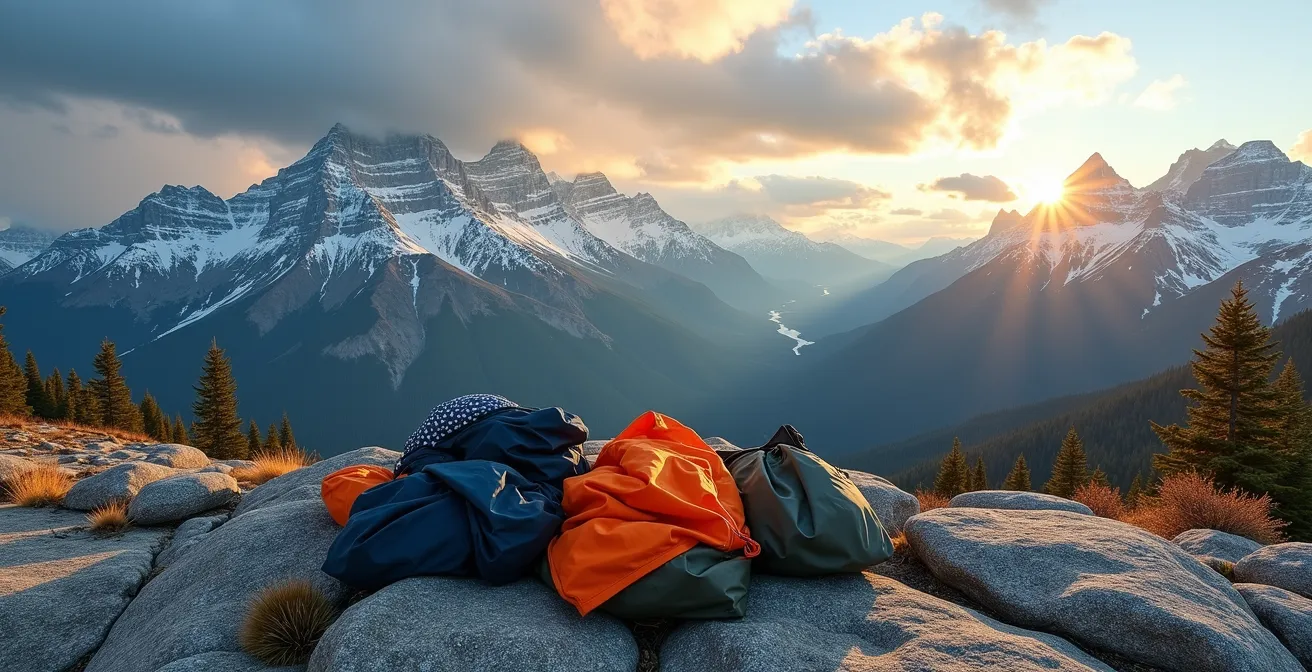
Packing for Alberta’s volatile weather isn’t about bringing everything; it’s about building a smart, modular gear system that adapts to any condition.
- Your clothing should be a three-part system (base, mid, shell) that you can adjust for any environmental trigger, from sun to snow.
- Your vehicle is your mobile basecamp, requiring its own dedicated emergency kit for safety on long, remote highways.
Recommendation: Shift your mindset from a simple checklist to a strategic system. Every item must serve a specific function to ensure you are prepared, not just over-packed.
The anxiety is familiar for any traveler planning a trip to Alberta. You see photos of sun-drenched lakes in Banff, but then read tales of summer snowstorms on the Icefields Parkway. The conventional advice to “pack for all seasons” often leads to bulging suitcases filled with items you’ll never use, a classic case of preparedness tipping into paranoia. Travelers from stable climates are often overwhelmed, trying to reconcile the need for shorts and a t-shirt with the simultaneous need for a winter-grade jacket.
Most packing lists offer a generic solution: “dress in layers.” While correct, this advice is incomplete. It tells you *what* to do, but not *why* or *how*. It doesn’t explain the logic behind the system or how to adapt it when you gain altitude on a mountain trail or face a sudden prairie hailstorm. The real challenge isn’t just the unpredictable weather; it’s the lack of a framework for dealing with it efficiently.
But what if the key wasn’t a longer packing list, but a smarter one? This guide breaks from tradition. We will not just list items. Instead, we will build a modular gear system from the ground up. You will learn the principles behind layering, the critical role your rental car plays as a “basecamp,” and how to prepare for specific environmental triggers unique to Alberta. By the end, you won’t just have a packed bag; you will have the confidence of an expert, ready for anything the Canadian Rockies throw at you.
This article provides a structured approach to your preparations. The following sections break down everything from the fundamental layering system for hiking to the specific emergency supplies your vehicle must contain, ensuring you are thoroughly equipped for your Alberta adventure.
Summary: Preparing for Alberta’s Unpredictable Climate
- Base, Mid, Shell: What is the Correct Layering Sequence for Rockies Hiking?
- Type A or B: Do European Travelers Need a Converter for Canada?
- Credit vs Cash: Do You Need Canadian Dollars for Rural Gas Stations?
- Blisters and Bugs: What Must Be in Your Personal First Aid Kit?
- Medical Evacuation: Does Your Standard Insurance Cover Helicopter Rescue?
- Blankets and Candles: What Must Be in Your Trunk Even in Summer?
- Why Do You Get Sunburnt in 15 Minutes at Sunshine Village?
- Preparing Your Rental Car for 2,000km of Alberta Highways
Base, Mid, Shell: What is the Correct Layering Sequence for Rockies Hiking?
The “dress in layers” mantra is the most common advice for the Rockies, but it’s often misunderstood. It’s not about piling on clothes; it’s a strategic, three-part system designed for moisture management and thermal regulation. As one hiker experienced on the Plain of Six Glaciers trail, the weather can shift from sunny and warm to a freezing snowstorm in a matter of hours. This is why a modular gear system is non-negotiable. Each layer has a distinct function, and mastering their sequence is the key to comfort and safety.
The system begins with the base layer, worn against your skin. Its sole job is to wick sweat away to keep you dry. Cotton is your enemy here; it holds moisture and chills you. Opt for merino wool or synthetic materials like polyester. The second part is the mid-layer, which provides insulation. This is your warmth layer. A fleece jacket, a packable down vest, or a wool sweatshirt are all excellent options. Its thickness depends on the forecast, but you should always have one in your pack, even on a warm day.
Finally, the outer layer, or shell, protects you from the elements: wind and rain. A high-quality waterproof and windproof jacket (like one made with Gore-Tex) is a critical investment. This layer keeps your insulation dry and blocks wind that can strip away your body heat. The full system—base, mid, and shell—allows you to adapt to any environmental trigger by adding or removing layers. Don’t forget your extremities: a warm hat (a “toque” in Canada) and gloves are small but vital. Lastly, this system extends to your feet. Sturdy, waterproof hiking boots with good ankle support, paired with wool or synthetic socks, are the foundation of your entire on-trail setup.
Type A or B: Do European Travelers Need a Converter for Canada?
After organizing your apparel system, the next module to consider is your electronics. For European travelers, arriving in Alberta with devices that can’t be charged is a frustrating and avoidable problem. The electrical standards in Canada are fundamentally different from those in Europe, and understanding this difference is crucial. It’s not just the shape of the plug; it’s the voltage and frequency of the electricity itself.
The primary issue is the voltage. Canadian outlets supply power at 120V with a 60Hz frequency, using plug types A and B. In contrast, most of Europe operates on 220-240V at 50Hz, with plug types C, E, or F. Plugging a simple European device directly into a Canadian wall socket with only a plug adapter can permanently damage it. Most modern electronics like laptops and phone chargers are “dual voltage” (look for “INPUT: 100-240V” on the charging brick), meaning they only need a simple plug adapter. However, single-voltage devices like some hair dryers or electric razors require a power converter to step down the voltage.
This comparative data, highlighted in a recent analysis of travel needs for the Rockies, clarifies the technical differences.
| Aspect | Canada | Europe |
|---|---|---|
| Voltage | 120V | 220-240V |
| Plug Type | Type A/B | Type C/E/F |
| Frequency | 60Hz | 50Hz |
Beyond the converter, a smart traveler’s kit should include a multi-port USB charging hub, as older Rockies lodges can have limited outlets. For the long drives, a 12V car charger adapter is essential, and a compact power strip can be a lifesaver for charging multiple devices simultaneously from a single outlet.
Credit vs Cash: Do You Need Canadian Dollars for Rural Gas Stations?
With your gear and electronics sorted, the next practical consideration is currency. While Canada is a modern, credit-friendly country, relying solely on plastic can lead to complications, especially once you leave the major cities of Calgary and Edmonton. The principle of a modular system applies here too: you need a mix of payment options to be truly prepared.

Your primary payment method will be a credit card, preferably one with no foreign transaction fees. However, be aware that automated “pay-at-the-pump” gas stations in rural areas or on First Nations reserves can sometimes reject foreign credit cards. The simple solution is to go inside the station to pre-pay with the attendant. The more pressing need for cash, or Canadian Dollars (CAD), arises in specific situations. Farmers’ markets in towns like Canmore and Banff are often cash-only, as are many roadside fruit stands you’ll encounter. Furthermore, many provincial park campgrounds use a self-registration system that requires you to place cash in an envelope.
You’ll also need coins for daily conveniences. Major Canadian grocery stores like Real Canadian Superstore and Safeway often require a $1 (Loonie) or $2 (Toonie) coin to use a shopping cart, which is refunded when you return it. It’s wise to get about $100-200 in Canadian currency upon arrival to handle these small but crucial transactions without stress. Having a small amount of local currency is not a step backward; it’s a key component of a resilient travel plan.
Blisters and Bugs: What Must Be in Your Personal First Aid Kit?
Your personal first-aid kit is not an afterthought; it’s an essential piece of your on-person gear system. While you can buy pre-made kits, a truly effective one is customized for the specific challenges of the Alberta environment: blisters from hiking, bug bites, and intense sun. As any seasoned backcountry traveler will advise, you must not only pack a kit but also “restock your first aid kit and refresh your skills” before you leave. This means checking expiration dates and knowing how to use every item inside.
For blisters, prevention is better than a cure. Moleskin is a classic, but modern hydrocolloid blister bandages (like Compeed) are far more effective at protecting a hot spot before it becomes a full-blown blister. Pack a variety of sizes. For insects, mosquitoes are a nuisance in the summer, especially near stagnant water. A repellent containing DEET or Icaridin is most effective. Ticks are also present in grassy and wooded areas, so pack fine-tipped tweezers for proper removal. After-bite lotion can provide relief from the inevitable itch.
A crucial addition that many travelers overlook is bear spray. While not strictly “first aid,” it is the single most important piece of personal safety equipment for any trail activity in the Rockies. Know how to carry it accessibly (not in your backpack) and how to use it. Your kit should also include standard items: assorted bandages, antiseptic wipes, pain relievers (like ibuprofen), antihistamines for allergic reactions, and any personal medications. This curated kit ensures you can handle the most common trail ailments swiftly, preventing minor issues from becoming trip-ruining problems.
Medical Evacuation: Does Your Standard Insurance Cover Helicopter Rescue?
While a personal first-aid kit handles minor issues, travelers must also plan for worst-case scenarios. The vast and rugged terrain of the Canadian Rockies means that a serious injury could require a helicopter rescue. This raises a critical question: does your standard travel insurance cover this? The answer is often no, and assuming you’re covered can be a multi-thousand-dollar mistake. It is vital to move from preparedness to a verification mindset.
As noted by travel experts at Travel Alberta, “The Rockies have well-trained search and rescue teams, which can be dispatched in a true emergency,” and this service is a testament to the region’s safety infrastructure. However, the cost of that rescue is not always covered. Standard travel medical insurance may cover hospital bills once you arrive, but the specialized service of a backcountry helicopter evacuation might be an exclusion. You must scrutinize your policy documents for specific clauses like “backcountry rescue” or “helicopter evacuation.” Do not assume a general policy is sufficient.
Furthermore, it is a dangerous misconception that the Kananaskis Conservation Pass, required for recreating in Kananaskis Country, covers rescue costs. It does not. The pass funds the maintenance of trails and facilities, not emergency services. For those venturing onto quieter trails or into the backcountry, carrying a satellite communication device like a Garmin inReach or SPOT is essential for contacting help when there is no cell service. Many of these device subscriptions also offer supplemental search and rescue (SAR) insurance, which is a wise investment.
Your Insurance Verification Plan: Backcountry Coverage Checklist
- Search your policy for “backcountry rescue” and “helicopter evacuation” clauses.
- Verify coverage for activities like “high-altitude trekking” if you plan to hike challenging trails.
- Note that your Kananaskis Conservation Pass does NOT cover any rescue costs.
- For remote travel, bring a satellite device like a SPOT or inReach to contact help without cell service.
- Consider adding a Garmin inReach subscription that includes a specific SAR insurance option.
Blankets and Candles: What Must Be in Your Trunk Even in Summer?
Your modular gear system extends beyond your backpack and into your vehicle. In Alberta, your rental car is more than transportation; it’s your “Car as Basecamp.” This rolling basecamp must have its own emergency kit, even in July and August. The idyllic summer drive can be deceptive. As many have experienced, a summer snowstorm on the Icefields Parkway is a real possibility. We found our down jackets handy, even in July. Getting stranded by a sudden weather event, vehicle breakdown, or road closure without supplies can be dangerous.
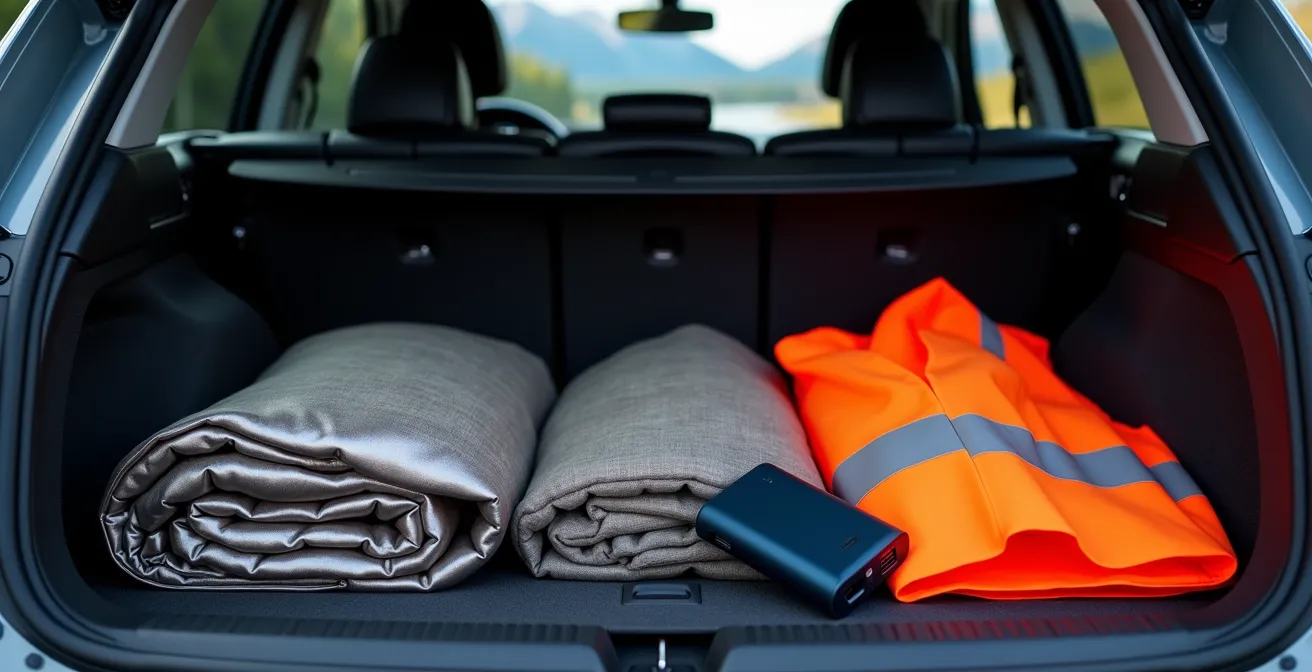
The traditional advice of “blankets and candles” is outdated. A modern trunk kit is built around modern technology and high-efficiency gear. The core of your kit should be warmth and visibility. Instead of a bulky blanket, pack a compact, reflective emergency blanket. Include warm layers you aren’t wearing: a spare hat, gloves, and a fleece. For visibility, especially in a wildlife collision scenario at dusk, a high-visibility vest and road flares or reflective triangles are critical.
Your kit must also address power and sustenance. A fully charged USB power bank is non-negotiable for keeping your phone alive. An LED headlamp with extra batteries is far safer and more effective than candles or a phone’s flashlight. Finally, pack high-energy food bars and extra bottles of water—enough for an unexpected 24-hour delay. This kit doesn’t represent paranoia; it’s a logical preparation for the documented realities of mountain and prairie travel. It ensures your car, your basecamp, is a sanctuary in an emergency, not a trap.
Why Do You Get Sunburnt in 15 Minutes at Sunshine Village?
One of the most underestimated environmental triggers in the Rockies is the sun. Travelers from lower elevations are often shocked at how quickly they get sunburned, even on a cloudy day. The reason is simple: altitude. As you ascend, the atmosphere thins, providing less protection from UV radiation. For every 1000 meters you climb, UV levels increase by 10-12%. Sunshine Village ski resort sits at a base elevation of 1,660 meters and its highest point is over 2,700 meters, putting you in a zone of intense UV exposure. This is why a hike up a pass can leave you with a severe burn.
This effect is compounded by reflective surfaces like snow, water, and glacial ice. As explained in an analysis of high-altitude hiking needs, snow can reflect up to 80% of UV radiation, meaning you’re getting hit from above and below. This is why you can get sunburnt in places the sun doesn’t seem to be hitting directly. The massive elevation changes in the Rockies amplify this risk significantly; for example, the Fernie ski resort has a 1,082 m elevation difference from its base to its peak, taking skiers through dramatically different UV environments.
Treating sun protection as a critical part of your gear system is essential. This means more than just a quick application of sunscreen in the morning. At elevation, you should apply a broad-spectrum SPF 50+ sunscreen every two hours. A hat with a wide brim is better than a baseball cap for protecting your ears and neck. Most importantly, wear polarized sunglasses to protect your eyes from the intense glare off snow and water, which can cause a painful condition called snow blindness. Lip balm with SPF is also a must-have to prevent severe chapping and burning. This isn’t just about comfort; it’s about preventing serious, short-term skin and eye damage.
Key takeaways
- Adopt a “Modular Gear System” mindset; every item must have a specific function (wicking, insulating, protecting).
- Your vehicle is your “Car as Basecamp” and requires its own emergency kit with modern essentials like a power bank and headlamp.
- Beyond gear, verify practical details: your insurance for helicopter rescue, your need for a power converter, and your strategy for using both cash and credit.
Preparing Your Rental Car for 2,000km of Alberta Highways
The final component of your preparedness system is the mechanical integrity of your “basecamp”: the rental car. An Alberta road trip is not a short jaunt; it’s an epic journey. A route covering Banff, Jasper, and the Icefields Parkway can easily exceed 2,000 kilometers, and some grand tours of the Rockies can cover over 2,500 miles (4,000 km). On these long, remote stretches, a vehicle failure is more than an inconvenience—it’s a serious safety issue, especially where you have “lost all reception, and connection with the outside world.”
Before you even leave the rental lot, you must conduct your own inspection. Do not assume the car is perfectly prepared for mountain driving. First, check the tire tread depth; you need good grip for steep, winding roads that can be wet or even icy. Second, inspect the windshield for any small cracks or chips, which can quickly spread with the temperature fluctuations in the mountains. Third, and most critically, confirm the vehicle has a real spare tire and the tools to change it. Many modern rentals come only with an inflator kit, which is useless for a major puncture or sidewall tear.
Your pre-trip preparation also involves digital readiness. Highway 93 (the Icefields Parkway) and Highway 40 (Kananaskis Trail) have long stretches with no cell service. Before you leave a town with Wi-Fi, you must download offline maps of your entire route using Google Maps or a similar app. Also, take a moment to test all the car’s lights, signals, and windshield wipers. A few minutes of inspection at the rental agency can prevent hours of distress on a remote highway, ensuring your basecamp is reliable for the entire journey. You can also improve your hydration strategy by stocking up on water, as the tap water in towns like Banff and Jasper is of excellent quality and perfectly safe to drink.
Frequently Asked Questions on Packing for Alberta
Do rural Alberta gas stations accept foreign credit cards?
Foreign credit cards can sometimes be rejected by automated pumps. Go inside to pre-pay to avoid issues, especially at independent stations or those on First Nations reserves.
Where is cash absolutely necessary in the Canadian Rockies?
Cash is essential at Canmore or Banff farmers’ markets, self-registration envelopes at provincial park campgrounds, and roadside fruit stands.
What is the ‘Toonie for a Cart’ rule?
Major Canadian grocery stores like Real Canadian Superstore and Safeway require a $1 (Loonie) or $2 (Toonie) coin to use a shopping cart, which is refunded upon return.