
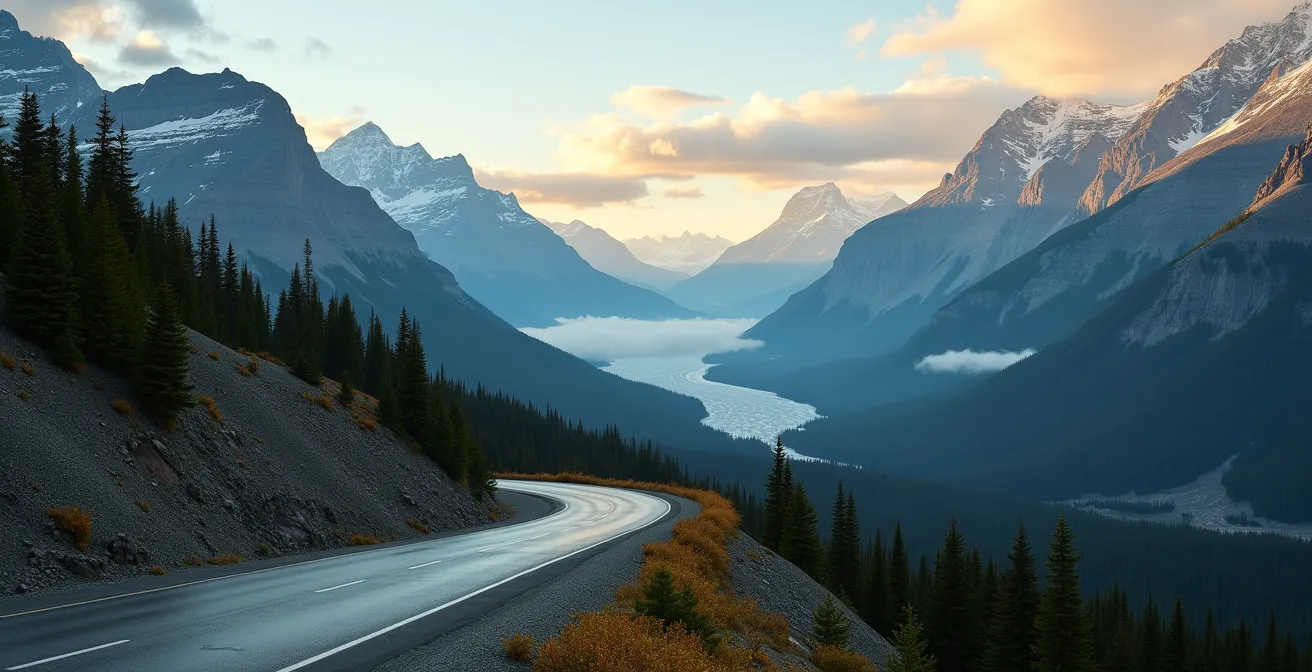
The greatest mistake on an Alberta road trip is believing the mountains are the only destination.
- The journey across the prairies and through the foothills is not an obstacle to overcome but a meditative experience that prepares you for the scale of the Rockies.
- Trading the fastest route (like the QE2) for a slower, more engaging path (like the Cowboy Trail) transforms the drive from a task into an adventure.
Recommendation: Redesign your itinerary not as a series of points to conquer, but as a continuous line of experience. Embrace the intentional detour and the unplanned stop; that is where the real journey begins.
The question seems absurd at first glance. Why would you deliberately prolong a drive? The modern traveler is conditioned for efficiency, to shrink the space between points A and B, to conquer the itinerary. We see the Canadian Rockies on a postcard—majestic, immediate—and we want to teleport into that frame. The long, flat stretches of prairie leading from Calgary or Edmonton feel like a preamble, an obstacle to be endured before the real show begins. We grip the steering wheel, push the speed limit, and tell ourselves the trip starts when we see the first peak.
But this is a profound misunderstanding of what an Alberta road trip offers. It’s a philosophy of travel that mistakes the destination for the journey. The art of slow travel isn’t about being inefficient; it’s about being present. It is the conscious choice to engage with the subtle, unfolding narrative of the landscape. It’s about understanding that the hypnotic emptiness of the prairies and the gentle roll of the foothills are not devoid of meaning—they are the very things that give the mountains their staggering context and power.
This guide is not about how to get from Banff to Jasper faster. It is a philosophical and practical argument for why you shouldn’t. We will explore how to combat the highway hypnosis of straight roads, discover the beauty in unmarked pullouts, and understand why a one-hour detour to a small town is more valuable than arriving an hour earlier. We will reframe the journey not as a race against the clock, but as a dialogue with the landscape, where the true destination is the perceptual shift that happens along the way.
This article provides a roadmap to a different kind of travel. Within this guide, we will explore the practical and philosophical shifts required to transform your drive into the most memorable part of your vacation. The following sections will guide you through this new perspective.
Table of Contents: A Guide to the Art of the Alberta Journey
- The Prairie Stare: How to Stay Alert on Straight Roads?
- Beyond the Sign: Which Unmarked Pullouts Offer the Best Views?
- Lacombe or Nanton: Which Small Towns Are Worth a 1-Hour Detour?
- Coolers and Bears: Where Can You Safely Eat Your Road Trip Lunch?
- Foothills to Peaks: How the Landscape Shift Affects Your Perception of Scale?
- Chinook Winds: How to Handle Strong Crosswinds on Highway 22?
- The Itinerary Mistake That Turns a 6-Hour Drive into a 10-Hour Ordeal
- Highway 22 Guide: Why Choose the Cowboy Trail Over the QE2 Highway?
The Prairie Stare: How to Stay Alert on Straight Roads?
The “Prairie Stare” is a familiar state for anyone who has driven across the vast, flat expanses of Alberta. It’s a hypnotic trance induced by the endless horizon and the monotonous straightness of the road. While it can feel meditative, it’s a precursor to driver fatigue, a significant danger on these long journeys. The mind drifts, attention wanes, and reaction times plummet. This isn’t just a feeling; it’s a documented risk. For instance, most fatigue-related collisions happen between 1-4 p.m. and 2-6 a.m., the very times when our bodies are naturally inclined to rest and the landscape offers the least stimulation.
The answer is not to fight the landscape with caffeine and sheer willpower, but to work with its rhythm. Slow travel embraces the need for rest and interruption. Instead of viewing a break as a delay, see it as an essential part of the experience—a moment to reset your senses and re-engage with your surroundings. The goal is to break the monotony before it becomes dangerous. Think of it as punctuating a long, continuous sentence with commas and full stops to give it meaning.
To combat the Prairie Stare, one must adopt a strategy of active engagement and intentional rest. This means planning for interruptions and having techniques at the ready to sharpen your focus when you feel it begin to dull. The following practices are not just safety tips; they are principles of mindful driving.
- Schedule a break every two hours or every 160 km, regardless of whether you feel tired.
- Take a short 20-40 minute power nap at a designated rest stop if sleepiness occurs.
- Travel with an awake and alert passenger who can act as a second pair of eyes and share the driving.
- Avoid driving during your body’s natural ‘down time,’ especially in the early afternoon.
- Stop immediately if you become sleepy. No technique can replace the restorative power of actual rest.
Beyond the Sign: Which Unmarked Pullouts Offer the Best Views?
The Icefields Parkway and other scenic Alberta routes are dotted with official, signposted viewpoints. They are magnificent, but they are also predictable. They offer the view that everyone is expected to see. The true art of slow travel lies in discovering the beauty that exists “beyond the sign”—the unmarked gravel pullouts, the slight bends in the road, the quiet spots that offer a more personal and profound connection with the landscape. These are the places where you can experience the scale and silence of the Rockies without the hum of tour buses and the click of a hundred cameras.
Finding these spots requires a shift in mindset from a checklist-follower to an explorer. It means trusting your intuition. If a particular curve in the valley catches your eye, find a safe place to pull over and simply watch. These impromptu stops are where the magic happens. You might witness the light changing on a glacier, spot distant wildlife, or just feel the immense scale of the wilderness sink in. These moments cannot be scheduled.
However, this freedom comes with responsibility. The reason many of these spots are unmarked is to protect the fragile environment and manage wildlife interactions. As one expert source wisely advises, pulling over suddenly for wildlife is a major hazard. As noted in the “How to Get from Banff to Jasper” guide by The Banff Blog:
It’s best not to pull over if you see wildlife. This is what we call a ‘Bear Jam’ and is a real problem in the park.
– The Banff Blog, How to Get from Banff to Jasper guide
Therefore, the search for the perfect unmarked view must be done with patience and safety as the guiding principles. The goal is a quiet moment of awe, not a chaotic traffic jam that endangers both people and animals. The best pullouts are often found on the inside of a curve or on long, straight stretches with clear sightlines, allowing you to signal and slow down well in advance.
Lacombe or Nanton: Which Small Towns Are Worth a 1-Hour Detour?
On the map between Calgary/Edmonton and the mountains, small towns like Lacombe and Nanton appear as mere dots. For the speed-focused traveler, they are obstacles that slow you down. For the slow traveler, they are opportunities—an “intentional detour” that adds texture and story to the journey. Choosing to turn off the main highway for an hour is a deliberate act of rejecting efficiency in favour of experience. It is where the abstract idea of “Alberta” becomes a tangible place with its own character and history.
But which town to choose? Each offers a different flavour of Alberta’s heritage. Nanton, south of Calgary on Highway 2, is a town steeped in Old West character and wartime history. Its main street is lined with antique shops, and it’s home to the Bomber Command Museum of Canada. It feels like a step back in time. Lacombe, north of Red Deer, presents a different charm. It boasts one of the most intact concentrations of Edwardian architecture in the province, with beautiful murals depicting its history as a thriving prairie hub. It’s a town for architecture buffs and art lovers.
The decision between them is not about which is “better,” but which story you want to be a part of for an hour. Do you want to feel the legacy of the ranching and aviation frontier, or do you want to wander through a perfectly preserved slice of prairie prosperity? This choice personalizes your journey, making it uniquely yours. Below is a comparison to help guide your intentional detour.
| Feature | Nanton | Lacombe |
|---|---|---|
| Character | Old West heritage town | Charming Prairie Downtown |
| Main Attractions | Bomber Command Museum, antique stores | Edwardian architecture, murals |
| Unique Stop | Nanton Candy Store | Blacksmith Shop Museum |
| Dining | Local cafes on Main Street | Tollers Bistro |
| Best For | WWII history buffs, antique lovers | Architecture enthusiasts, art lovers |
Spending an hour in one of these towns does more than just break up the drive. It recalibrates your sense of time and connects you to the human history of the land you are traveling through. It transforms the journey from a simple line on a map into a collection of rich, memorable experiences.
Coolers and Bears: Where Can You Safely Eat Your Road Trip Lunch?
The road trip lunch is a sacred ritual. It’s a moment of pause, a chance to stretch your legs and refuel. In the majestic wilderness of Alberta’s national parks, a simple sandwich can feel like a feast when enjoyed with a mountain view. However, this simple pleasure comes with a significant responsibility. In bear country, “where” and “how” you eat are critical considerations for both your safety and the well-being of the wildlife. An improperly stored cooler or a few dropped crumbs can have serious consequences, habituating bears to human food and creating dangerous situations.
The park infrastructure is designed to mitigate these risks. Parks Canada has invested heavily in strategies to keep wildlife and people separate and safe. The success is evident in programs like the network of wildlife overpasses and underpasses in Banff, which Parks Canada reports have reduced vehicle collisions by 80%. This same level of intentional design applies to day-use areas. Choosing to eat at a designated site like Cascade Ponds or Two Jack Lake is not about convenience; it’s about participating in a proven system of coexistence.
These areas have high human traffic, which discourages curious wildlife, and are equipped with bear-proof garbage bins. Using them correctly is a non-negotiable part of the social contract of visiting a national park. The goal is to leave no trace—not a single crumb. A safe picnic is a clean picnic. This diligence ensures the bears remain wild and the next visitor can enjoy the same pristine beauty.
Your Bear-Smart Picnic Protocol
- Choose a designated day-use area with high traffic and proper facilities.
- Place a tablecloth on the ground or table to catch all food crumbs for easy cleanup.
- Store all food, coolers, and scented items (like sunscreen) in your hard-sided vehicle immediately after eating.
- Use the provided bear-proof bins correctly, ensuring the latch clicks shut after you deposit your trash.
- Be aware of your surroundings; avoid setting up a picnic near dense buffaloberry patches, a key food source for bears in late summer.
By following this protocol, the road trip lunch is transformed from a potential risk into a moment of respectful communion with nature. It’s an act that honours the wildness of the place you’ve come to admire.
Foothills to Peaks: How the Landscape Shift Affects Your Perception of Scale?
One of the most profound experiences of an Alberta road trip is the dramatic transition from the rolling foothills into the Rocky Mountains. It’s a moment of sublime revelation. For hours, you drive through a landscape of gentle curves and vast ranchlands. The world feels wide and open. Then, often quite suddenly around the bend past Cochrane or as you approach the park gates from Hinton, the “First Wall” of the Rockies appears. The scale of the world changes instantly and profoundly.
This is the “perceptual shift” at the heart of the slow travel philosophy. The preceding hours spent in the foothills are not wasted time; they are essential for this moment to have its full impact. Without the context of the low, rolling hills, the mountains would just be big rocks. But with that gradual approach, their verticality becomes almost shocking. Your perception of scale, distance, and your own size is completely recalibrated. This is a feeling that cannot be captured in a photograph; it must be earned through the journey.
This journey through changing landscapes is what makes the drive so powerful. As one Alberta travel specialist eloquently puts it when describing the Icefields Parkway, the drive itself is the main event. In the Audley Travel Guide, Jamie describes the experience:
Following the Continental Divide along North America’s backbone, the 233 km Icefields Parkway is one of Canada’s most striking drives, cutting through a valley of steep-sided, glacier-clad mountains.
– Jamie, Alberta specialist, Audley Travel Guide
The drive prepares you, teaches you a new way of seeing, and culminates in the awe-inspiring theatre of the high peaks. By rushing, you rob yourself of this critical narrative arc. You arrive at the mountains, but you don’t truly *understand* them. Slowing down allows you to participate in this dialogue between the land and your perception, turning a simple drive into a deeply philosophical experience.
Chinook Winds: How to Handle Strong Crosswinds on Highway 22?
Driving the Cowboy Trail (Highway 22) is an experience in itself, but it comes with a uniquely Albertan challenge: the Chinook wind. These powerful, warm winds cascade off the Rocky Mountains, often creating sudden and severe crosswinds, particularly in the open stretches near Lundbreck and south towards the Crowsnest Pass. For an unprepared driver, a sudden gust can be a terrifying event, pushing your vehicle across the lane. Handling these winds is a skill, a dance between anticipation and reaction.
The first step is recognizing the signs. The most dramatic indicator is the Chinook Arch, a stunning meteorological phenomenon where a band of clouds forms a clear arch over the mountains to the west. While beautiful, it’s a clear warning of turbulent air. A slow traveler pays attention to these natural cues, understanding them as part of the landscape’s language. This is not a time for high speeds or relaxed grips on the wheel; it’s a time for heightened awareness and defensive driving.
High-profile vehicles like RVs, trailers, and large trucks are especially vulnerable. When these winds are strong, creating extra space around them is not just polite, it’s a critical safety measure. A sudden gust can easily push a large vehicle into an adjacent lane. The key is smooth, deliberate control. Over-correcting is a common and dangerous mistake. Instead, a firm grip and small, steady steering inputs are required to maintain your line.
Here are some essential techniques for navigating the powerful crosswinds of Southern Alberta:
- Identify the Chinook Arch cloud formation as an early warning sign of strong winds.
- Keep both hands firmly on the steering wheel, ideally at the 9 and 3 o’clock positions for maximum control.
- Anticipate powerful gusts when you are clearing natural windbreaks like tree lines, hills, or road cuts.
- Create extra space between your vehicle and others, especially around high-profile trucks and RVs.
- Before you depart, check the AMA Road Reports or the 511 Alberta app for any active wind warnings on your route.
The Itinerary Mistake That Turns a 6-Hour Drive into a 10-Hour Ordeal
The most common itinerary mistake is rooted in a simple illusion: that a line on a map represents a predictable amount of time. A navigation app might say the Icefields Parkway is a 3 to 4-hour drive, and a traveler trying to “make good time” might budget for 6. This is the mistake that turns a dream drive into a stressful, 10-hour ordeal. This approach fails to account for the realities of traveling in one of the world’s most popular and wild destinations. It treats the journey like a commute, not an exploration.
The delays are not exceptions; they are a guaranteed part of the experience. A “bear jam,” a slow-moving RV navigating a steep grade, a sudden summer hailstorm—these are not possibilities, but certainties. The biggest factor in recent years, however, has been the sheer volume of visitors. The crush of popularity has fundamentally changed access to iconic spots, and failing to plan for this reality is the fast track to frustration.
Case Study: The Moraine Lake Effect
The situation at Moraine Lake serves as a powerful cautionary tale. The location became so popular that its small parking lot was overwhelmed. By 2022, the lot was at capacity 24 hours a day, leading to traffic chaos and countless disappointed visitors turned away. The situation became so untenable that Parks Canada made the decision to close the road to all personal vehicles. Now, access is only possible via shuttles or commercial tours, which require advance booking and add significant time to any itinerary. Trying to “quickly stop by” Moraine Lake is no longer possible, and those who didn’t adapt their plans found their entire day derailed.
This is the consequence of the checklist mindset. When the goal is to tick off Moraine Lake, Lake Louise, and Peyto Lake, any delay feels like a failure. The slow traveler, however, builds this “friction” into the plan. They might choose only one major stop for the day, booking their shuttle in advance and dedicating ample time to truly experience it. They accept that the journey’s pace is dictated by the mountains, the weather, and the crowds—not by their watch. This acceptance is the key to a joyful and stress-free drive.
Key Takeaways
- The true Alberta road trip experience includes the meditative drive across the prairies and foothills, not just the mountain parks.
- Embrace “intentional detours” to small towns and unmarked viewpoints to create a unique and personal journey.
- Plan for unpredictability; delays from weather, wildlife, and crowds are part of the experience, not exceptions to it.
Highway 22 Guide: Why Choose the Cowboy Trail Over the QE2 Highway?
For travelers heading south from the Rockies towards the US border or looking for a more scenic route back to Calgary, a fundamental choice presents itself: the fast and efficient Queen Elizabeth II Highway or the meandering Highway 22, the legendary Cowboy Trail. For the slow traveler, this is no choice at all. The QE2 is a tool for covering distance; the Cowboy Trail is a destination in its own right. It is the physical embodiment of the slow travel philosophy—a road that demands engagement and rewards it tenfold.
The QE2 is a multi-lane, straight corridor designed for speed. The scenery is monotonous, the exits lead to generic service centers, and it is notorious for inducing the “Prairie Stare.” In contrast, the Cowboy Trail winds and rolls through the heart of Alberta’s ranchlands, hugging the contours of the foothills with the Rocky Mountain front as a constant, breathtaking backdrop. The driving experience is active and engaging; every curve reveals a new vista, keeping the mind alert and the spirit captivated.
But the difference is more than just scenic. The Cowboy Trail is a cultural journey. It connects historic ranches like the Bar U Ranch National Historic Site, a preserved cornerstone of Canada’s ranching legacy which you can explore through data provided by the Government of Canada’s open data portal. It passes through authentic small towns with famous local steak houses and distilleries, offering a taste of place that no highway chain restaurant can match. The comparison below highlights the stark difference in experience.
| Aspect | Highway 22 (Cowboy Trail) | QE2 Highway |
|---|---|---|
| Driving Experience | Gentle curves through foothills | Straight, monotonous stretches |
| Cultural Stops | Bar U Ranch, small-town rodeos | Limited cultural attractions |
| Scenic Value | Rolling ranchlands, mountain views | Prairie corridor |
| Driver Alertness | Engaging curves reduce fatigue | Prone to ‘Prairie Stare’ |
| Food Options | Longview Steakhouse, Eau Claire Distillery | Chain restaurants at service centers |
Choosing the Cowboy Trail is a statement. It’s a declaration that you value the quality of the journey over the speed of your arrival. It is the final and most important lesson in the art of the Alberta road trip: the best path is rarely the straightest one.
To truly embrace this approach, your next step is to lay out your map, not to find the fastest route, but to sketch the most interesting one. Redefine your itinerary by building in time for the unplanned, the scenic, and the slow.