
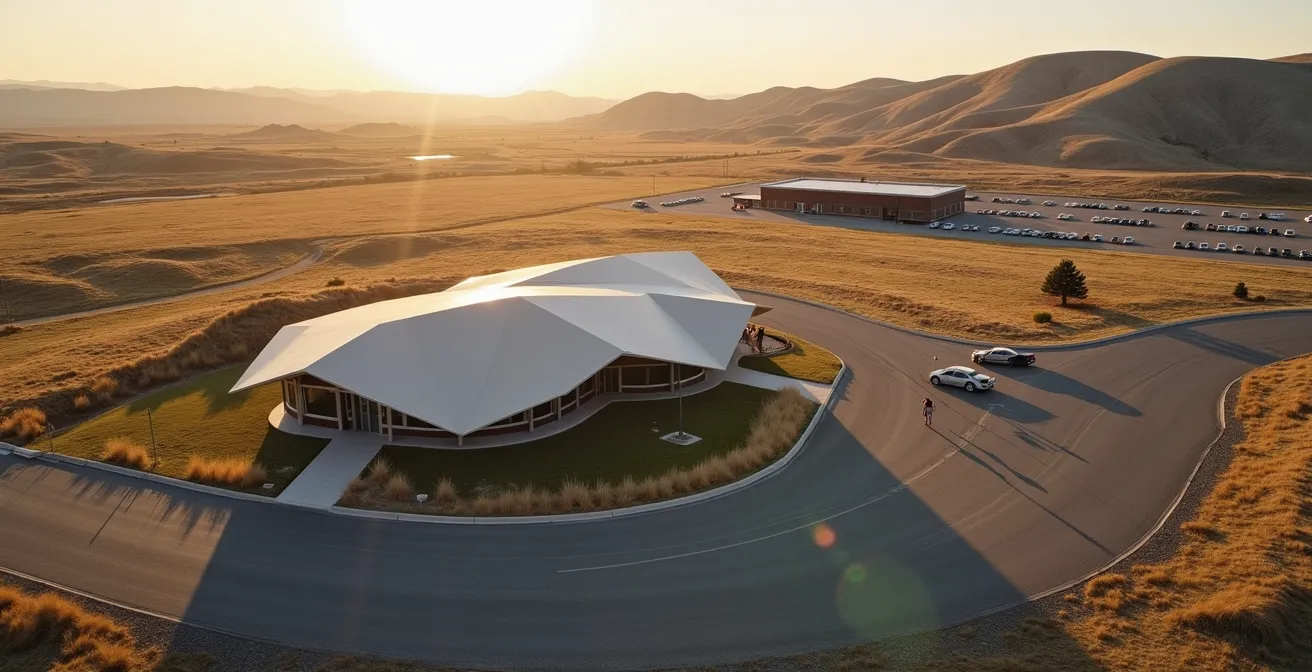
In summary:
- Book timed tickets 2-3 weeks in advance for a 10 AM or 2 PM slot to avoid the peak 11 AM to 1 PM visitor pulse.
- Prioritize high-impact exhibits like Dinosaur Hall for later in the day and use a counter-flow strategy to avoid traffic.
- Plan for a picnic and scheduled outdoor breaks to manage your family’s energy budget and avoid long cafeteria lines.
- Create a sensory plan by identifying quiet “Green Zones” (like the Burgess Shale exhibit) to decompress from loud and dark areas.
The vision is clear: your children’s faces, wide with awe, staring up at the colossal skeleton of a Tyrannosaurus Rex. The reality you dread is just as clear: shuffling through a packed hall in the July heat, the roar of the crowd drowning out the roar of the animatronic dinosaurs, and navigating the fragile “energy budget” of an overstimulated child. For parents, a summer trip to Alberta’s world-renowned Royal Tyrrell Museum of Palaeontology can feel like a high-stakes gamble between geologic wonder and total meltdown.
Standard advice is plentiful and predictable: book tickets in advance, arrive early. But this barely scratches the surface of the challenge. A successful visit with young children during peak season isn’t about simply showing up; it’s a strategic operation. It involves understanding the museum’s unique visitor flow dynamics and treating your day not as a leisurely stroll, but as a well-executed mission to maximize wonder and minimize frustration.
Forget just avoiding the crowds. This guide is your operational playbook to outsmart them. We’re moving beyond generic tips to provide a clever, tactical approach. We will dissect the art of strategic booking, teach you how to conduct “sensory triage” in noisy exhibits, and create a crowd-contrarian itinerary that turns a potentially stressful day into the incredible family adventure you envisioned. This is your plan for conquering the Tyrrell.
This comprehensive guide provides a strategic framework for your visit. Below, you will find a detailed breakdown of each phase of your mission, from securing the optimal entry time to planning a full, crowd-beating weekend in the Canadian Badlands.
Summary: A Strategic Field Guide to Conquering the Tyrrell Museum
- Timed Entry: Why Must You Book Your Tyrrell Tickets Online?
- Black Beauty to the Burgess Shale: Which Exhibits Should You Prioritize?
- The Overflow Lot: Is the Shuttle Bus to the Museum Reliable?
- Cafeteria vs Picnic: Where to Eat During a Full Day at the Museum?
- Noise and Darkness: Is the Museum Scary for Toddlers?
- Atlas Coal Mine: Is the Underground Tour Too Scary for Kids?
- Bus Tour or Guided Hike: What is the Only Way to See the Bone Beds?
- What to Do in Drumheller Besides the Museum for a Full Weekend?
Timed Entry: Why Must You Book Your Tyrrell Tickets Online?
Let’s be unequivocally clear: showing up at the Tyrrell in July without a pre-booked ticket isn’t a plan; it’s a recipe for disappointment. The question is not *if* you should book online, but *how* you can do so strategically to gain an immediate advantage. With annual visitation averaging 450,000 people, the timed-entry system is the museum’s primary tool for managing crowd pressure, and your primary tool for bypassing the worst of it.
The key is to understand the museum’s daily “visitor pulse.” The highest pressure point occurs between 11:00 AM and 1:00 PM, when the morning rush converges with early afternoon arrivals. Your mission is to operate outside this window. Aim to book your entry for the first slot of the day (10:00 AM) to get ahead of the wave, or for the post-lunch slot (around 2:00 PM) when the early crowds begin to fatigue and depart. Booking two to three weeks in advance is critical for summer weekends and holidays like Heritage Day.
If you’ve missed the ideal window, don’t despair. A secondary tactic is to check the museum’s booking site at 8:00 AM Mountain Time for same-week cancellations. This requires diligence but can yield valuable last-minute slots. While walk-up availability is a possibility during the quieter off-season (November to March), relying on it during the summer is a gamble you can’t afford to take with an eager family in tow. Securing your entry time online is the first and most crucial step in your strategic visit.
Black Beauty to the Burgess Shale: Which Exhibits Should You Prioritize?
With a child’s finite “energy budget,” you cannot see everything. The strategic parent doesn’t try to. Instead, you must become a curator of your own tour, prioritizing exhibits based on a crucial metric: the Impact-to-Time Ratio. This means maximizing the “wow” factor while minimizing time spent in high-traffic, low-reward areas. A common mistake is to follow the herd, moving clockwise from the entrance and hitting the main Dinosaur Hall first, right along with everyone else.
A savvier strategy is to employ a counter-flow approach. Consider starting in the quieter, more contemplative wings like the Burgess Shale exhibit. These low-crowd areas are perfect for acclimating your family to the museum environment before tackling the main attractions. Save the spectacular Dinosaur Hall for the end of your visit (after 3:00 PM), when the crowd pressure has significantly decreased, allowing for a more immersive and less overwhelming experience.
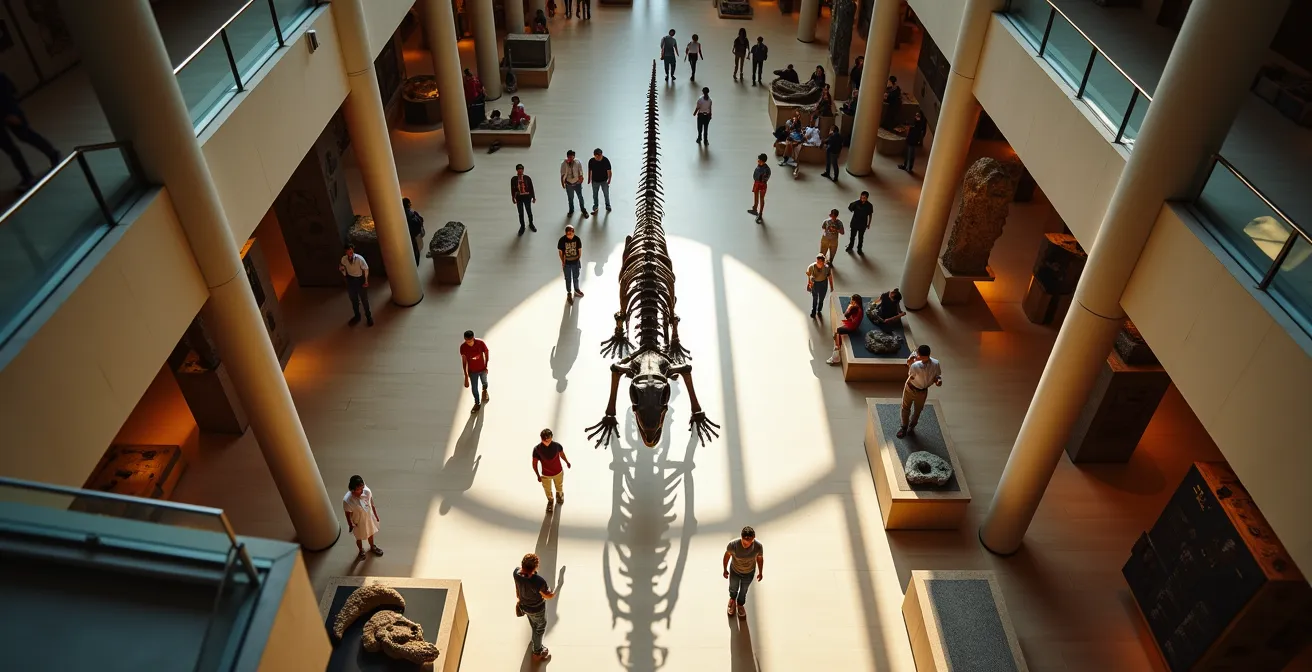
As this overhead view suggests, visitor traffic naturally concentrates in a few key areas. By consciously moving against this current, you can find pockets of calm and create a more personal experience. To aid in your planning, the following table breaks down the key exhibits by their strategic value.
| Exhibit | Time Investment | Crowd Level | Impact Score | Best Time |
|---|---|---|---|---|
| Dinosaur Hall | 60 minutes | Very High | 10/10 | 3 PM onwards |
| Black Beauty T-Rex | 15 minutes | High | 9/10 | Early morning |
| Preparation Lab Window | 20 minutes | Low | 8/10 | Weekdays 11 AM |
| Burgess Shale | 20 minutes | Low | 7/10 | Anytime |
| Cretaceous Garden | 15 minutes | Medium | 6/10 | Outdoor break time |
The Overflow Lot: Is the Shuttle Bus to the Museum Reliable?
First, a crucial clarification: the Royal Tyrrell Museum does not typically operate a shuttle bus from its overflow parking. The “shuttle” is often a misconception; the reality is a 10-15 minute walk. And on a 30°C July day, that walk can feel like a trek across the prehistoric plains themselves. The main parking lot is large but often reaches full capacity by 10:15 AM on peak summer Saturdays. You should operate under the assumption that you will be parking in the overflow lot.
So, is the situation reliable? The path is well-maintained and offers stunning badlands scenery, but its reliability depends entirely on your family’s stamina and preparedness. To mitigate the strain, employ the drop-off zone strategy. This tactical maneuver involves one parent dropping the rest of the family and the gear bag at the museum’s main entrance before heading off to find parking. This splits the burden and ensures the kids’ energy is saved for the exhibits, not the parking lot hike.
Remember the scale of your environment. While the main lot can seem challenging, the museum itself is well-organized and easy to navigate once inside. However, understanding that the museum’s massive facility spans 135,000 square feet helps put the walk into perspective. It’s a significant prelude to a day that will already involve a lot of walking. Plan for it, use the drop-off strategy, and treat the walk as a scenic introduction to the badlands, not an unexpected ordeal.
Cafeteria vs Picnic: Where to Eat During a Full Day at the Museum?
The decision of where to eat is not a minor detail; it’s a strategic choice that profoundly impacts your time, budget, and sanity. The museum’s cafeteria, while convenient, becomes a major bottleneck between noon and 1:30 PM. Waiting in a long line with hungry children can quickly deplete your family’s remaining energy budget. The picnic is your most powerful strategic alternative.
Packing your own lunch allows you to operate on your own schedule, refuelling when your team needs it, not when the queue allows. It transforms lunchtime from a stressful chore into a refreshing break. The nearby Midland Provincial Park offers scenic picnic tables, providing a perfect opportunity for kids to burn off energy outdoors before heading back in for the second half of your museum exploration. This physical and mental reset is invaluable.
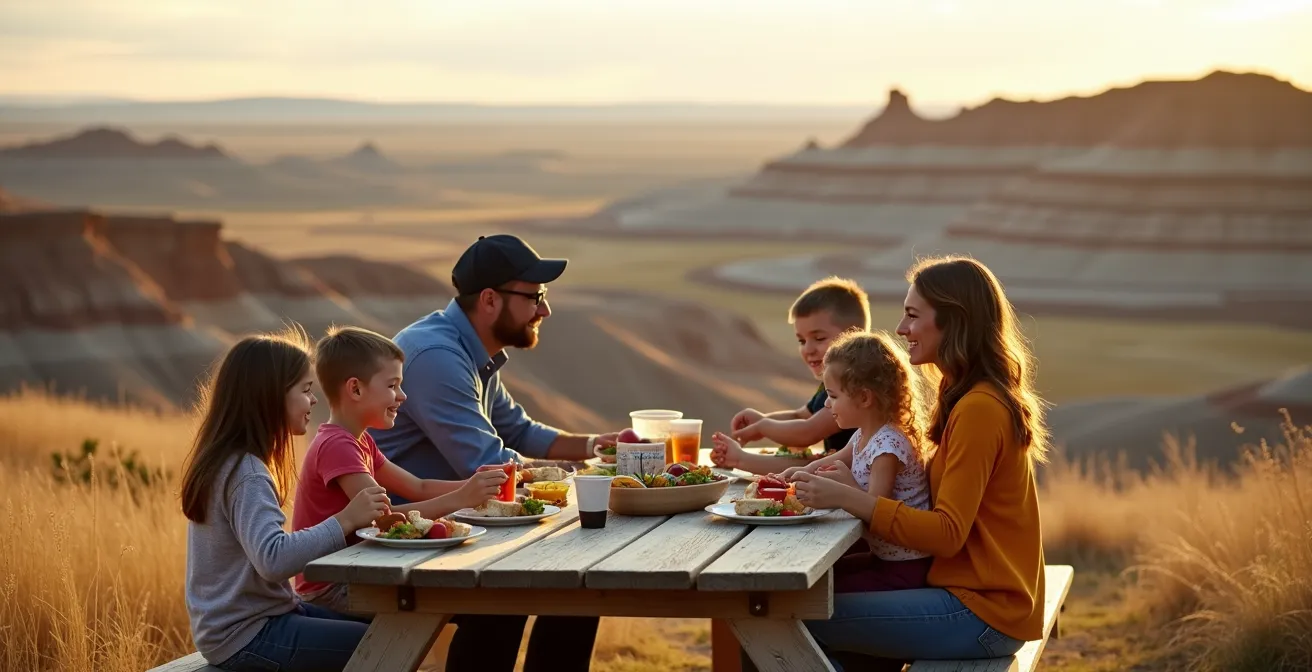
As this tranquil scene illustrates, a picnic offers more than just cost savings; it provides a moment of peace and a chance to connect with the stunning badlands landscape that makes this region so unique. To help you make the best tactical decision for your family, this analysis from expert travel analysis weighs the options.
| Option | Cost (CAD) | Time Investment | Pros | Cons |
|---|---|---|---|---|
| Museum Cafeteria | $60-80 | 40 min at peak | No prep needed, indoor comfort | Long lines 12-1:30 PM |
| Packed Picnic | $20-30 | 20 min | Eat on your schedule, save money | Must carry supplies |
| Midland Provincial Park Tables | Free with picnic | 30 min | Scenic, has facilities | Can be crowded |
| Car Picnic | Free with food | 15 min | Fastest option, AC available | Not scenic |
Noise and Darkness: Is the Museum Scary for Toddlers?
For a toddler, the line between “awesome” and “overwhelming” is razor-thin. The Royal Tyrrell Museum, with its dramatic lighting, cavernous spaces, and sudden dinosaur roars, can certainly be intimidating for the youngest visitors. A smart strategist doesn’t hope their child won’t be scared; they plan for it by conducting sensory triage throughout the visit.
This means proactively identifying “Red Zones” and “Green Zones.” A Red Zone, like the main Dinosaur Hall, features periodic thunder effects and the deep, rumbling roars of animatronics. A Green Zone is a bright, quiet space perfect for decompression, such as the outdoor Cretaceous Garden or even the expansive, naturally lit main lobby. Your mission is to alternate between these zones, preventing sensory overload before it happens. Don’t underestimate the value of overlooked quiet corners, like the benches in the Burgess Shale hallway, as quick-escape havens.
As one parent noted in their trip report, the experience is different for every age. In a review on Pursuing Pretty, a lifestyle blog, a mother of two shares her experience:
My boys were still a little young to appreciate all the interesting information that there was to learn about. My husband and I were wanting to stop and read everything which proved difficult while trying to chase two very excited kids. Give yourself 2-3 hours to enjoy this museum and even more if your children’s patience will allow for it.
– Pursuing Pretty
This highlights the need for a concrete plan. The following checklist is your tactical guide to managing the museum’s sensory environment.
Your Action Plan: Sensory Management for Young Children
- Identify Red Zones: Note that the Dinosaur Hall thunder effects repeat roughly every 15 minutes. Be prepared to cover ears or temporarily step out.
- Map Green Zones: Locate the Cretaceous Garden and main lobby on your map upon arrival. These are your primary spaces for decompression.
- Scout Quiet Corners: Find the benches in the less-crowded hallways (like the Burgess Shale exhibit) for quick, unplanned moments of calm.
- Schedule Outdoor Breaks: Plan mandatory 20-minute outdoor runs or walks after completing intense exhibits to reset your child’s sensory input.
- Prepare an Exit Strategy: From any dark or loud exhibit, know your quickest route back to a Green Zone or an exit to prevent feelings of being trapped.
Atlas Coal Mine: Is the Underground Tour Too Scary for Kids?
Expanding your mission beyond the Tyrrell Museum brings you to another iconic Drumheller landmark: the Atlas Coal Mine National Historic Site. It’s an incredible piece of Alberta’s industrial heritage, but for families, the main attraction—the underground tunnel tour—comes with a critical question of suitability. The short answer is: for young children, it very likely is too scary, and the site’s own rules reflect this.
The “Underground Experience” tour has a strict age requirement of 6 years and older. This is not arbitrary. The tour involves navigating dark, confined spaces for approximately 45 minutes, wearing a hard hat and lamp. For a child sensitive to darkness or enclosed areas, this can be a source of significant anxiety rather than excitement. According to travel guides focusing on the region, even the process of getting the safety gear can be a point of stress for some kids.
Case Study: The Family-Friendly Atlas Alternative
Fortunately, a “no” to the underground tour doesn’t mean a “no” to the Atlas Coal Mine. The site offers an excellent surface tour that is suitable for all ages. This tour allows you to ride the old mine train and get an up-close look at Canada’s last wooden tipple—an enormous and impressive coal-loading structure. This provides a rich historical experience and a fantastic photo opportunity without the associated anxiety of the underground portion, making it the superior strategic choice for families with toddlers and young children.
The strategic decision here is clear. Unless your children are over six and confident in dark, enclosed spaces, opt for the surface tour. It delivers a high-impact historical experience with zero risk of a subterranean meltdown, preserving your family’s morale for the rest of your Drumheller adventure.
Bus Tour or Guided Hike: What is the Only Way to See the Bone Beds?
The fossils inside the Royal Tyrrell Museum are spectacular, but they represent only a fraction of the story. While the museum’s collection contains over 200,000 specimens, an even more profound experience awaits outside its walls: seeing a dinosaur bone bed in its natural state. This is not something you can simply drive to. Access to the nearby Centrosaurus bone bed is exclusively controlled by the museum and available only through a guided tour—either by bus or by hike.
Choosing between the two is a critical strategic decision for a family. This is not a choice between “good” and “bad,” but a trade-off between physical effort, weather dependency, and authenticity. The guided hike offers an unparalleled, hands-on experience, allowing you to walk the same ground as the dinosaurs on uneven terrain. However, its 2-hour duration and exposure to the elements make it a challenging option for families with children under 8.
The bus tour is the more accessible and family-friendly option. It minimizes walking, provides shelter from the sun or rain, and is suitable for all ages. While it may score slightly lower on the “authenticity” scale as you’re more insulated from the environment, it reliably delivers the core experience of seeing the bone bed without the physical demands of the hike. For most families with young children, the bus tour is the superior tactical choice, guaranteeing the reward without the risk of physical exhaustion.
| Tour Type | Physical Difficulty | Age Suitability | Duration | Weather Dependency | Authenticity Score |
|---|---|---|---|---|---|
| Guided Hike | Moderate (uneven terrain) | 8+ years | 2 hours | High (sun/rain exposure) | 10/10 |
| Bus Tour | Minimal walking | All ages | 1.5 hours | Low (covered transport) | 7/10 |
Key Takeaways
- Strategic Timing: Book a 10 AM or 2 PM slot to bypass the peak 11 AM – 1 PM visitor surge.
- Energy Management: Plan a picnic and scheduled outdoor breaks to conserve your children’s finite energy budget.
- Sensory Strategy: Proactively manage noise and darkness by identifying “Green Zones” (like the Cretaceous Garden) for decompression.
What to Do in Drumheller Besides the Museum for a Full Weekend?
A trip to the Tyrrell Museum shouldn’t exist in a vacuum. To truly conquer Drumheller, you must see the museum as the centerpiece of a larger, strategically planned weekend. The key to success is embracing a crowd-contrarian itinerary. This means visiting the area’s other popular attractions when the majority of tourists are packed into the museum, and vice-versa.
For families driving from Calgary, this approach flips the traditional schedule on its head. Instead of heading straight to the museum on Saturday morning, you go to the Hoodoos Trail and the Atlas Coal Mine first, enjoying them with fewer people. You then execute your museum mission in the late afternoon, from 3 PM to 5 PM, as the crowds are thinning out. This simple reversal drastically improves the experience at every location.
Beyond the main attractions, Drumheller is a playground of dinosaur-themed fun. A scavenger hunt for the decorated dinosaur statues scattered throughout town is a low-cost, high-reward activity for kids. A climb up the World’s Largest Dinosaur statue offers a kitschy but memorable view, but again, timing is everything—tackle it early on Sunday morning before the lineup forms. For a unique change of pace, the historic Bleriot Ferry offers a quaint, free-of-charge river crossing experience that feels like a step back in time. Here is a sample operational plan for a full weekend:
- Saturday Morning: Drive early from Calgary. Go directly to the Hoodoos Trail, then the Atlas Coal Mine (surface tour) while the museum is at its peak crowd level.
- Saturday Afternoon: Have a late, relaxed lunch in town. Execute your Tyrrell Museum visit from 3:00 PM to 5:00 PM as the crowds depart.
- Saturday Evening: Check into a hotel, ideally one with a pool for essential kid decompression time.
- Sunday Morning: Visit the World’s Largest Dinosaur before 9:00 AM to beat the queue.
- Sunday Midday: Grab a quick ice cream in downtown Drumheller, then begin your drive home before the main traffic exodus.
By transforming your visit from a simple trip into a strategic mission, you are not just ensuring survival—you are guaranteeing a memorable and awe-inspiring adventure for your entire family. Now, it’s time to assemble your gear, finalize your plan, and prepare for an unforgettable journey into the age of dinosaurs.