
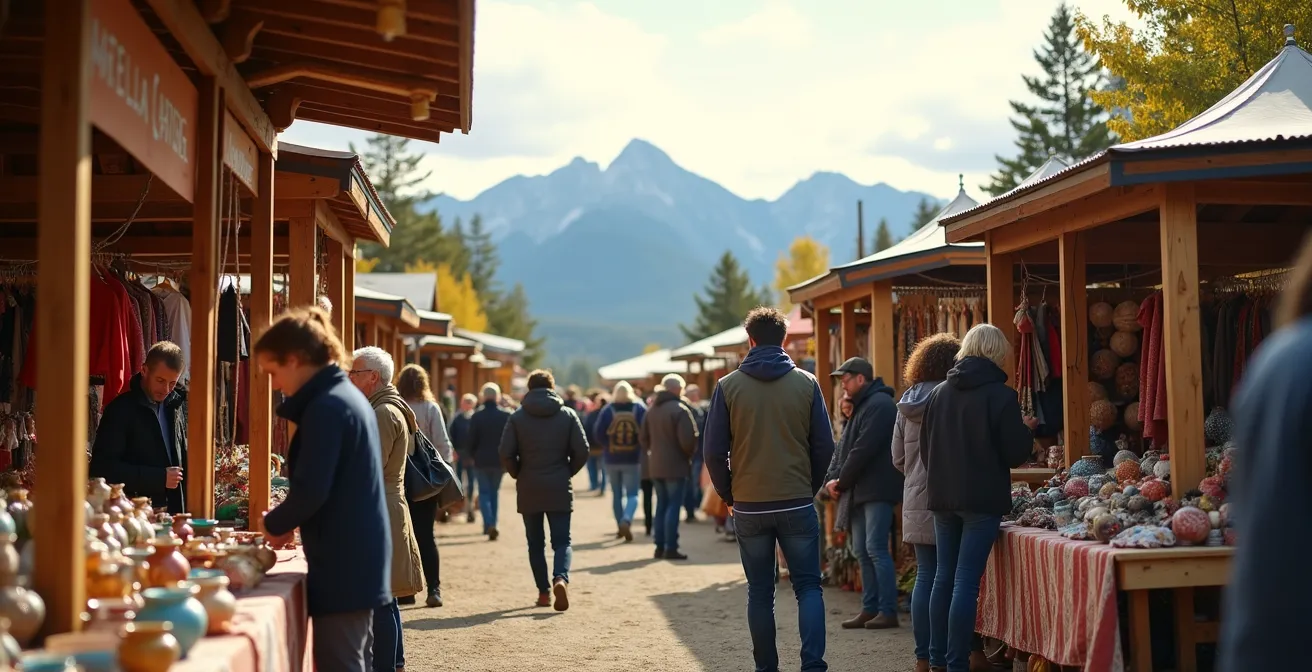
Supporting local in Alberta is not just a preference; it’s a strategic investment in the province’s economic sovereignty and cultural survival.
- Your spending directly addresses the staff housing crisis, ensuring the people who serve you can afford to live in their communities.
- It guarantees authenticity, connecting you with genuine artisans and Indigenous operators instead of mass-produced imitations.
Recommendation: Shift your mindset from a passive tourist to a conscious economic partner by questioning the origin of goods and services at every step of your journey.
As a visitor to Alberta, you are greeted by breathtaking Rocky Mountain peaks, vast prairies, and vibrant cities. It’s easy to be captivated by the scenery. But beneath this majestic surface lies a complex local economy, one where every dollar you spend tells a story. Many travelers rightly assume that buying a souvenir or dining out contributes to the local community. However, the line between a genuine local business and a multinational chain disguised in rustic decor is becoming increasingly blurred, especially in our world-renowned tourist hubs.
The common advice is to “shop local,” but this guidance often lacks the crucial “why” and “how.” What does “local” truly mean in a place like Banff, where global brands dominate main street? How does your choice of restaurant impact the server who is struggling to find housing? This is where we must move beyond the surface-level platitudes. The real power of a visitor lies not just in spending money, but in understanding the hidden economic and social mechanics behind each transaction. It’s about recognizing the link between your souvenir purchase and an artisan’s ability to thrive, or your tipping practice and a worker’s livelihood.
This guide adopts a different perspective. We will argue that conscious spending is an act of economic solidarity with the people and culture of Alberta. It’s about ensuring your visit enriches the province, not just a distant corporate headquarters. We will delve into the critical issues facing our communities—from the staff housing crisis to the preservation of Indigenous heritage—and reveal how your choices as a traveler are not just a footnote, but a central part of the solution. This is not just about feeling good; it’s about doing good, intelligently.
Throughout this article, we will equip you with the practical knowledge to navigate Alberta’s economy with purpose. We’ll explore how to verify authentic goods, understand local customs, and connect with the true keepers of Alberta’s culture, ensuring your journey leaves a positive, lasting legacy.
Contents: Why Supporting Alberta-Owned Businesses is a Powerful Choice
- Made in Alberta: How to Ensure Your Souvenir Isn’t Mass-Produced Abroad?
- 15%, 18%, or 20%: What is the Standard Tip in Alberta Restaurants?
- Living in a Postcard: How to Be a Considerate Guest in Banff Residential Areas?
- The Staff Housing Crisis: Understanding the Challenges of Your Server
- Authenticity Check: How to Find Indigenous-Owned Tourism Operators?
- Made in China or Canada: How to Spot Fake Souvenirs on Banff Avenue?
- Strathcona or Downtown: Which Farmers Market Requires the “Make It, Bake It, Grow It” Rule?
- What Does “Treaty 7 Territory” Mean for a Visitor to Southern Alberta?
Made in Alberta: How to Ensure Your Souvenir Isn’t Mass-Produced Abroad?
The search for a meaningful souvenir is a core part of the travel experience. Yet, many items marketed as “local” are anything but. True economic support begins with ensuring your purchase benefits an Albertan artist, not a foreign factory. The key is to engage with the seller and learn the story behind the product. A genuine local retailer will not only know the artist but will be proud to share their story, their process, and where in Alberta they create their work. This is the first step in building an authenticity supply chain that directly rewards local talent.
This is more than just a transaction; it is an investment in our province’s creative culture. When you buy a piece of pottery, a painting, or jewelry from a verified Albertan, you are funding the continuation of a craft. This is a stark contrast to buying a mass-produced item that merely uses a Canadian symbol as a marketing tool. To empower yourself as a conscious consumer, you need a simple framework for verification.

As the image above illustrates, true craftsmanship is tangible. It’s in the texture of the clay and the focus of the maker. This is the world you are supporting with a genuine purchase. The Alberta Craft Council has formalized this verification, becoming a trusted standard for both artists and buyers.
Case Study: The Alberta Craft Council’s Local-Only Gallery Model
The Alberta Craft Council’s galleries in Edmonton and Calgary have a strict jury process that guarantees 100% Alberta-made products. Artists must provide studio location verification and detailed documentation of their creation process, all of which is peer-reviewed by established Alberta artisans. This system has created a network of over 300 verified artists, providing a gold standard for tourists seeking authentic local crafts and ensuring the money stays within the provincial economy.
Your Action Plan: The 3-Question Artisan Story Test
- Ask ‘Who is the specific artist or maker?’ A genuine local seller will proudly provide a name and background.
- Ask ‘Where in Alberta is their studio located?’ Authentic artisans can specify exact towns or regions, connecting the art to a place.
- Ask ‘Can you tell me the story behind this specific piece?’ Real sellers know the creative process and inspiration, turning a product into a story.
- Bonus verification: Look for Alberta Craft Council Gallery certification in Edmonton or Calgary for a guaranteed investment in local crafts.
15%, 18%, or 20%: What is the Standard Tip in Alberta Restaurants?
Tipping culture can be confusing for visitors, but in Alberta, it’s a direct and crucial part of a service worker’s income. While the question of how much to tip is common, understanding the economic context behind it is more important for a responsible traveler. Unlike some jurisdictions with a lower “tipped minimum wage,” Alberta has a unified minimum wage for all workers. According to Alberta government data, the province unified its minimum wage to $15.00/hour for all workers in 2018, including those who receive tips.
However, this wage alone is often insufficient to live in high-cost tourist destinations like Banff, Canmore, or Jasper. The high cost of living, particularly for housing, means that tips are not merely a bonus for good service; they are a vital component of a livable income. Service staff rely on this income to afford rent, groceries, and transportation in the very towns that exist to serve tourists. Therefore, the standard of tipping reflects a social contract between visitor and resident.
So, what is the standard?
- 15% is generally considered the minimum for adequate service.
- 18-20% has become the new standard for good to excellent service, especially in dining establishments. This range acknowledges the high cost of living for staff.
- Above 20% is reserved for exceptional service that went above and beyond.
When you tip fairly, you are doing more than just rewarding an individual. You are contributing to the sustainability of the local workforce. It is a direct acknowledgment of the housing-hospitality link—the understanding that for a town to offer excellent hospitality, its workers must be able to live there affordably and with dignity. Your tip is a small but powerful vote for a sustainable service industry.
Living in a Postcard: How to Be a Considerate Guest in Banff Residential Areas?
Visiting Banff is like stepping into a postcard, but it’s crucial to remember that this stunning landscape is also a living community. For the thousands of residents who call the national park home, the line between public tourist space and private residential life is thin and easily crossed. Being a considerate guest, rather than just a consuming tourist, means actively respecting the rules and rhythms of the local community. This respect is not just about being polite; it’s about public safety and the well-being of the residents who make your visit possible.
Simple actions, like keeping noise down during quiet hours (10 PM to 7 AM), are vital for shift workers who may be sleeping during the day to be ready for an early morning or late-night shift. Parking is another critical issue; residential permit zones are reserved for locals who have extremely limited options, so visitors must always use designated public parking. Most importantly, respecting wildlife bylaws by securing all garbage is not just a suggestion—it’s an essential practice to prevent attracting bears into town, which endangers both residents and the animals themselves.
Case Study: The Impact of Banff’s “Need to Reside” Bylaw
Parks Canada enforces a unique “Need to Reside” regulation, requiring all Banff residents to have legitimate employment within the park. This creates an intense housing shortage. When tourists book illegal short-term rentals (e.g., unauthorized Airbnbs), they are not just finding a place to stay; they are directly displacing an essential worker’s family. In 2024, enforcement actions successfully returned 47 illegally rented units to the local housing pool, directly providing homes for the teachers, healthcare workers, and hospitality staff who are the backbone of the community.
Choosing legal, licensed accommodation is one of the most significant ways you can support the town’s social fabric. When you book a hotel or a licensed bed and breakfast, you are supporting a system that allows Banff’s community to survive.
Your Action Plan: Banff Good Neighbour Checklist for Tourists
- Respect quiet hours (10 PM – 7 AM), especially for the many shift workers in the local workforce.
- Use only designated tourist parking; never park in residential permit zones marked with ‘R’ signs.
- Secure all garbage in wildlife-proof bins to prevent attracting bears and endangering residents.
- Stay on public sidewalks and paths. Do not cut through private yards for a shortcut or a photo.
- Book only legal accommodations. Illegal rentals directly displace the local families and workers who keep the town running.
The Staff Housing Crisis: Understanding the Challenges of Your Server
When you are enjoying a meal with a mountain view in Canmore or Banff, the person serving you is likely facing a challenge you cannot see: the severe staff housing crisis. In Alberta’s mountain towns, the cost of living has skyrocketed while the availability of affordable housing has plummeted. This isn’t just a local problem; it’s a critical issue that directly affects the quality and sustainability of the tourism industry. Many service workers commute long distances or live in crowded, expensive accommodations, a reality that creates immense stress and high turnover.
This housing-hospitality link is the most urgent issue defining our local economies. Without stable, affordable housing, businesses struggle to retain experienced staff, leading to shorter operating hours, strained service, and in some cases, outright closures. As a visitor, you can play a role in supporting a more sustainable model. By choosing to patronize businesses that are actively part of the solution, you send a powerful market signal that employee welfare matters.

The pre-dawn commute depicted above is a daily reality for many who work in our resort towns. Recognizing this struggle is the first step. The next is to support employers who are investing in their people.
Case Study: Pursuit’s Staff Accommodation Solution
Major operators like Pursuit (Banff Jasper Collection) are tackling the housing crisis head-on by providing dedicated staff accommodation for a significant portion of their workforce. According to their reports, providing housing for over 60% of their employees has reduced staff turnover by 40%. This investment not only ensures service continuity and quality during peak seasons but also demonstrates a commitment to the well-being of the community. Visitors who consciously choose businesses that advertise “Staff Accommodation Provided” are directly supporting better working conditions.
Your patience, your generous tips, and your choice of business all contribute. When you see a “now hiring” sign alongside a “staff accommodation available” notice, you are looking at a business that understands its responsibility. Supporting them is a direct investment in the health of the entire tourism ecosystem.
Authenticity Check: How to Find Indigenous-Owned Tourism Operators?
Engaging with Indigenous culture is one of the most profound experiences a visitor to Alberta can have. However, to do so responsibly, one must ensure they are supporting genuine, Indigenous-owned and-operated businesses, not just “Indigenous-themed” enterprises. This is a critical act of economic reconciliation and respect for the First Peoples of this land. Supporting authentic Indigenous tourism provides a direct flow of revenue to communities, fostering self-determination and the preservation of culture. The economic impact is substantial; Indigenous Tourism Alberta reports the sector contributed $126 million to the provincial GDP in 2024, a figure projected to grow.
The key to authenticity is verification. Indigenous Tourism Alberta (ITA) is the primary resource for this. Their directory features members who have met strict criteria, most notably the requirement of being at least 51% Indigenous-owned. This standard ensures that the economic benefits and control remain within the community. Beyond ownership, true authenticity lies in the connection to the land and the specific Nation whose territory you are visiting. Alberta is covered by Treaties 6, 7, and 8, and each territory is the traditional home of distinct Nations.
For example, when visiting the Calgary or Banff area in Treaty 7 territory, seeking out an experience led by a member of the Siksika, Piikani, Kainai, Stoney Nakoda, or Tsuut’ina Nations offers a layer of geographic and cultural authenticity that cannot be replicated. Asking operators about their Nation affiliation and community connections is not an intrusive question; it is a sign of respect and a way to ensure you are hearing stories from the people to whom they belong.
Your Action Plan: The Indigenous Tourism Alberta Verification Process
- Check the official member directory on the Indigenous Tourism Alberta website for a list of verified operators.
- Look for businesses that explicitly state they are a minimum of 51% Indigenous-owned, the ITA’s requirement for membership.
- Identify which Treaty territory you are in (e.g., Treaty 6, 7, or 8 in Alberta) to understand the local context.
- Seek operators from the specific Nations of that Treaty area (e.g., Blackfoot Confederacy Nations in Treaty 7).
- Respectfully ask operators about their Nation affiliation and their connections to the community and land.
Made in China or Canada: How to Spot Fake Souvenirs on Banff Avenue?
Walking down Banff Avenue, you’re surrounded by storefronts offering mountain-themed apparel, “Native-inspired” art, and shimmering gemstones. Unfortunately, a significant portion of these goods are mass-produced overseas and have no connection to Alberta’s economy or culture. Spotting fakes and supporting genuine local retailers is a crucial act of economic discernment. The most obvious warning sign is pricing and promotion; stores with perpetual “50% OFF” signs or identical inventory across multiple locations are often clearinghouses for imported goods.
Authentic local products come with a story, an artist’s name, and a fair price that reflects the cost of labour and materials. Generic labels like “Native-inspired” or “Canadian-made” (without further detail) are often red flags. A “Made in Canada” sticker can be misleading if it only refers to the final, minimal assembly of imported components. Your best defense is a healthy skepticism and a willingness to ask questions. A retailer selling genuine local products will be eager to tell you about the artist or the origin of the materials.
Case Study: Genuine Ammolite vs. The Fakes
Ammolite, Alberta’s official gemstone, is found commercially only in Southern Alberta’s Bearpaw Formation. An authentic, certified piece is a true piece of Alberta’s 71-million-year-old history, selling for hundreds or even thousands of dollars. Fakes, often made from abalone shell or resin, are sold for as little as $20. Genuine Ammolite has a unique, complex iridescence that shifts with the viewing angle, a depth that fakes cannot replicate. Reputable local gem shops like Korite provide certificates of authenticity and can explain the gemstone’s unique geological story, connecting your purchase directly to the land.
By educating yourself on the markers of authenticity for key local products like Ammolite, you protect yourself from scams and ensure your investment supports the industries that make Alberta unique.
Your Action Plan: Banff Avenue Red Flag Checklist for Mass-Produced Items
- Red Flag: Store-wide, year-round ‘50% OFF’ signs that create false urgency.
- Red Flag: Identical inventory (e.g., the same t-shirt designs or mugs) in multiple, unaffiliated storefronts along the avenue.
- Red Flag: Vague or missing artist information, especially on items with “Native-inspired” labels.
- Red Flag: Suspiciously low prices for items presented as ‘genuine’ Ammolite, turquoise, or other valuable materials.
- Red Flag: Cheap-looking ‘Made in Canada’ stickers that can be easily peeled off or appear to be placed over other labels.
Strathcona or Downtown: Which Farmers Market Requires the “Make It, Bake It, Grow It” Rule?
A visit to a farmers’ market feels like the ultimate way to support local, but in Alberta, not all markets are created equal. The term “farmers’ market” can describe anything from a true producer-only market to a public market that allows resellers of imported goods. Understanding the difference is key to ensuring your money goes directly to the person who grew the carrots or baked the bread. The gold standard is the “Make It, Bake It, Grow It” rule.
This rule, a hallmark of authentic farmers’ markets, mandates that vendors must be the original producers of everything they sell. This model guarantees an unbroken authenticity supply chain from the farm or workshop to you. The Old Strathcona Farmers’ Market in Edmonton is a prime example of a 100% producer-only market. In contrast, other markets may operate on an 80/20 model, allowing a certain percentage of resellers, or a public market model with a mix of local producers and commercial vendors. While these markets still offer value, they require more diligence from the consumer to identify the true local producers.
The following table, based on data from provincial resources, breaks down the common models you’ll find across Alberta.
| Market Type | Example | Vendor Rules | Authenticity Guarantee |
|---|---|---|---|
| 100% Producer-Only | Old Strathcona (Edmonton) | Must make, bake, or grow everything | Direct from producer guaranteed |
| 80/20 Provincial Standard | Calgary Farmers’ Market | 80% producers, 20% resellers allowed | Ask each vendor about origin |
| Public Market Model | Downtown markets | Mixed vendors and imports | Varies by stall |
This comparative analysis from Alberta’s business resources highlights the importance of asking the right questions, regardless of the market you visit.
Your Action Plan: The Universal Alberta Market Question
- Ask any vendor a simple question: ‘Where is your farm, kitchen, or studio located?’
- Listen for specific Alberta town or county names. A true local producer will answer with pride and precision.
- Follow up with: ‘Can I visit your farm/studio?’ Genuine producers are often open to visitors and see it as a compliment.
- Look for vendor signs that display specific farm names and locations, not just generic product descriptions.
- Check if the vendor can explain their growing, baking, or making process in detail. Their expertise is a sign of authenticity.
Key Takeaways
- True support for the local economy requires active verification, not just assumptions. Ask about the artist, the farm, or the maker.
- Your spending choices directly impact the staff housing crisis. Supporting businesses that invest in their employees helps sustain our communities.
- Authenticity is paramount. Prioritize verified Indigenous operators and markets with “make it, bake it, grow it” rules to ensure your money supports genuine culture and craft.
What Does “Treaty 7 Territory” Mean for a Visitor to Southern Alberta?
When you visit Southern Alberta—including Calgary, Banff, and Canmore—you are on Treaty 7 territory. This is not just a historical fact; it is a present-day reality that defines the relationship between Indigenous and non-Indigenous people on this land. For a visitor, understanding this means recognizing that you are a guest in a place governed by a living agreement. Treaty 7 was signed in 1877 at Blackfoot Crossing between the Crown and the Nations of the Blackfoot Confederacy (Siksika, Piikani, Kainai), the Tsuut’ina, and the Stoney Nakoda. It is a foundational agreement about sharing the land and its resources.
Framing your visit through this lens transforms your perspective. You are not just exploring a park or a city; you are moving through the traditional and ancestral lands of sovereign Nations. This recognition invites a deeper level of respect and encourages you to seek out opportunities for economic reconciliation. Supporting Nation-owned businesses, like the Grey Eagle Resort & Casino (Tsuut’ina) or Blackfoot Crossing Historical Park (Siksika), is a powerful way to honor the spirit of the treaty. Your tourism dollars become a tool for Indigenous self-determination, directly contributing to the economic and cultural vitality of the Treaty 7 Nations.
Case Study: Blackfoot Crossing Historical Park and Treaty 7 Economic Reconciliation
Owned and operated by the Siksika Nation, Blackfoot Crossing Historical Park stands on the very site where Treaty 7 was signed. It serves as a powerful example of reconciliation through tourism. The park employs over 40 Siksika members, educates thousands of visitors annually on Blackfoot culture and treaty history, and generates significant revenue for the Nation. According to data from tourism bodies, the park is a key driver of Indigenous self-determination, turning historical education into tangible economic benefit for the community whose story it tells.
Your Action Plan: The Treaty 7 Territory Visitor Guide
- Learn which Treaty 7 Nation’s traditional territory you are on (e.g., Siksika, Piikani, Kainai, Stoney Nakoda, or Tsuut’ina).
- When possible, book experiences with tour operators or guides from that specific Nation for the most authentic perspective.
- Visit Nation-owned attractions like Blackfoot Crossing Historical Park (Siksika) or the Grey Eagle Resort (Tsuut’ina).
- Purchase authentic arts and crafts directly from Treaty 7 Nation artists at galleries, markets, or community events.
- Frame your visit as an act of honoring a living agreement about respectfully sharing the land.
By choosing to be a conscious traveler, you wield immense power. You can help ensure that Alberta’s tourism industry is one that is equitable, sustainable, and authentic—one that enriches our communities, protects our cultures, and offers a more profound experience for all. Start today by making your next purchase or booking a deliberate act of support for the local Alberta economy.