
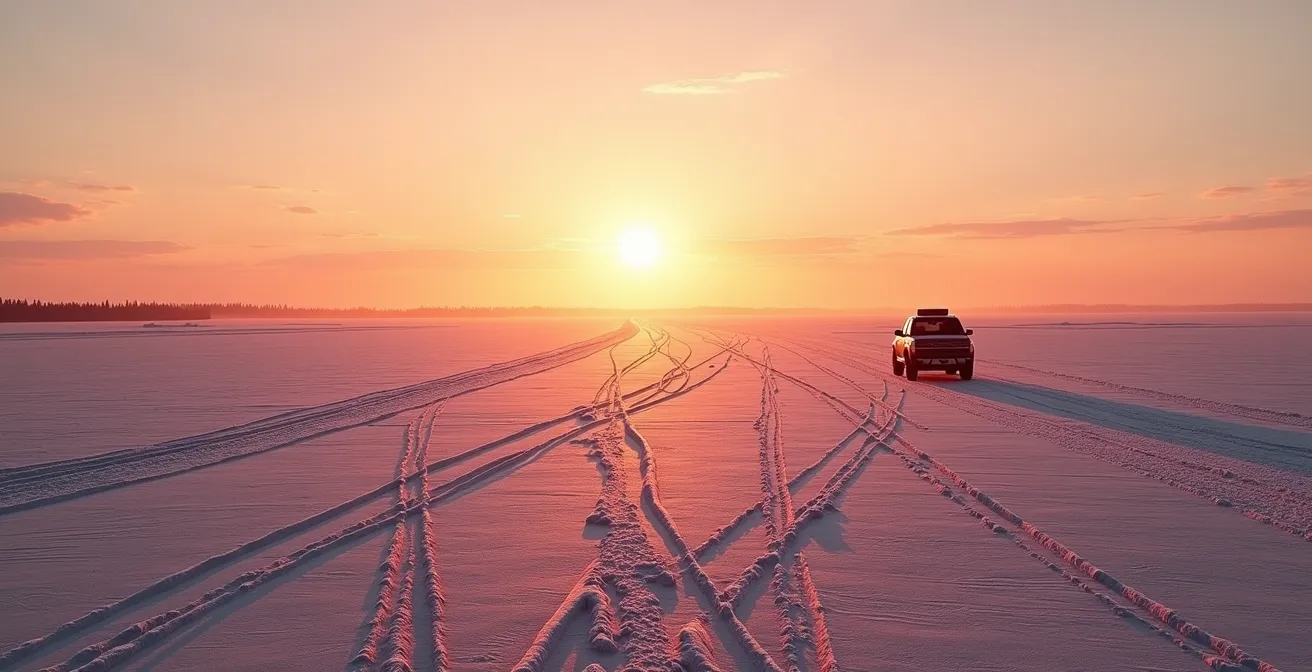
The grueling drive to Wood Buffalo isn’t a downside; it’s the very thing that protects its profound, untouched wilderness.
- You’ll encounter genetically unique bison found nowhere else on Earth and walk on glittering salt plains that look like another planet.
- You’ll witness the aurora in the world’s largest dark sky preserve, an experience of pure darkness unattainable in more accessible parks.
Recommendation: If your goal is an authentic expedition, not just a scenic drive, the effort is not only worth it—it’s the entire point.
There it is on the map, a vast expanse of green straddling the border of Alberta and the Northwest Territories. Wood Buffalo National Park. Then you check the distance from Edmonton: over 1,300 kilometres. A solid 12 hours of driving, assuming the roads are good. The question immediately forms in the mind of any road-tripper: is it actually worth the colossal effort?
Most travellers opt for the undeniable, accessible beauty of Jasper or Banff. They hear whispers of Wood Buffalo’s massive bison herds, its world-class dark skies, and the shimmering northern lights. But that drive, a long, lonely stretch of Highway 35, often acts as an insurmountable barrier. The conventional wisdom is to stick to the Rockies, where the rewards are more immediate and the logistics far simpler. It’s easy to conclude the park is just too remote, too difficult, too much.
But what if that perspective is wrong? What if the drive isn’t a bug, but a feature? This is the core of the expedition mindset. The difficulty isn’t a deterrent; it is the very filter that preserves an experience so raw and profound it’s nearly extinct in our connected world. That immense distance guards a wilderness that doesn’t just need to be seen, but earned. It weeds out the casual tourists, leaving the park for those who seek not just beauty, but solitude and authentic adventure.
This guide isn’t here to give you a simple ‘yes’ or ‘no’. It’s here to arm you with the truth about the park’s unparalleled rewards and its very real challenges. We will explore the unique creatures you’ll find, the surreal landscapes you can walk upon, the celestial wonders you’ll witness, and the practical, non-negotiable preparations you must make. By the end, you won’t wonder if the park is worth it; you’ll know if you are ready for the park.
To help you weigh the monumental effort against the extraordinary rewards, this article breaks down the essential elements of a Wood Buffalo expedition. Follow along to understand what truly makes this journey a once-in-a-lifetime test for the serious adventurer.
Summary: Planning Your Expedition to Wood Buffalo National Park
- Wood Bison vs Plains Bison: What Makes the Northern Giants Unique?
- Bulldog Flies and Mosquitoes: How to Survive the Bugs in July?
- Why Can You Walk on a Glittering Red Desert in the Middle of Boreal Forest?
- Why is Wood Buffalo the World’s Largest Dark Sky Preserve?
- Fuel and Tires: What Emergency Gear Do You Need for Highway 35?
- Elk Island or Jasper: Which Dark Sky Preserve Offers Better Foreground Views?
- Iron and Fat: Why is Bison Recommended for Heart Health?
- Aurora Borealis in Alberta: How to Forecast and Photograph the Lights?
Wood Bison vs Plains Bison: What Makes the Northern Giants Unique?
Seeing a bison is one thing; seeing a Wood Bison is another entirely. These are the true giants of the north, genetically and physically distinct from their southern cousins, the Plains Bison. Wood Bison are taller, heavier, and have a more prominent, triangular hump that sits forward of their front legs. But the real difference isn’t just cosmetic; it’s a matter of ecological isolation and genetic purity. These aren’t just any bison; they are a living link to a wilder past.
The park is home to the only self-sustaining population of Wood Bison in the world, a lineage that has evolved in this specific boreal environment for millennia. In fact, deep within the park, the Ronald Lake herd represents a pocket of incredible genetic significance. Recent studies have confirmed this specific herd is a unique and irreplaceable reservoir of Wood Bison genetics; genetic analyses show that it is 100% genetically distinct with no evidence of cattle gene introgression that has affected other populations. This is what the “filter of effort” protects: a truly wild animal, unaltered by the world outside.
Finding them requires patience and knowledge of their seasonal habits. To maximize your chances, plan your search according to the time of year:
- Spring (May-June): During calving season, look for herds grazing in the lush meadows of the Peace-Athabasca Delta.
- Summer (July-August): Your best bet is to check the natural salt licks and the Salt River Day Use Area during the cooler hours of the early morning.
- Fall (September-October): Herds are often visible along Highway 5 and near Parsons Lake Road as they move to different feeding grounds.
- Winter: For the most intrepid, winter ice roads between Fort Chipewyan and Fort Smith offer incredible, crowd-free wildlife viewing opportunities.
Bulldog Flies and Mosquitoes: How to Survive the Bugs in July?
Let’s be honest, because an explorer respects the truth: the bugs in northern Alberta in July can be biblical. This isn’t the occasional nuisance mosquito you find in the city. We’re talking about relentless swarms of mosquitoes and the infamous “Bulldog” horseflies, which are large, aggressive, and have a painful bite. Ignoring this reality is the fastest way to ruin your expedition. But for the prepared, it’s just another challenge to be managed with the right strategy and gear.
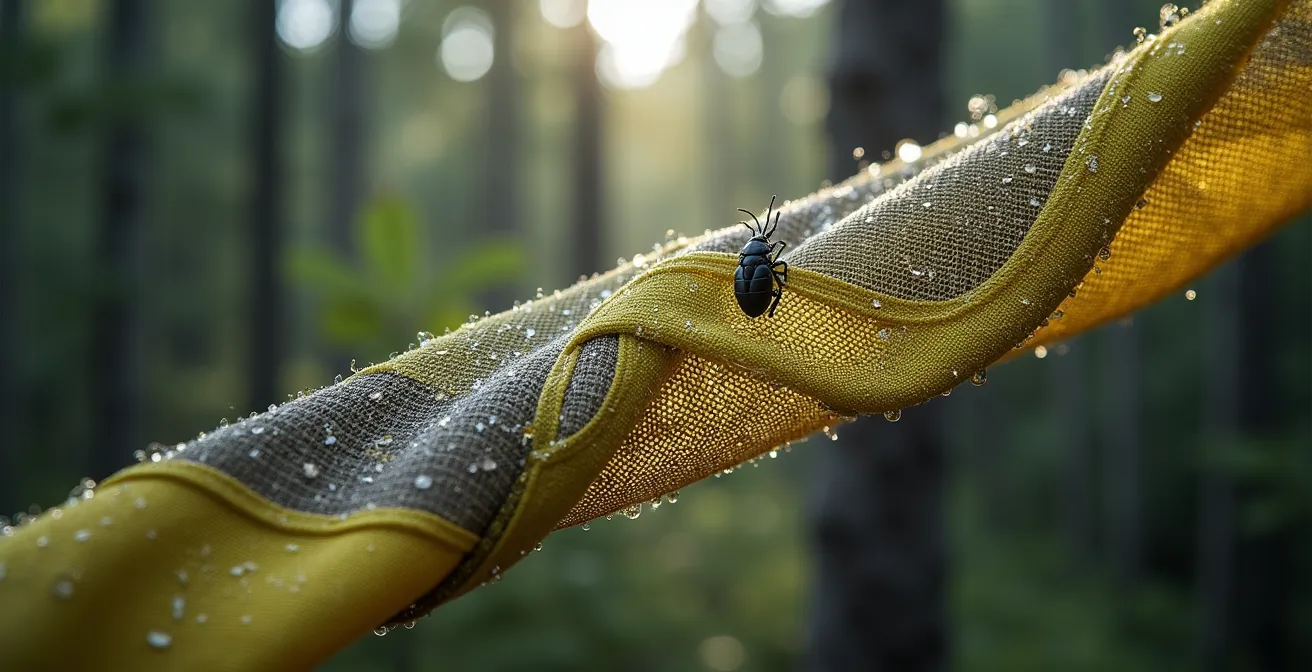
Your defence is a multi-layered system. It starts with permethrin-treated clothing, which repels and kills insects on contact. Over this, a full bug jacket with a head net is non-negotiable. This isn’t about fashion; it’s about creating a physical barrier that allows you to function and even enjoy the wilderness during peak season. A high-DEET repellent is necessary for any exposed skin, but relying on it alone is a rookie mistake. The sheer volume of insects will overwhelm chemical-only defences.
Beyond gear, your daily itinerary is your best weapon. Bugs are most active during the heat of the day and at dusk, especially near standing water. By adapting your schedule, you can significantly reduce your exposure and maintain your sanity:
- Early Morning (5-8 AM): The cool morning air keeps bug activity low. This is your prime window for hiking and exploration.
- Mid-day Refuge (12-3 PM): As temperatures and bug activity peak, retreat to naturally windy locations like the Salt Plains Overlook or the shore of Pine Lake. A breeze is your best friend.
- Evening Strategy (6 PM onwards): Avoid wetland trails. This is the time to be inside your vehicle, a screened tent, or to deploy a device like a Thermacell at your campsite, which creates a protective zone.
Why Can You Walk on a Glittering Red Desert in the Middle of Boreal Forest?
One of the most surreal experiences in Wood Buffalo National Park is stepping out of a dense, green boreal forest and onto a vast, glittering plain of red-tinged salt. It feels like you’ve been transported to a desert on Mars. This is not an illusion; it is a profound geological anomaly known as the Salt Plains. This landscape is one of the park’s most defining and photogenic features, a direct result of the unique geology hidden beneath your feet.
The spectacle is created by a simple but powerful natural process. The park sits atop a massive underground salt deposit left over from an ancient sea. Groundwater percolates deep into the earth, dissolving this salt and becoming highly saline. This saltwater is then forced back to the surface by geological pressure, emerging as springs. As the water evaporates under the sun and wind, it leaves behind a stark crust of salt crystals, covering an enormous area and creating an otherworldly environment.
The Unique Ecosystem of the Grosbeak Lake Salt Plains
The salt flats are a singular feature in Canada, a landscape sculpted by saline spring water. According to the UNESCO World Heritage Centre report, this process not only covers large areas but also creates fascinating salt pans and mounds that can rise up to two meters high. This extreme environment is not barren; it supports a host of specialized, salt-tolerant plants (halophytes) and attracts wildlife, creating a unique micro-ecosystem that thrives where little else can survive.
Walking on these plains is an unforgettable sensory experience. The ground crunches underfoot, the air tastes faintly of salt, and you can find rare red samphire plants and the tracks of bison and wolves that come here for the essential minerals. It is a powerful reminder that the wonders of this park are not just what you see, but are deeply connected to the ancient earth below.
Why is Wood Buffalo the World’s Largest Dark Sky Preserve?
Many parks in Alberta boast dark skies, but Wood Buffalo operates on a completely different scale. It’s not just a dark sky preserve; it is the world’s largest. The sheer size of this designation is staggering. In 2013, it was recognized by the Royal Astronomical Society of Canada, protecting an incredible 44,741 km² of protected darkness. To put that in perspective, that’s an area larger than Switzerland, completely free from the polluting glow of artificial light.
This isn’t just an abstract title. This massive buffer zone creates an environment of pristine darkness, a natural state that is now one of the rarest resources on the planet. In most places, even designated dark sky areas, a faint “sky-glow” from distant cities is visible on the horizon. Here, there is nothing. The blackness is absolute, allowing the human eye to perceive the night sky with a clarity that is simply impossible anywhere else in the easily accessible world. The Milky Way doesn’t just appear as a faint cloud; it is a brilliant, textured river of light, and countless more stars are visible than you’ve likely ever seen.
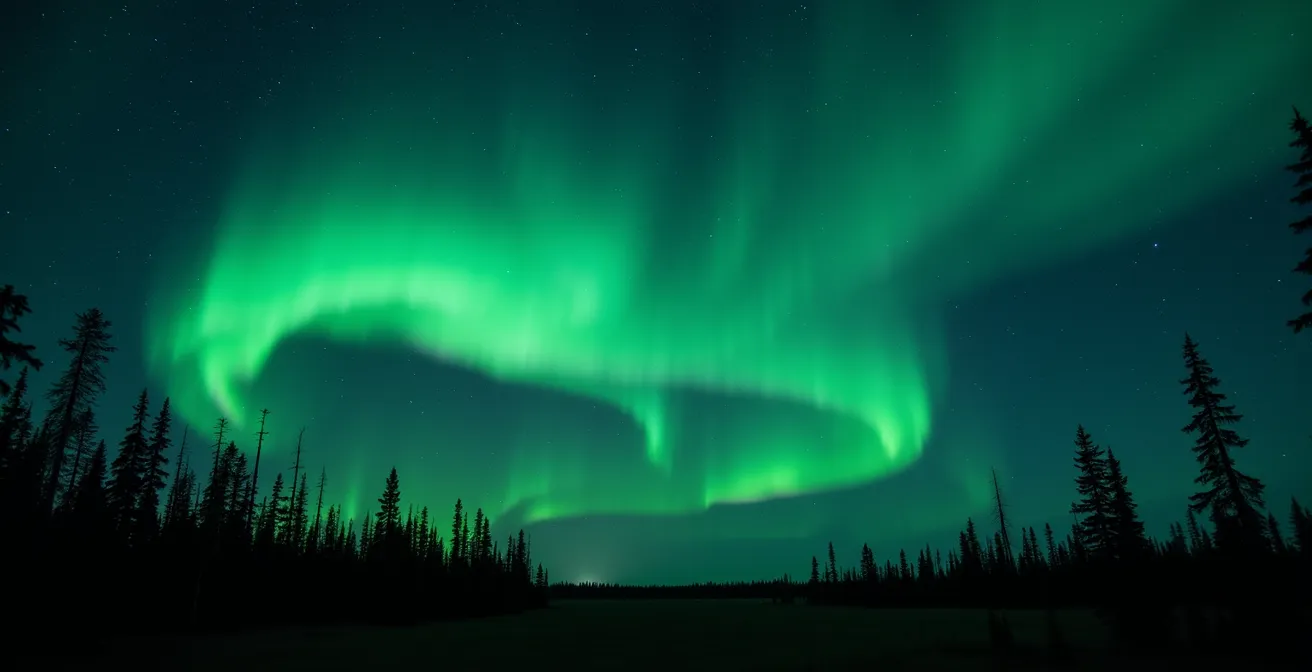
This perfect darkness makes the park one of the premier destinations on Earth for viewing the Aurora Borealis. When the northern lights ignite, they do so against a canvas of pure black, with no competing light to wash out the fainter colours and more subtle movements. The greens, pinks, and purples of the aurora appear more vibrant and detailed, creating a truly immersive and overwhelming spectacle. It’s a humbling experience that connects you directly to the cosmos, made possible only by the park’s immense scale and profound remoteness.
Fuel and Tires: What Emergency Gear Do You Need for Highway 35?
This is where the expedition mindset transitions from a philosophy to a practical, non-negotiable checklist. The journey into Wood Buffalo National Park, particularly along Highway 35 from Alberta, takes you into a region with extremely limited services. There is no cell coverage for hundreds of kilometres, and fuel stations are few and far between. Assuming you can “just wing it” is not just naive; it’s dangerous. Your vehicle is your lifeline, and preparing it for the worst-case scenario is a fundamental part of the trip.
First, let’s talk fuel. You cannot simply hope to find a gas station when your tank gets low. Planning your fuel stops is critical. Topping up your tank at the last reliable station is mandatory, and carrying extra fuel is highly recommended. As this analysis of the routes shows, the distances are significant.
| Route | Last Fuel Station | Distance to Park | Buffer Recommendation |
|---|---|---|---|
| From Alberta (Highway 35) | High Level | 267 km | Fill up + jerry can |
| From NWT (Highway 5) | Enterprise/Hay River | 204 km | Full tank required |
| From BC (Liard Highway) | Fort Nelson | 380 km | Extra fuel essential |
Beyond fuel, the gravel sections of the highways are notorious for eating tires. A simple flat can become a trip-ending disaster if you aren’t prepared. Your vehicle’s factory-standard donut spare is next to useless out here. You need a robust plan for tire emergencies, along with other critical safety gear.
Your Non-Negotiable Highway 35 Survival Checklist
- Tire Preparedness: Carry a full-size spare tire. A temporary donut will likely not survive the gravel roads to get you to the next service station. Also, pack a heavy-duty tire plug kit specifically designed for gravel road punctures and know how to use it.
- Communication: A satellite messenger device (like a Garmin inReach or SPOT) is essential. With no cell coverage for over 300 km on some stretches, this is your only link to help in an emergency.
- Fuel Buffer: Bring at least one 20L jerry can of extra fuel. This provides a critical buffer for the round trip from High Level and allows for unplanned detours or exploration within the park.
- Wildlife Collision Kit: The risk of hitting wildlife is real, especially at dawn and dusk. Your kit should include reflective safety triangles, a comprehensive first-aid kit, and an emergency blanket in case you are stranded.
- Vehicle Fluids & Tools: Carry extra coolant, oil, and a basic toolkit. On these remote roads, you are your own first-response mechanic.
Elk Island or Jasper: Which Dark Sky Preserve Offers Better Foreground Views?
For any Albertan adventurer, the question is logical: “Why drive 12 hours to Wood Buffalo when I can see the aurora from Jasper or Elk Island?” It’s a fair point. Both are designated Dark Sky Preserves and offer fantastic night sky experiences. The difference, however, lies in the *quality* of the darkness and the *uniqueness* of the viewing environment. While Jasper and Elk Island are excellent, Wood Buffalo offers an experience that is an order of magnitude more profound.
The primary advantage of more accessible parks is, well, their accessibility. But this comes at a cost. Elk Island, while beautiful, is so close to Edmonton that a noticeable dome of light pollution is visible on the southern horizon. Jasper, though much darker, is surrounded by massive mountain ranges. These majestic peaks create stunning silhouettes but also block the low northern horizon, which is often where aurora displays begin. As this comparison shows, each park offers a different trade-off between effort and reward.
| Park | Light Pollution | Aurora Visibility | Unique Foreground | Effort Level |
|---|---|---|---|---|
| Wood Buffalo | Zero sky-glow | 180° unobstructed | Salt plains reflections | Maximum (12hr drive) |
| Jasper | Minimal | Mountain-blocked low aurora | Mountain silhouettes | Moderate (4hr from Edmonton) |
| Elk Island | Edmonton dome visible | Good for strong displays | Lake reflections | Easy (1hr from Edmonton) |
The true game-changer for Wood Buffalo is its geomagnetic advantage. Due to its high latitude, it sits much closer to the auroral oval, the ring around the magnetic pole where aurora activity is concentrated. This means you don’t need a major geomagnetic storm to get a spectacular show. A National Geographic report highlights that Wood Buffalo requires only a Kp 3-4 index for strong displays, a level that might barely register on the horizon in Jasper. This dramatically increases your odds of witnessing a world-class light show. Add to that the park’s unique foregrounds—like capturing the aurora reflecting off the crystalline salt plains—and you have a photographic opportunity that simply cannot be replicated anywhere else.
Iron and Fat: Why is Bison Recommended for Heart Health?
Nutritionally, wood bison meat is often lauded for its health benefits. As a wild, grass-fed animal, its meat is exceptionally lean, lower in fat and cholesterol, and higher in iron and omega-3 fatty acids compared to commercially raised beef. For the health-conscious explorer, it is an excellent source of protein. But to focus only on its nutritional profile is to miss the deeper significance of this animal. The true value of the Wood Bison is not just in its meat, but in its role as a cornerstone of both the ecosystem and the culture of this land.
This is a wild animal in the truest sense. Unlike farmed populations, the approximately 2,800 free-ranging wild wood bison in Alberta live as they have for thousands of years, shaping the landscape through their grazing patterns. Their presence is a sign of a healthy, functioning boreal ecosystem. Consuming bison here is not just a meal; it’s a direct connection to the local food web and a taste of the wild landscape itself.
The Cultural Keystone: Indigenous Traditional Use of Bison
For local Dene, Cree, and Métis peoples, the Wood Bison is far more than just a food source; it is a cultural keystone. The annual bison hunt was a significant community event that provided not just meat, but materials essential for survival and culture. According to a Government of Canada report, bison fat, or tallow, was traditionally rendered and used for a multitude of purposes. It was a key ingredient in making pemmican—a high-energy food vital for long journeys—but also served as a base for traditional medicines and as a waterproofing agent for moccasins and canoes. Every part of the animal held a purpose and a meaning, weaving it into the very fabric of life in the north.
So, while bison is indeed a heart-healthy choice, its true importance is far greater. It represents a connection to wildness, a history of survival, and a deep cultural heritage. Understanding this context transforms a simple meal into a profound experience, adding another layer of meaning to the journey.
Key Takeaways
- The journey is the destination: The long drive filters out casual tourism, preserving a raw, authentic wilderness experience.
- Unique natural phenomena: From genetically pure Wood Bison to vast, otherworldly salt plains, the park’s offerings are truly one-of-a-kind.
- Unparalleled aurora viewing: Its status as the world’s largest dark sky preserve combined with its high latitude offers the best chance to see the northern lights in Alberta.
- Preparation is paramount: This is an expedition, not a casual road trip. A survival mindset and proper gear for fuel, tires, and communication are non-negotiable.
Aurora Borealis in Alberta: How to Forecast and Photograph the Lights?
Witnessing the Aurora Borealis is a bucket-list item for many, but capturing a great photograph of it requires more than just luck. It requires planning, patience, and a basic understanding of both forecasting and camera settings. While Wood Buffalo offers a world-class stage, you still need to know when the performance is likely to start. The key is to monitor space weather, specifically the Kp-index, which is a scale from 0 to 9 that measures geomagnetic activity.
Apps like “My Aurora Forecast” or websites like the NOAA Space Weather Prediction Center are essential tools for any aurora chaser. They provide real-time data on solar wind speed, density, and the all-important Kp-index. For southern Alberta, you might need a Kp of 5 or higher for a decent show. As we’ve seen, in Wood Buffalo, a Kp of 3 or 4 can be enough for a sky-filling display, dramatically increasing your chances. The best time to watch is between 10 PM and 3 AM on a clear, moonless night.
Once the forecast looks promising, your photographic technique comes into play. You don’t need a professional-grade camera, but you do need one with manual controls. Your essential gear includes a sturdy tripod, as you’ll be using long exposures, and the widest, fastest lens you have (e.g., a 24mm f/2.8 or wider). The basic settings to start with are: set your focus to infinity (manually, using live view to focus on a bright star), open your aperture as wide as possible (e.g., f/1.8), set your ISO between 1600 and 3200, and start with an exposure time of 15-20 seconds. From there, you can adjust your shutter speed and ISO to get the perfect exposure without making the stars trail. Capturing the aurora is a dance between light and time, a final, rewarding challenge at the end of a long road.
Frequently Asked Questions About a Wood Buffalo Expedition
When is the best time to see aurora at Wood Buffalo?
The absolute best months for viewing the Aurora Borealis are January and February. This is due to the long, dark nights and typically clearer skies. Be prepared for extreme cold, as temperatures often hover between -25°C and -30°C (-13°F to -22°F), which demands serious winter gear.
What makes Wood Buffalo superior for aurora photography?
Two main factors: its designation as the world’s largest dark sky preserve means there is absolutely zero light pollution, allowing your camera to capture fainter colours and details in the aurora. Secondly, the unique landscape of the salt plains provides an incredible foreground, allowing you to capture stunning reflections of the northern lights on the salt-crusted ground.
Where are the best viewing spots within the park?
For the best chance to see and photograph the aurora, head to locations with a clear, unobstructed view of the northern horizon. Pine Lake and the Salt River Day Use Area are two of the most recommended spots. Their wide-open vistas are essential for capturing aurora displays that often start low on the horizon before moving overhead.
The maps are there. The gear lists are clear. The only remaining question is not whether the park is worth the effort, but whether you’re ready to answer the call of a true northern expedition. Plan your journey, embrace the challenge, and discover what lies beyond the end of the road.