
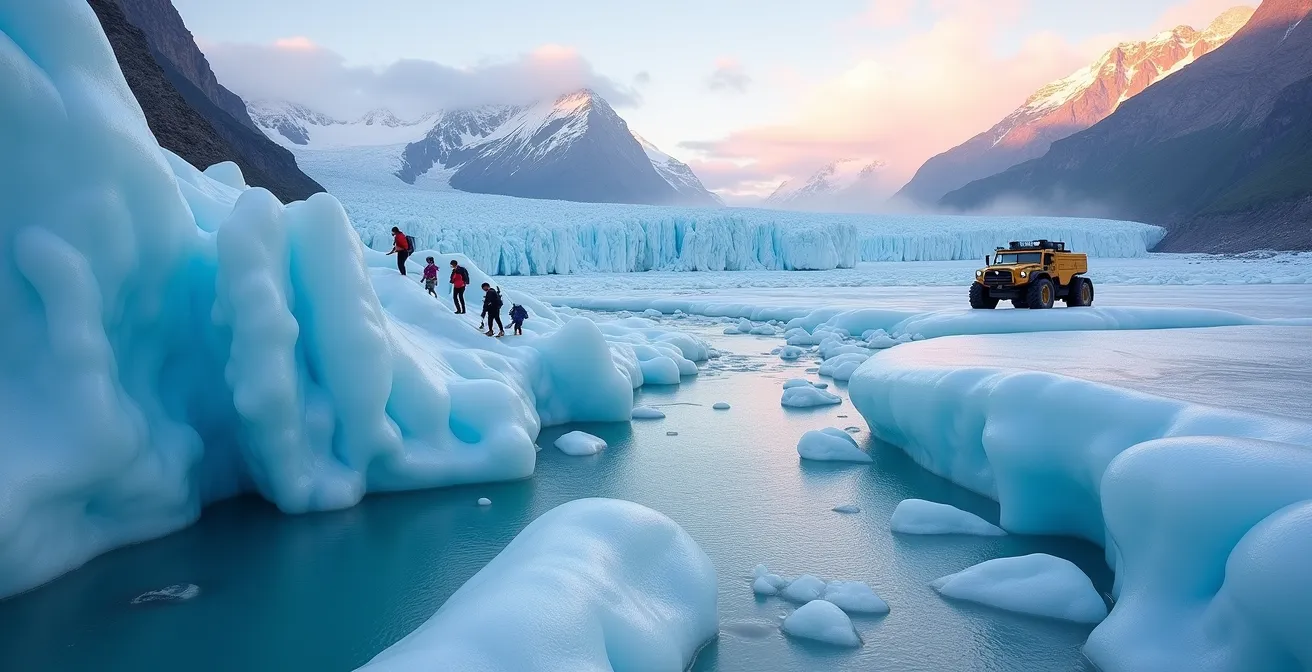
The choice between the Ice Explorer and the Guided Hike isn’t about adventure vs. comfort, but about the experiential return you demand for your $100+ investment.
- The Ice Explorer bus offers a quick, accessible overview for a high-volume crowd, perfect for a photo op and ticking a box.
- The Guided Hike provides a slower, deeper, and more genuine geological connection, offering a greater sense of scale and solitude.
Recommendation: If you want a quick taste and a memorable photo, the bus tour is efficient. For a truly profound understanding of the glacier’s power and fragility, the Guided Hike delivers a far superior experiential ROI.
The Icefields Parkway in Alberta presents a dazzling, and expensive, dilemma. With every curve revealing another postcard-perfect vista, time and money are your most precious resources. At the heart of it all lies the Columbia Icefield, where two flagship experiences compete for your attention and a significant chunk of your travel budget: the massive Ice Explorer bus and the intimate Guided Ice Hike. Standard advice often frames it as a simple choice: the bus is for families, and the hike is for the fit and adventurous. But this oversimplifies a crucial financial and experiential decision.
When a ticket pushes past the $100 mark, the question is no longer just “What will I see?” but “What value will I receive?” This guide moves beyond the marketing brochures to offer a critical, budget-focused analysis. We’ll dissect the experiential return on investment (ROI) of each tour, contrasting the engineered, high-volume bus ride with the raw, natural connection of walking on the ice. Is the goal a quick, impressive photo, or is it a deeper understanding of a disappearing natural wonder? The answer determines which tour is truly “worth it” for you.
This article breaks down the critical factors to consider, from safety and timing to the value of surrounding attractions, to help you make an informed decision that aligns with your budget and travel philosophy. Explore the sections below to determine which experience offers the best return on your investment.
Summary: Deciding on Your Columbia Icefield Experience
- Why Walking on the Glacier Without a Guide is a Death Wish?
- Morning or Afternoon: When is the Best Light on the Athabasca Glacier?
- Is the Glass Floor Skywalk Worth the Stop or Just a Tourist Trap?
- How Much Has the Toe of the Glacier Receded Since Your Last Visit?
- Shorts in the Parking Lot, Parka on the Ice: How to Dress for the Tour?
- North to South or South to North: Which Direction Offers Better Views?
- Why Is the Athabasca Glacier 1.5km Further Away Than in 1844?
- The Hike to the Wolf Head: Is the Viewpoint Worth the Steep Walk?
Why Walking on the Glacier Without a Guide is a Death Wish?
From the parking lot, the Athabasca Glacier looks like a walkable, gentle river of ice. This is a dangerous illusion. Venturing past the designated safety barriers onto the ice without a certified guide is not just prohibited by Parks Canada; it’s a life-threatening gamble. The seemingly solid surface hides a network of hidden dangers, including deep crevasses and glacial moulins—vertical shafts carved by meltwater. Professional certified guides explain that these glacier formations can plunge hundreds of meters deep into the ice, often concealed by a thin, fragile layer of snow.
An accredited guide, typically certified by the Association of Canadian Mountain Guides (ACMG), possesses the training and equipment to navigate this treacherous terrain safely. They understand how to read the ice, identify weak snow bridges, and manage the risks. The choice isn’t between a guided walk and a free walk; it’s between a structured, safe experience and a reckless, potentially fatal one. The cost of a guided tour includes not just expertise but also essential safety equipment, insurance, and the peace of mind that comes with it. Attempting to go it alone means facing invisible dangers with zero support, where a rescue operation could cost you thousands and void any travel insurance.
This table starkly illustrates the difference, making it clear that the only safe way to set foot on the glacier is with a professional.
| Aspect | Guided Tour | Unguided Access |
|---|---|---|
| Crevasse Detection | Professional equipment & training | Invisible dangers under snow |
| Legal Status | Fully permitted by Parks Canada | Prohibited beyond safety fence |
| Insurance Coverage | Included in tour | Voided by most policies |
| Rescue Costs | Covered | Personal liability (thousands) |
Morning or Afternoon: When is the Best Light on the Athabasca Glacier?
Choosing between a morning or afternoon tour isn’t just about your schedule; it’s about the quality of your experience, especially for photography. The light and ice conditions on the Athabasca Glacier change dramatically throughout the day, influencing both the views and the feel of the landscape. Early morning tours typically offer the best photographic potential. The low-angle sun creates crisp, side-lighting that accentuates the textures and deep blue colors within the ice formations. Views of the surrounding peaks, like Mount Athabasca, are often clearer before daytime heat and potential wildfire smoke settle in the valley.
Conversely, late afternoon can provide its own magic. The coveted ‘alpenglow’ can cast a warm, pink hue on the snow-covered mountains, creating a spectacular backdrop. However, the trade-off is often slushier ice conditions as the sun melts the surface throughout the day. During Alberta’s wildfire season, typically July and August, morning is almost always the superior choice for visibility. Furthermore, be prepared for a significant temperature shift. Powerful katabatic winds, where cold, dense air flows down the glacier’s surface, mean the temperature on the ice can be drastically lower than in the parking area. It’s not uncommon for these katabatic wind effects to create temperatures that are 15°C cooler, a crucial factor in how you dress and when you choose to go.
Ultimately, the “best” time depends on your priority. For serious photographers seeking dramatic ice detail and clear mountain vistas, morning is unbeatable. For those hoping for a chance at a colourful alpine sunset, the late afternoon holds promise, provided the weather and air quality cooperate.
Is the Glass Floor Skywalk Worth the Stop or Just a Tourist Trap?
The Columbia Icefield Skywalk is an engineering marvel, a crescent of glass and steel suspended high above the Sunwapta Valley. But from a budget-conscious perspective, is it an essential experience or an expensive, engineered add-on? The value proposition here is entirely about perspective. For a separate admission fee (or bundled with the Ice Explorer), you get to step out onto a platform that hangs 35 metres from the cliff edge. The sensation of standing on glass with a clear view down is undeniably unique. An analysis of public records confirms the glass-floor platform height and extension measurements show a drop of 280 metres (918 feet) to the valley floor below.
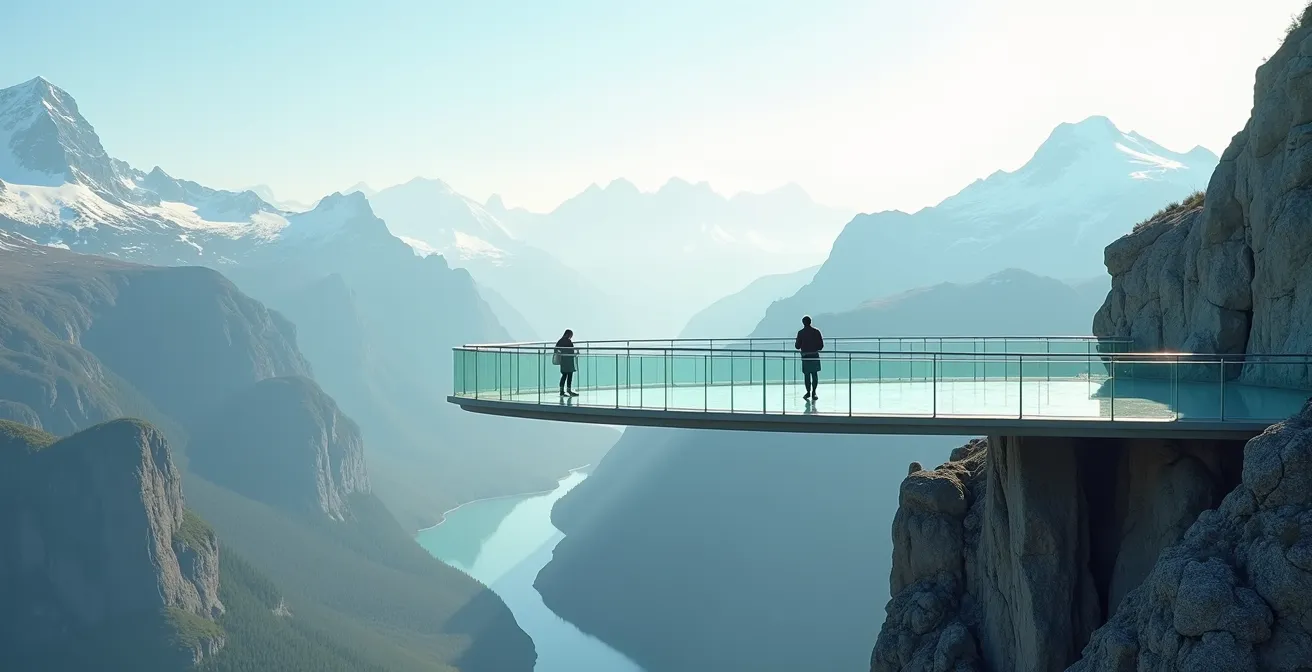
However, critics argue that the Icefields Parkway is already lined with dozens of free, equally stunning viewpoints that don’t require a ticket. The core of the Skywalk’s “experiential ROI” lies in the included audio guide and interpretive displays, which offer lessons in geology, biology, and human history. For some visitors, this educational component elevates the experience beyond a simple photo opportunity. As one visitor noted in a review:
Worth every penny! Knowledge of history and geology brought tools to give appreciation of immense challenge
– GoPlaces285613, Tripadvisor Review
The verdict? If your goal is a thrilling, man-made perspective and a structured lesson on the region, the Skywalk can feel worth the price. If you are a purist seeking natural, unmediated views of the Rockies, your money and time might be better spent at a free viewpoint like the one at Peyto Lake or Parker Ridge, which offer arguably more impressive panoramic vistas without the crowds or cost.
How Much Has the Toe of the Glacier Receded Since Your Last Visit?
The Athabasca Glacier is not a static landmark; it’s a dynamic, shrinking giant. A visit here is a front-row seat to the tangible effects of climate change. The glacier has lost over half its volume in the past 125 years and has receded more than 1.5 kilometers, leaving behind a stark, rocky moraine. This rapid retreat is a powerful, and somber, part of the experience. Parks Canada has placed a series of dated markers along the path to the glacier’s toe, allowing you to physically walk through time and witness the dramatic scale of the loss. Seeing the marker for 1890 standing far out in the valley, where today there is only rock and a distant wall of ice, is a profound moment.
This isn’t a phenomenon that’s slowing down. On the contrary, the pace is accelerating. This visible retreat is a stark reminder that this landscape is finite. Some grim climate models suggest that 90% of Alberta’s glaciers may disappear by 2100, transforming this iconic Canadian landscape forever. This context adds a layer of urgency and significance to any visit, shifting it from mere sightseeing to bearing witness. The story of the glacier’s retreat is as important as the ice itself.
Case Study: The Parking Lot That Was Once Glacier
To truly grasp the speed of the retreat, consider this: in the 1980s, the very spot where the current tourist parking lot is located would have been buried under several hundred feet of solid ice. Every step you take from your car towards the glacier’s current toe is a walk across land that was, within the lifetime of many visitors, part of the glacier itself. This single fact often provides a more visceral understanding of climate change than any chart or graph.
To fully appreciate this aspect of your visit, take the time to observe the signs of retreat. Note the dated markers, the barren landscape of crumbled rock that plants have yet to colonize, and consider that this melting ice feeds the North Saskatchewan River, a vital water source for cities like Edmonton. Seeing the glacier is one thing; understanding its retreat is another.
Shorts in the Parking Lot, Parka on the Ice: How to Dress for the Tour?
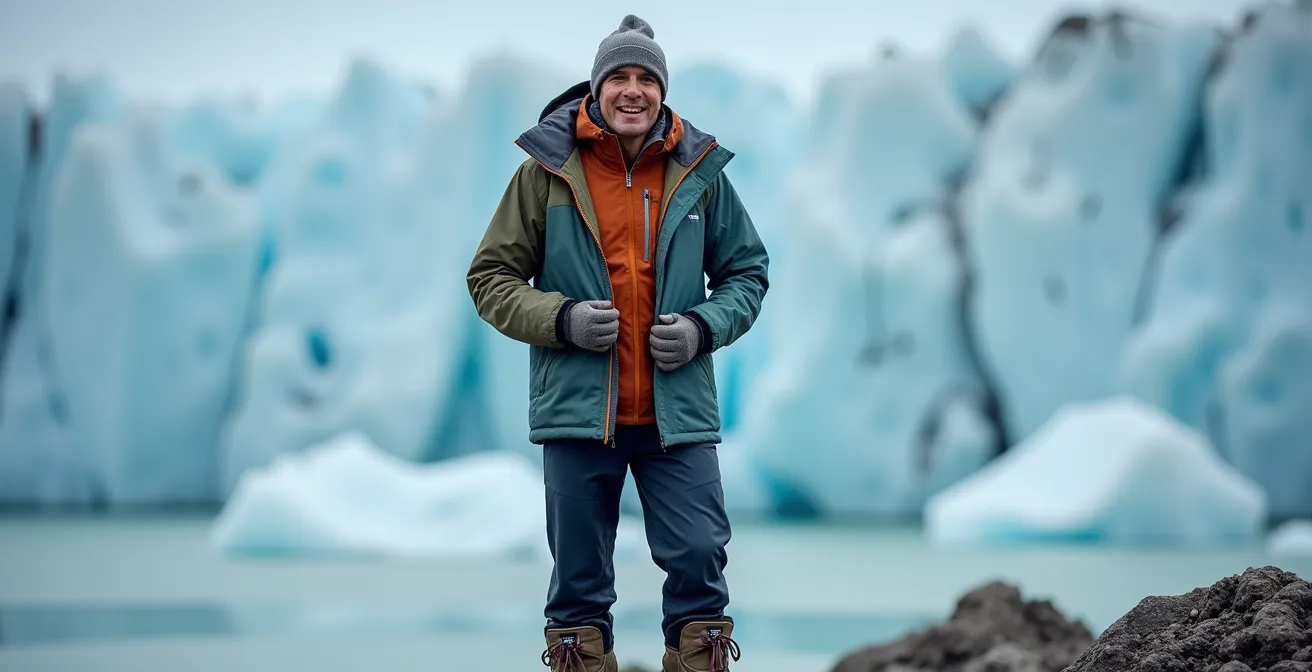
One of the biggest mistakes visitors make at the Columbia Icefield is underestimating the weather. It’s a classic scene: tourists shivering in shorts and t-shirts on the ice while the temperature plummets. A sunny, 20°C day in the parking lot can feel like a winter day on the glacier itself due to the aforementioned katabatic winds and the reflective power of the ice. Proper attire isn’t just about comfort; it’s about safety and being able to fully enjoy your expensive tour.
The key is layering. Do not simply bring a heavy winter coat. The best approach is a three-layer system that you can adjust as conditions change:
- Base Layer: A moisture-wicking material (like merino wool or a synthetic fabric) that pulls sweat away from your skin to keep you dry and warm. Avoid cotton, as it retains moisture and will make you cold.
- Mid-Layer: An insulating layer, such as a fleece or a lightweight down jacket, to trap body heat.
- Outer Layer: A waterproof and windproof shell. This is arguably the most critical layer, as it protects you from the biting wind and any potential rain or snow, even in August.
Beyond clothing, other items are essential. Sturdy, closed-toe footwear is a must—hiking boots are ideal. Sunglasses are non-negotiable to protect against the intense glare off the ice, and sunscreen is surprisingly vital. Finally, a hat and gloves are small items that make a huge difference in comfort. Being properly dressed allows you to focus on the incredible surroundings, not on how cold you are.
North to South or South to North: Which Direction Offers Better Views?
The Icefields Parkway is consistently recognized as one of the most scenic drives in the world with over 100 visible glaciers along 232km route. A common debate among travelers is which direction offers the superior experience: driving from Banff to Jasper (south to north) or from Jasper to Banff (north to south)? From a purely practical standpoint, the Columbia Icefield is slightly closer to Jasper (108 km) than Lake Louise (125 km). But the real difference lies in the visual narrative of the drive.
Driving south to north (from Banff/Lake Louise towards Jasper) is often described as a journey of dramatic reveals. Key attractions like Bow Lake and the iconic Peyto Lake viewpoint appear early in the drive. As you approach the Columbia Icefield, the massive glaciers seem to burst into view around mountain bends, creating a series of “wow” moments. This direction builds anticipation effectively.
In contrast, driving north to south (from Jasper towards Banff) offers a different kind of grandeur. The dominant peaks of the Columbia Icefield, like Mount Athabasca and the Dome Glacier, are visible from a great distance, looming on the horizon for a significant portion of the drive. This creates a sense of approaching something immense and powerful. You also encounter attractions like Sunwapta and Athabasca Falls first, saving the high-alpine lake scenery for the latter half of the journey. There’s no single “better” direction; it’s a matter of personal preference for either surprise reveals or a long, majestic approach.
This comparative table breaks down the key differences to help you decide which driving narrative best suits your travel style.
| Aspect | South to North (Banff to Jasper) | North to South (Jasper to Banff) |
|---|---|---|
| Glacier Views | Dramatic ‘reveals’ around bends | Columbia Icefield peaks visible longer |
| Distance to Columbia Icefield | 125km from Lake Louise | 108km from Jasper |
| Key Stops En Route | Bow Lake, Peyto Lake first | Sunwapta Falls, Athabasca Falls first |
| Morning Wildlife | Valley bottoms more visible eastside | Different angle for western valleys |
Why Is the Athabasca Glacier 1.5km Further Away Than in 1844?
The staggering 1.5-kilometer retreat of the Athabasca Glacier since 1844 is a direct consequence of a simple equation: the rate of melting at its toe (ablation) has far outpaced the rate of new ice formation at its source. A glacier is a living river of ice, constantly flowing downhill under its own weight. For it to remain stable, the amount of snow accumulating in the upper icefield, or névé, must be enough to offset the melting at the lower end. For decades, this balance has been critically disrupted.
The process of creating glacial ice is incredibly slow. Snow that falls high up in the Columbia Icefield is gradually compressed by the weight of subsequent snowfalls. Over time, it transforms from fluffy snow to granular firn, and eventually to dense, blue glacial ice. Astonishingly, it takes at least 200 years for snow to convert into glacier ice that begins its slow journey down the valley. This means the ice melting at the glacier’s toe today began as snowfall during the Napoleonic Wars. The glacier’s flow is simply not fast enough to replace the ice being lost to warmer summer temperatures and less winter snowfall.
What we are witnessing is a dramatic and visible imbalance. The glacier’s “budget” is in a severe deficit. It is spending (melting) far more ice than it is earning (accumulating). This is why the toe recedes further up the valley each year, leaving a trail of rock and a stark visual record of our warming climate. Understanding this glacial budget is key to comprehending why the landscape is changing so rapidly before our eyes.
Key Takeaways
- The decision between the Ice Explorer and the Guided Hike hinges on your desired experiential return on investment: a quick overview versus a deep, immersive connection.
- Safety is non-negotiable. Walking on the glacier without a certified guide is illegal and extremely dangerous due to hidden crevasses and moulins.
- The rapid retreat of the Athabasca Glacier is a central part of the story, offering a powerful, real-time lesson on climate change.
The Hike to the Wolf Head: Is the Viewpoint Worth the Steep Walk?
While the Ice Explorer and guided walks command the most attention, some of the most rewarding experiences at the Columbia Icefield are found on the surrounding hiking trails. These viewpoints offer a different kind of experiential ROI: they are free, require physical effort, and reward you with breathtaking panoramas and a sense of solitude that’s impossible to find on a tour bus. Hikes like Wilcox Pass and Parker Ridge provide elevated perspectives of the glaciers that you simply cannot get from the valley floor.
The Wilcox Pass trail, often referred to as the “hike to the wolf head” due to the shape of the ridge, is a local favorite. It’s a steep walk, climbing steadily through forest before emerging into a vast alpine meadow. From here, you are treated to a jaw-dropping, head-on view of the entire Athabasca Glacier tongue and the surrounding peaks. It provides a sense of scale and context that is difficult to grasp when you’re standing on the ice itself. Another excellent option is the Parker Ridge hike, which involves a series of switchbacks leading to fantastic views of the massive Saskatchewan Glacier, a different glacier fed by the same icefield.
Is the effort worth it? Absolutely, provided you are prepared. These are high-elevation hikes where the air is thin and the weather can change in an instant. The “steep walk” is a genuine challenge for those not accustomed to mountain hiking. However, for the investment of a few hours and some sweat, the payoff is an unparalleled vista, free from crowds, and a profound sense of accomplishment.
Action Plan: Maximizing Viewpoint Hikes
- Start early: Begin your hike in the morning for the best light conditions on the glaciers and to secure a parking spot.
- Pack layers: As you gain elevation, your exposure to wind and colder temperatures will increase dramatically. A windproof shell is essential.
- Budget time: Allow 3-4 hours for a round trip on most of these viewpoint hikes to avoid rushing and to fully enjoy the summit.
- Assess your fitness: Be honest about your physical condition. The steep sections at high elevation can be very strenuous.
- Bring binoculars: They are invaluable for observing the intricate details of the glacier’s surface—crevasses, icefalls, and seracs—from a safe distance.
Ultimately, your choice on how to experience the Columbia Icefield comes down to a personal calculation of value. Weigh these factors against your own travel style, physical ability, and budget to make an informed decision that will ensure your time on the iconic Icefields Parkway is unforgettable.
Frequently Asked Questions about Columbia Icefield Tours
What footwear is required for the guided hike?
Wear waterproof or water-resistant shoes or hiking boots with good traction. The tour operators, like IceWalks, provide microspikes (crampons) that fit over your own footwear to ensure a secure grip on the ice.
Do I need special gear in summer?
Yes. Even on a clear summer day, you must bring waterproof outer layers, a hat, and gloves. Sunglasses and sunscreen are also essential due to the intense glare reflecting off the vast expanse of ice.