
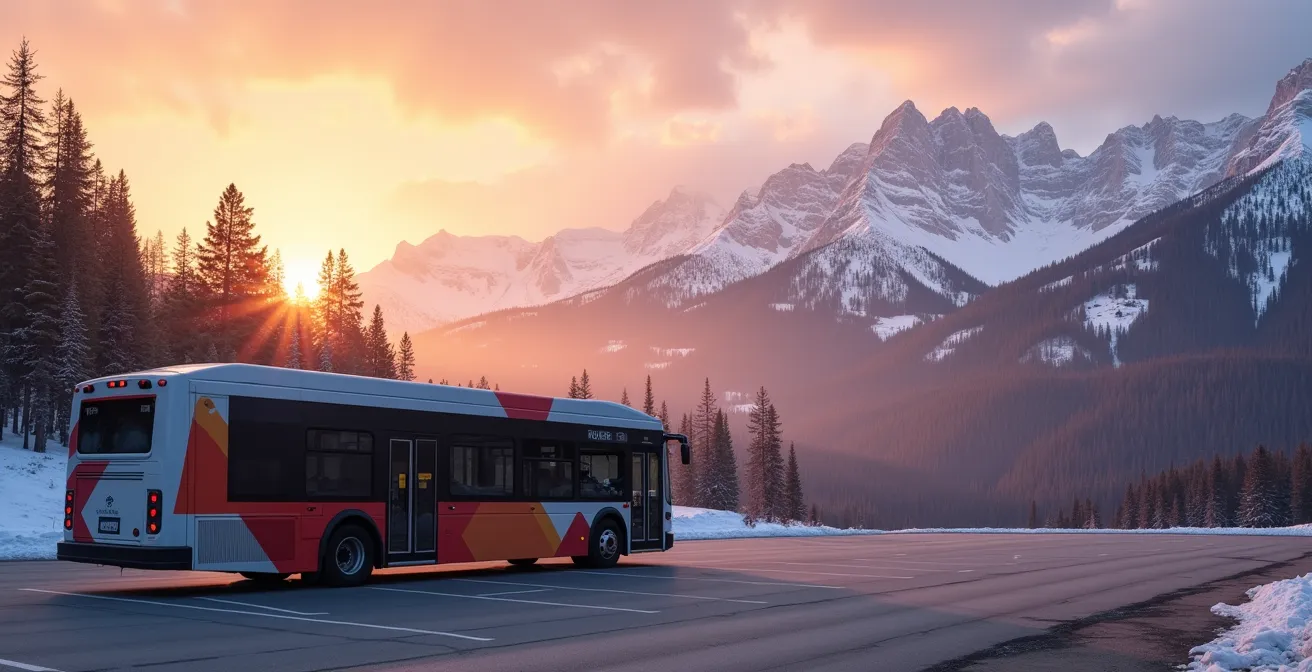
The overwhelming fear of the Lake Louise parking fiasco and 4 AM wake-up calls prevents many from enjoying one of Canada’s most stunning vistas. The solution isn’t luck or losing sleep; it’s a strategic approach. By understanding the logistics of the shuttle system, predictable crowd patterns, and the real value of on-site experiences, you can build a flexible, stress-free plan that guarantees you’ll see the lake, even if things don’t go perfectly on the first try.
The turquoise water, the hanging Victoria Glacier, the sheer grandeur of the Rockies—the image of Lake Louise is iconic. Yet, for many visitors to Alberta, the dream is overshadowed by a logistical nightmare: the infamous parking situation. Stories of lots filled before sunrise and cars being turned away by the hundreds create a level of anxiety that can tarnish the entire experience. Most advice boils down to “get there before 5 AM” or “book a shuttle,” but this misses the point.
The real challenge isn’t just access; it’s crafting an enjoyable day without succumbing to the pressure of the crowds. Visiting Lake Louise isn’t a battle to be won at dawn. It’s a logistical puzzle that, once solved, opens up a world of possibilities beyond just getting that one photo from the shoreline. The key isn’t to beat everyone else to the parking lot, but to adopt a strategic mindset. It’s about understanding the system’s predictable patterns and using them to your advantage—a concept we’ll call “logistical arbitrage.”
This guide will move beyond the generic tips. We won’t just tell you *what* your options are; we will break down the *why* and *how* behind each choice. We’ll explore the precise timing of shuttle ticket releases, analyze the real value of experiences like the tea house hike and canoe rentals, and reveal how to use “crowd aikido” to find serenity even on the busiest days. You will learn to think like a Banff logistics expert, armed with a framework to build a resilient and memorable visit.
This article provides a complete strategic framework for your visit, from securing transport to making the most of your time at the lake. Explore the sections below to master each component of your plan.
Summary: Your Strategic Guide to Visiting Lake Louise, Stress-Free
- Parks Canada Shuttle: When Exactly Are the “Last Minute” Tickets Released?
- Tea House Hike: Is the Trek to Lake Agnes Worth the Effort?
- Skating on Lake Louise: Do You Need to Bring Your Own Skates?
- The Shoreline Reality: How to Look Past the Wall of Selfies?
- Is the $150 Canoe Rental at Lake Louise a Rip-off or a Memory?
- June or August: When is the Water Colour at Its Most Vibrant?
- Roam Transit vs Private Commercial Bus: Which Moraine Lake Shuttle is Reliable?
- How to Visit Moraine Lake Now That Private Cars Are Banned?
Parks Canada Shuttle: When Exactly Are the “Last Minute” Tickets Released?
The Parks Canada shuttle is the primary, most reliable way to access Lake Louise. While a large portion of tickets are released in the spring and sell out quickly, many visitors don’t realize there’s a second, predictable opportunity. The key to logistical arbitrage is knowing precisely when the remaining seats become available. According to Parks Canada’s official reservation system, 60% of daily shuttle seats are released exactly 48 hours in advance, at 8:00 AM Mountain Daylight Time (MDT).
This isn’t a game of random luck; it’s a game of speed and preparation. Securing these “last-minute” tickets requires a methodical approach, as they are often gone within minutes. Success means having your accounts set up, your payment information saved, and your fingers ready at the exact moment of release. Being logged in on multiple devices (a phone and a laptop, for example) can significantly increase your chances, as one device might refresh a fraction of a second faster than the other. This process is the single most important tactic for visitors who did not book months ahead.
Don’t be discouraged if your top time slot is gone instantly. The goal is simply to secure a ticket to the lake; you can adjust your hiking and activity plans around the shuttle time you get. Viewing the 8 AM release as a strategic opportunity rather than a desperate last resort is the first step in taking control of your Lake Louise visit.
Your Action Plan: The 8 AM Ticket Scramble
- Contact Points: Create your Parks Canada account using GC Key or another login method well before the release day. This is your primary point of contact with the reservation system.
- Asset Collection: Before 8 AM, log in on multiple devices (e.g., your phone and a computer) and ensure your payment details are pre-saved to eliminate friction during checkout.
- Plan Cohesion: Navigate to the shuttle reservation page and pre-select your desired date (which will be exactly 48 hours from the current day). This aligns your plan with the system’s live availability.
- Execution & Malleability: At exactly 8:00 AM MDT, refresh the page on all devices simultaneously. Be prepared to select your second or third choice time slot immediately, as the most popular times vanish in seconds.
- Integration & Confirmation: Once a time slot is in your cart, you must complete the checkout within the 2-minute timer. A ticket in your cart is not a confirmed booking until payment is finalized.
Tea House Hike: Is the Trek to Lake Agnes Worth the Effort?
Once at Lake Louise, the most popular activity beyond the shoreline stroll is the hike to the Lake Agnes Tea House. The question of whether it’s “worth it” depends entirely on managing expectations. This isn’t a casual walk; it’s a moderately challenging 3.5 km uphill hike with a 400m elevation gain, typically taking 1 to 2 hours one way. The reward is not just the destination but the journey itself, which offers increasingly beautiful views back over Lake Louise as you climb.
The tea house, a rustic family-run cabin operating since 1905 without electricity, sits at an elevation of 2,135 meters. It serves over 100 varieties of tea, soup, and homemade baked goods to hikers from early June to October. The charm is undeniable, but so are the crowds. Visitor analysis shows that arriving before 10:30 AM is crucial to avoid the longest queues, which can exceed 30 minutes during the peak season of July and August. The experience is about earning your cup of tea and enjoying a piece of history in a spectacular alpine setting.
The hike provides a powerful lesson in “crowd aikido”—by investing the physical effort to climb away from the main shoreline, you enter a different, more rewarding tier of the Lake Louise experience. The view from the top, looking down on the turquoise jewel of Lake Agnes, is a memory that far outweighs the muscle burn.

As the image shows, the tea house is nestled in a stunning alpine cirque. For those with extra energy, continuing the hike up to the Little Beehive or Big Beehive lookouts offers an even more breathtaking panorama of the entire valley. The effort is significant, but the payoff in views and tranquility is immense.
Skating on Lake Louise: Do You Need to Bring Your Own Skates?
Visiting Lake Louise in winter offers a completely different, yet equally magical, experience. The turquoise water freezes into one of the world’s most scenic skating rinks, complete with an ice castle and groomed skate tracks. For visitors, the logistical question is whether to haul their own skates to Alberta. The simple answer is no; renting is both convenient and relatively affordable. You have two primary options: on-site or in the village.
Renting directly at the lake from the Fairmont Chateau’s rental shop is the most convenient option, with pricing based on 2024-2025 winter season pricing data around $15 CAD for a two-hour rental. Alternatively, shops in the Lake Louise village or in Banff town offer daily rentals for a similar price ($12-$14 CAD), which can be more economical if you plan to skate for more than a couple of hours or visit other skating locations. The trade-off is convenience versus cost-effectiveness for longer durations.
However, the quality of your skating experience depends more on *when* you go than where you get your skates. Ice conditions vary significantly throughout the season:
- Mid-December: The season officially kicks off. The famous ice castle is built, and the Zamboni begins daily maintenance, creating a pristine surface.
- January: This is the peak of ice quality. Consistently cold temperatures (-15°C to -25°C) ensure the ice is hard, smooth, and fast.
- February: Conditions remain excellent. The Ice Magic Festival adds stunning ice sculptures to the shoreline, but the Family Day long weekend can be extremely busy.
- March: The experience changes. Warmer afternoon temperatures (up to +5°C) can create slushy surfaces. The best skating is in the morning before the sun softens the ice.
- Early April: The season typically concludes around April 15th. It’s essential to check the Fairmont’s webcam for real-time conditions before heading up.
Choosing the right time of day in March, or the right month of the season, is the real logistical secret to a perfect skate on Lake Louise.
The Shoreline Reality: How to Look Past the Wall of Selfies?
The first view of Lake Louise from the main viewing area can be both breathtaking and disheartening. You’ve made it, but so has everyone else. The first 100 meters from the parking lot and shuttle drop-off are often a dense wall of people, cameras, and selfie sticks. The strategic error most visitors make is assuming this is the only experience. The reality is that this “wall of selfies” is incredibly thin.
This is where “Crowd Aikido” becomes a powerful tool. Instead of fighting for space at the front, you simply use the crowd’s inertia against itself by walking away from it. Visitor behavior data is clear: the crowds thin out exponentially the further you walk. A study of visitor patterns shows that while 50-85% of visitors attempting to park are turned away in peak hours, the vast majority of those who do arrive stay near the entrance. The crowd density can thin by as much as 90% for those who walk the flat 1.5 km shoreline trail to the back of the lake.
At the far end, where the glacial meltwater feeds the lake, the noise fades and the scale of the mountains becomes even more profound. You can find your own quiet spot on the alluvial fan and enjoy the same iconic view with a fraction of the people. Another powerful strategy is timing. An evening visit after 7 PM often means free, available parking and golden hour light. Most day-trippers have left for dinner, leaving the shoreline to photographers capturing the “alpenglow” on Fairview Mountain.
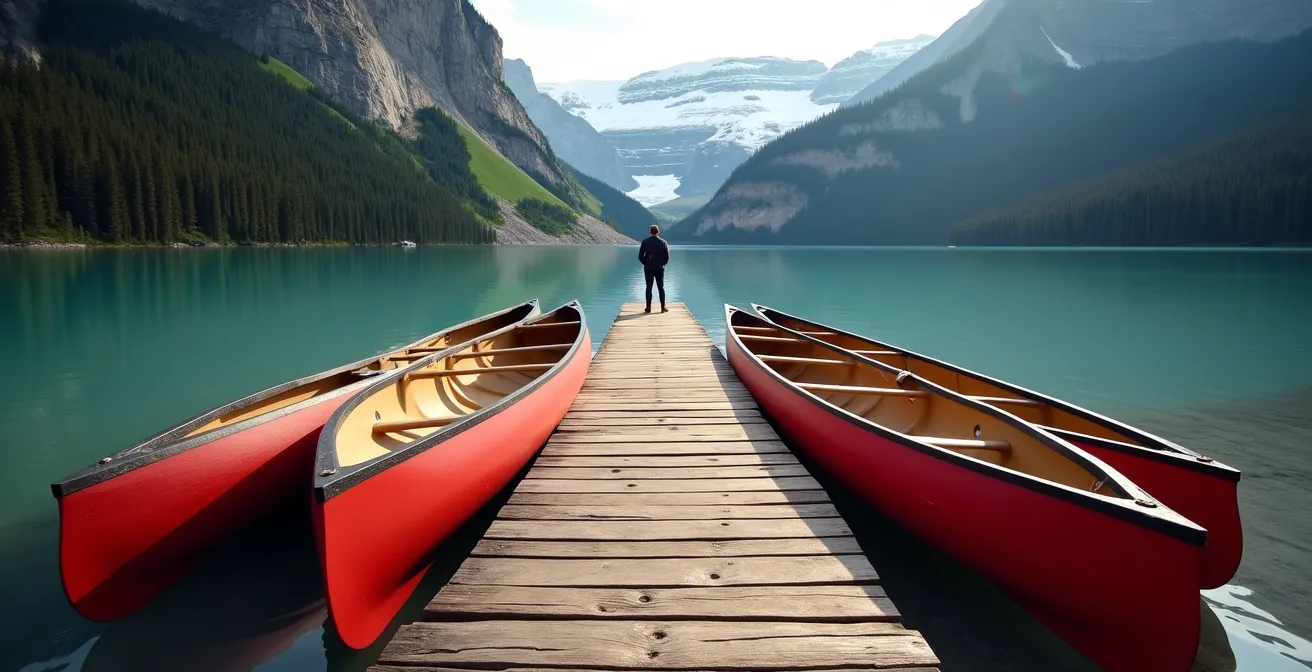
The goal is to change your perspective, both literally and figuratively. By walking just 15-20 minutes, or by shifting your visit to the evening, you transform a crowded tourist stop into a serene natural wonder. The best view of Lake Louise isn’t always the first one you see.
Is the $150 Canoe Rental at Lake Louise a Rip-off or a Memory?
The sight of bright red canoes gliding across the turquoise water is synonymous with Lake Louise, but the price tag often causes sticker shock: around $150 CAD for an hour. This leads many to ask if it’s a “tourist trap” or a “rip-off.” The answer requires shifting from a cost mindset to a value mindset. The question isn’t “is it expensive?” but rather “what am I getting for my money?”
As one analysis puts it, the proposition is simple:
At ~$2.50/minute, is it worth it for 60 minutes of escaping 99% of the crowds?
– Lake Louise Visitor Analysis, How to See Lake Louise Without the Parking Nightmare
The $150 buys you more than a boat ride; it buys you a private, unimpeded 360-degree view from the center of the lake. It’s a guaranteed escape from the shoreline crowds and a perspective that very few visitors get to experience. When viewed as an investment in a core memory, the cost can be justified. To put the price in context, it’s helpful to see how it compares to other iconic lakes in the Canadian Rockies.
This table offers a direct comparison, helping to frame the Lake Louise rental price within the regional market, based on recent tourism data.
| Lake Location | Rental Price | Duration | Per Person (3 people) | Water Color | Crowd Level |
|---|---|---|---|---|---|
| Lake Louise | $150 CAD | 1 hour | $50 | Turquoise | Very High |
| Moraine Lake | $145 CAD | 1 hour | $48 | Bright Blue | High |
| Emerald Lake (Yoho) | $90 CAD | 1 hour | $30 | Emerald Green | Moderate |
| Bow Lake | No rentals | N/A | N/A | Turquoise | Low |
As the data shows, the price is in line with the equally popular Moraine Lake, and significantly higher than at the less crowded Emerald Lake in nearby Yoho National Park. The decision is a personal value judgment: for some, it’s an unjustifiable expense. For others, it’s the price of admission for an hour of unparalleled tranquility and an unforgettable memory, making it one of the best “value” purchases of their trip.
June or August: When is the Water Colour at Its Most Vibrant?
One of the most common planning questions is when to visit for the best experience. For Lake Louise, the debate often centers on June versus August. Both months offer spectacular scenery, but they are dramatically different. The vibrancy of the lake’s famous turquoise color is caused by “rock flour”—fine glacial silt suspended in the water that refracts sunlight. This process is active as soon as the lake thaws (typically by mid-June) and continues all summer, meaning the color itself is brilliant in both months.
The deciding factors, therefore, are the surrounding environment and crowd levels. August is peak season, with warm weather and all hiking trails accessible. However, it’s also the height of summer holidays, leading to maximum crowds. More critically, the August wildfire season significantly impacts visibility in many years. A smoky haze can obscure the mountains and dull the landscape, even if the lake color remains intense up close.
June, by contrast, offers a different aesthetic. While some high-alpine trails might still be snowbound, the mountains themselves are dramatically streaked with snow, creating a more rugged and dramatic visual contrast with the turquoise water. Critically, with most North American schools still in session, the crowds are more manageable, and the risk of wildfire smoke is significantly lower. The trade-off is cooler weather and potentially limited access to certain high-elevation hikes.
This comparative table, drawing on seasonal tourism reports for Alberta, breaks down the key differences to help you make an informed decision.
| Factor | June | August |
|---|---|---|
| Average Crowds | Moderate (schools in session) | Peak (summer holidays) |
| Snow on Peaks | Dramatic snow coverage | Minimal snow, exposed rock |
| Wildfire Smoke Risk | Low | High (peak season) |
| Trail Accessibility | Some high alpine trails closed | All trails typically open |
| Average Temperature | 15°C high / 5°C low | 22°C high / 8°C low |
| Lake Thaw Status | Fully thawed by mid-June | Completely clear |
| Accommodation Availability | Better availability | Very limited, book early |
For photographers and those prioritizing dramatic landscapes with fewer people, late June is often the superior choice. For those who want the warmest weather and guaranteed access to all trails, and are willing to brave the crowds, August is the classic option. There is no single “best” time, only the best time for your specific priorities.
Roam Transit vs Private Commercial Bus: Which Moraine Lake Shuttle is Reliable?
Since private vehicles were banned from Moraine Lake Road, shuttle access has become the only way in, and a new layer of logistics for visitors. The two main options are the public Roam Transit system and licensed private commercial operators. Both are reliable, but they serve different needs, and choosing the right one is a key strategic decision, especially for those wanting to visit both Lake Louise and Moraine Lake.
Roam Transit is the public, cost-effective option. The Route 8X (Lake Louise Express) connects Banff to Lake Louise, and with a $25 CAD for Super Pass including Lake Connector access, you gain the ability to use the Parks Canada Lake Connector shuttle between Lake Louise and Moraine Lake. It’s an excellent value, but requires reservations that can sell out, and operates on a fixed public transport schedule. It’s best for budget-conscious travellers who are flexible with their timing.
Private commercial operators, like the Moraine Lake Bus Company, offer a premium service built around solving specific problems. Their key advantage is offering guaranteed, pre-booked seats at fixed times, including sunrise shuttles that depart as early as 4:00 AM to get photographers to the lake for first light—a time Roam Transit doesn’t service. According to their operational model, their pricing often includes guaranteed parking at their departure point (like the Lake Louise Gondola lot), removing another layer of stress. These services are more expensive per person but can become competitive for families when factoring in the certainty and convenience. They are ideal for photographers, visitors with a tight schedule, or anyone who wants to eliminate uncertainty.
The choice boils down to a trade-off: cost versus certainty. Roam Transit is the efficient, affordable public utility. Private shuttles are the premium, problem-solving service that guarantees access at specific, high-demand times. For many, a hybrid strategy works best: using Roam for general travel around the park and booking a private shuttle specifically for a guaranteed Moraine Lake sunrise.
Key Takeaways
- The shuttle system isn’t random; a majority of tickets are released predictably 48 hours in advance, creating a key strategic opportunity.
- The “value” of an experience like the canoe rental should be measured in memory and tranquility, not just the dollar cost.
- Crowd density plummets just a 15-minute walk from the main viewpoint, making “Crowd Aikido” your most powerful tool for finding peace.
How to Visit Moraine Lake Now That Private Cars Are Banned?
With the permanent ban on personal vehicles on Moraine Lake Road, the days of trying to find a parking spot at sunrise are over. Access is now entirely dependent on shuttles (Parks Canada, Roam Transit, or private operators) or human-powered means. While this requires more planning, it has made the experience more predictable and less chaotic. However, on peak summer days, even the shuttles can sell out completely. This is where a true logistics expert shines: by having a “Plan B Matrix” of high-quality alternatives ready to go.
Being unable to get a Moraine Lake shuttle does not mean your day is ruined. The Banff and Yoho National Parks are filled with equally stunning locations that offer a similar “wow” factor with far easier access. The key is to know what they are and where to find them. Instead of heading back to your hotel in defeat, pivot to one of these world-class alternatives:
- Peyto Lake: Located just 40 minutes north on the Icefields Parkway, its wolf-head shape and impossibly vibrant blue water are arguably as stunning as Moraine Lake, with a large, guaranteed parking lot.
- Bow Lake: Also on the Icefields Parkway, this massive lake sits at the foot of the Bow Glacier and offers spectacular views right from the roadside, with ample space to explore.
- Emerald Lake: A short drive into Yoho National Park (British Columbia), this lake lives up to its name with a deep green hue, a great shoreline trail, and more affordable canoe rentals.
- Morant’s Curve: For a different kind of iconic Canadian photo, this spot on the Bow Valley Parkway offers the classic view of a CPR train rounding a bend with the Rockies in the background.
For the ultra-fit, renting a bike (or e-bike) in Lake Louise village and cycling the Moraine Lake Road is a challenging but incredibly rewarding option that requires no reservations. The ultimate strategy is to view your shuttle booking not as a single point of failure, but as the “Plan A” in a series of fantastic options. This mental shift from desperation to flexibility is the final piece of the logistical puzzle, ensuring a spectacular day in the mountains no matter what.
Now that you have a complete strategic framework, the next step is to apply this problem-solving mindset to your own trip. Start by mapping out your ideal day, then build in the backup plans and shuttle strategies discussed here to create a resilient and stress-free itinerary.