
The key to finding restorative solitude in Alberta isn’t about discovering a secret, crowd-free location; it’s about building a “safety bubble” of knowledge and gear that makes true isolation feel secure, not scary.
- Your biggest fears—bears and no cell signal—are manageable with the right preparation, turning them from anxieties into accepted parts of the experience.
- Calm practice with the right safety tools (like bear spray) is infinitely more effective than relying on passive deterrents like bells.
Recommendation: Instead of chasing crowded tourist icons, invest your time and budget in one well-equipped, accessible wilderness stay that provides a secure base for genuine disconnection.
You’ve seen the photos on Instagram: a lone figure staring at a turquoise lake, framed by the immense, silent peaks of the Alberta Rockies. It sparks a deep longing for disconnection, a retreat from the relentless demands of your urban professional life. Yet, the reality of achieving that solitude is daunting. The thought of venturing beyond the packed parking lots of Banff and Lake Louise brings a wave of anxiety: What about bears? What if there’s no cell service and something goes wrong? How can you find peace when your mind is occupied by fear?
Most advice centres on managing the crowds: “go to Moraine Lake at sunrise,” “hike on weekdays,” or “make a lot of noise on the trail.” But this advice misses the point. The real barrier for many isn’t the presence of other people, but the fear of their absence. The anxiety isn’t about finding a quiet trail; it’s about feeling safe once you’re on it. The conventional wisdom offers little comfort to someone who fears the profound silence of the backcountry as much as they crave it.
But what if the goal isn’t to find a secret place, but to master a secure way of being alone in nature? This guide is built on a different premise: true, restorative solitude is achieved by creating a “safety bubble.” It’s a combination of the right mindset, practical knowledge, and essential gear that transforms fear of the unknown into confidence in your preparation. This isn’t about becoming a hardcore survivalist; it’s about empowering you, the urban professional, to safely access the profound mental benefits of the Alberta wilderness.
We will deconstruct your primary anxieties one by one. This article provides a clear roadmap to help you manage a lack of connectivity, choose accommodations that balance comfort and isolation, understand real-world wildlife safety, and pack intelligently for the mountains’ wild unpredictability. You will learn to build a foundation of confidence that makes solitude an accessible luxury, not a terrifying risk.
Summary: Finding Secure Solitude in the Alberta Rockies
- Why Your Cell Phone Will Fail You 10 Minutes Outside of Banff Townsite
- Glamping or Lodge: Which Wilderness Stay Justifies a $600/Night Splurge?
- Bear Spray vs Bells: What Actually Keeps You Safe on Short Nature Walks?
- Moraine Lake or Upper Kananaskis: Which Offers Better Views with Fewer Crowds?
- Is Solo Hiking in Alberta Safe for Women Travelers in September?
- Inert Cans: Why You Must Practice Using Bear Spray Before Hiking?
- Blisters and Bugs: What Must Be in Your Personal First Aid Kit?
- How to Pack for a Day Hike That Starts at 20°C and Ends at -5°C?
Why Your Cell Phone Will Fail You 10 Minutes Outside of Banff Townsite
For the urban professional, a lack of cell signal can feel like a severed lifeline. The impulse to check for service is automatic, a modern-day security blanket. In the Alberta Rockies, you must treat this not as a possibility, but as a certainty. Once you leave the immediate vicinity of towns like Banff, Canmore, or Lake Louise, you are entering a digital blackout zone. The towering mountains that create the majestic scenery are also impenetrable barriers for cellular signals, where mobile service is a rarity, with less than 10% coverage in many Kananaskis backcountry areas.
This isn’t a flaw in the infrastructure; it’s a fundamental feature of the wilderness. Trying to find a signal is a frustrating and futile exercise. The key to overcoming this anxiety is to shift your mindset from relying on external connectivity to building internal preparedness. Your phone remains an incredibly powerful tool, but only if you prepare it for an offline world. Before you lose service, you must transform it into a self-sufficient navigation and information hub. This is the first and most critical layer of your “safety bubble.”
Your preparation should include downloading detailed offline maps for your intended routes, saving park regulations and emergency contact numbers as screenshots, and loading wildlife identification guides. This proactive approach turns your device from a potential source of panic into a reliable partner. True security here isn’t a signal bar; it’s knowing you have all the information you need already in your pocket. Here are the essentials for your offline toolkit:
- Navigation: Download AllTrails or Gaia GPS maps for offline use before leaving town.
- Information: Install the official Alberta Parks or Parks Canada app with pre-loaded trail information.
- Knowledge: Save offline wildlife identification guides like iNaturalist.
- Emergencies: Screenshot emergency contact numbers and local park regulations.
- Forecasting: Pre-download detailed weather forecasts for 5-day periods for your specific elevation.
Glamping or Lodge: Which Wilderness Stay Justifies a $600/Night Splurge?
When seeking solitude, the temptation is to book a remote cabin and disappear. But for someone new to true isolation, this can backfire, replacing urban stress with the anxiety of being utterly alone. The real luxury you’re paying for in a high-end wilderness stay isn’t just a comfortable bed or a gourmet meal; it’s curated isolation. These places—be it a high-end glamping tent or a secluded lodge—act as a secure basecamp, providing the psychological safety net you need to truly relax and explore.
Glamping offers an immersive nature experience—the sounds of the forest, the canvas walls—but with critical comforts like a real bed, heating, and an ensuite bathroom. It bridges the gap between camping and a hotel. A lodge, on the other hand, provides more solid walls, communal spaces for quiet reflection (like a library or a deck with a view), and the subtle security of having staff and a few other like-minded guests nearby. The “splurge” is justified because you are outsourcing your safety concerns. You can go for a solo walk knowing there’s a warm, safe place to return to, and that you are not entirely off-grid in an emergency.
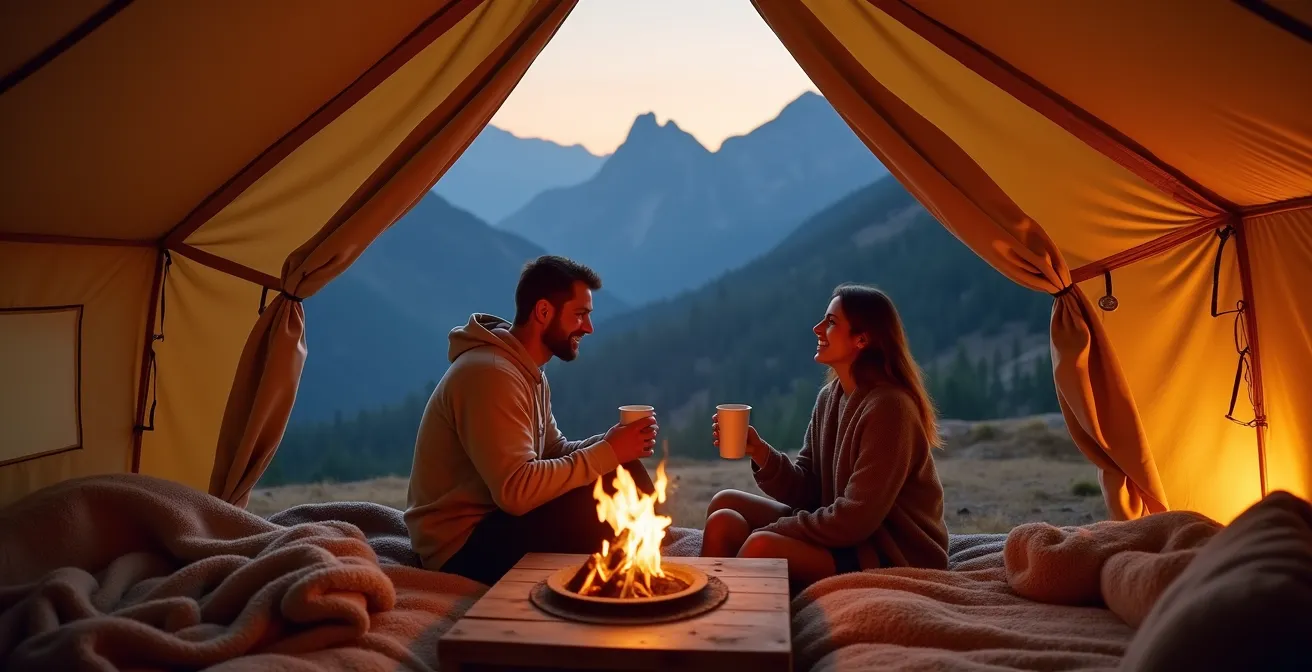
The choice between them depends on your personal “solitude tolerance.” Do you want to feel the elements from the comfort of a heated tent, or do you prefer the solid, quiet remove of a log-walled room? The following table breaks down the nuances of what you’re really getting at different types of stays known for their blend of access and isolation. Notice how “guest density” and “auditory privacy” are as important as price.
| Criteria | Mount Engadine Lodge | Glamping Tents | Skoki Lodge |
|---|---|---|---|
| Guest Density | 19 guests max | 10 guests (5 tents) | 22 guests max |
| Auditory Privacy | Solid log walls | Canvas with fireplace | Rustic log construction |
| Exclusive Access | Drive-in convenience | Semi-isolated units | 11km hike/ski required |
| Price Range | $400-500/night | $450-600/night | $200-300/night |
| Amenities | Full service, WiFi in lobby | Ensuite bathroom, heating | No electricity or running water |
Bear Spray vs Bells: What Actually Keeps You Safe on Short Nature Walks?
No topic causes more anxiety for the aspiring solitude-seeker than bears. This fear is often addressed with a simple, yet misleading, piece of advice: wear a bear bell. The theory is that the constant jingling alerts bears to your presence, giving them time to move away. However, many wildlife experts are skeptical. The sound doesn’t travel far, can be mistaken for a natural noise, and in some cases, may even spark a bear’s curiosity. It provides a false sense of security, doing more to soothe the hiker’s mind than to influence a bear’s behaviour.
The professional standard for bear safety is not passive noise, but an active, ready-to-use deterrent: bear spray. This isn’t just a suggestion; it’s the unanimous recommendation of Parks Canada, ACMG guides, and wildlife biologists. The fear of a bear encounter is understandable, but it’s important to frame it with facts. While any encounter is serious, fatal attacks are exceedingly rare. It’s crucial to distinguish between managing a deep-seated fear and addressing a statistical risk. In fact, while the risk is real, it’s statistically low, with research confirming only 8 fatal grizzly attacks in Alberta over 33 years. This statistic isn’t meant to make you complacent, but to empower you to act from a place of knowledge, not panic.
Your “safety bubble” in bear country is not a sound, but a skill. It involves being alert (no headphones), watching for signs like tracks or scat, occasionally calling out (“Hey, bear!”) in dense bush or near streams, and, most importantly, carrying bear spray where you can access it in seconds. This proactive awareness, combined with a tool you know how to use, is what creates genuine safety.
It is impossible to know if bears involved in fatal attacks were acting in a predatory or defensive way. An increase in urbanization in Canada may contribute to an increase in fatal bear attacks, or at least human-bear interactions.
– Alexandra Poirier, Lakehead University Bear Attack Study 2024
Moraine Lake or Upper Kananaskis: Which Offers Better Views with Fewer Crowds?
Moraine Lake is the postcard image of the Canadian Rockies, and for good reason. Its otherworldly blue water and the Valley of the Ten Peaks are breathtaking. But the fame comes at a cost: vehicle access is now restricted, requiring a shuttle bus reservation, and the shoreline trails are perpetually busy. For the solitude-seeker, it can be a frustrating experience, a beautiful view shared with hundreds of your closest strangers. The “solitude” here is measured in inches, not acres.
This is where Kananaskis Country, or “K-Country,” enters the picture. Located just southeast of Banff National Park, it offers the same calibre of soaring peaks, glacial lakes, and alpine meadows, but with a fraction of the international tourist traffic. Places like Upper and Lower Kananaskis Lakes provide vistas that rival the national park icons, but with parking lots you can actually use and trails where you might walk for an hour without seeing another soul. A key logistical point is that you will need a Kananaskis Conservation Pass for any vehicle stopping in the area, a small price for the relative tranquility.
The difference is one of intention. Banff and Lake Louise are destinations, ticking items off a global bucket list. Kananaskis is an experience, a place for those who prioritize quiet immersion over iconic photos. As a solo traveler noted in an in-depth article on Canadian solo travel, K-Country’s relative obscurity to international tourists makes it an ideal sanctuary. This sentiment is echoed by those who have sought refuge from the Banff crowds:
While the crowds flock to Banff and Lake Louise, the quieter, wilder, emptier valleys of Kananaskis Country feel gloriously peaceful by comparison, even in the peak months of summer.
– Mount Engadine Lodge Guest, Wanderlust Magazine
Is Solo Hiking in Alberta Safe for Women Travelers in September?
The question of safety for solo female travelers is a valid and important one. In Alberta, the answer is a confident yes, with a crucial condition: safety is a product of preparation, not chance. The wilderness is impartial; it presents the same challenges to everyone. The key is to be an informed and well-equipped hiker, and in September, this is especially true.
September is a magical time in the Rockies. The summer crowds have thinned, the larches are turning a brilliant gold, and the air is crisp. However, it’s also a period of “hyperphagia,” when bears are feeding intensively to prepare for hibernation. This means they are more active and potentially more focused on food, leading to a statistical increase in human-bear encounters. This isn’t a reason to stay away, but it is a compelling reason to be hyper-vigilant: make noise, carry your bear spray, and be acutely aware of your surroundings.
The human element of risk is arguably lower in Alberta’s well-managed parks than in many urban environments. Trails are generally well-marked and patrolled by park staff. The hiking community is respectful and helpful. The real challenge, and the real victory, is in building the self-reliance to handle the wilderness on its own terms. Many women find solo hiking in Alberta to be an incredibly empowering experience, a chance to connect with both nature and their own capabilities. For example, one solo female traveler’s account of her Alberta road trip details a successful journey through the wilderness, including safely managing a bear encounter while hiking alone through calm, prepared action.
Success stories like these are not about luck; they are about knowledge. They prove that with the right preparation—understanding wildlife behaviour, having the right gear, and knowing how to use it—solo travel in the Alberta wilderness is not only safe but deeply rewarding. The feeling of competence and peace gained from a successful solo hike is a powerful antidote to any initial anxiety.
Inert Cans: Why You Must Practice Using Bear Spray Before Hiking?
Owning bear spray is not the same as being prepared to use it. In the sudden, high-adrenaline moment of a defensive bear encounter, you will not have time to read the instructions. Your actions will be driven by muscle memory. This is why practicing with an inert (training) can is one of the most vital components of your “safety bubble.” It costs a fraction of a live can and allows you to build the confidence and mechanical skill needed to deploy the spray effectively under pressure.
The goal is to be able to go from seeing a threat to deploying the spray in under five seconds, without fumbling. This involves practicing the entire sequence: reaching for the holster, removing the can, flipping off the safety clip with your thumb, and aiming. You should be able to do this without looking down at your hands. The canister should feel like an extension of your arm, not a foreign object you’re struggling to operate.
This practice demystifies the tool and transforms it from a source of anxiety (“Will I be able to use it?”) into a source of genuine confidence. Knowing you can deploy it swiftly and correctly is a powerful psychological asset, allowing you to hike with heightened awareness rather than crippling fear. The following drill should be practiced until it becomes second nature.
Your 5-Second Bear Spray Deployment Drill
- Holster Draw: Practice removing the spray from its holster without looking down. Your hand should know exactly where to go on your hip or chest strap.
- Safety Clip: Use your thumb to find and remove the safety clip in one smooth, decisive motion. This is often the step where people fumble.
- Stance and Extension: As you draw, extend your arm fully toward the target while taking a step back with your dominant foot to create a stable base.
- Aiming: Aim slightly downward toward the front of an oncoming bear. The spray deploys in a cone-shaped cloud and you want to create a barrier it has to pass through.
- Burst Motion: Practice a firm, 2-second press of the trigger. You don’t need to empty the can; short, controlled bursts are most effective.
Blisters and Bugs: What Must Be in Your Personal First Aid Kit?
While a bear encounter is the most dramatic fear, the far more likely threats to a pleasant day of solitude are far more mundane: a friction-sore on your heel or the maddening buzz of a horsefly. These “minor” issues can quickly escalate, turning a peaceful walk into a miserable ordeal. Your personal first aid kit is therefore a critical piece of your psychological “safety bubble,” providing immediate solutions to the small problems that can derail your entire experience.
A generic, pre-packaged kit is a start, but for Alberta, it needs to be specifically adapted. The terrain is rocky and unforgiving on feet, and the insect life can be notoriously persistent, especially near water sources. Your kit should focus on prevention as much as treatment. For instance, applying tape to known blister-prone spots *before* you start hiking is far more effective than dealing with a raw wound halfway up a mountain.
This isn’t about carrying a paramedic’s bag. It’s about having a small, lightweight, and highly-specialized pouch with the tools to handle the most common trail ailments in this specific environment. Having the right remedy on hand for a black fly bite or a developing blister provides an immense sense of self-sufficiency and control, allowing you to focus on the beauty around you instead of your own discomfort. Your Alberta-specific kit should include:
- Blister Prevention: Leukotape or Moleskin for pre-hike application on hot spots, especially on rocky terrain.
- Insect Relief: An after-bite treatment specifically formulated for the intense itch of black fly and horsefly bites.
- Tick Removal: Fine-tipped tweezers for the safe removal of wood ticks, which are common in the foothills and grassy areas.
- Weather Protection: An emergency Mylar blanket for sudden temperature drops, hail, or unexpected delays.
- Communication Backup: A satellite messenger device (like a Garmin inReach or SPOT) is the ultimate safety net for solo travel in areas with zero cell coverage.
Key Takeaways
- True solitude is a skill built on preparation, not a location found on a map. Your confidence is your most important piece of gear.
- Active safety measures (like practicing with bear spray and being alert) are far more effective than passive ones (like bells).
- Embrace the lack of connectivity by preparing your devices for an offline world. Your phone is a powerful tool, even without a signal.
How to Pack for a Day Hike That Starts at 20°C and Ends at -5°C?
In the Alberta Rockies, there’s a saying: “If you don’t like the weather, wait five minutes.” A day that starts with a warm, sunny sky can see a sudden hailstorm at midday and end with freezing temperatures as the sun drops behind a peak. It is not uncommon for daily temperature swings to exceed 25°C (45°F), especially as you change elevation. Packing for a single, stable weather forecast is the most common mistake a visitor can make. This is the final layer of your “safety bubble”: dressing not for the weather you have, but for the weather you might get.
The solution is not to pack a massive, heavy bag, but to master the art of layering. This system allows you to adapt to changing conditions by adding or removing lightweight items. Each layer has a specific job: the base layer wicks sweat away from your skin, the mid-layer provides insulation, and the outer shell protects you from wind and rain. Cotton should be avoided at all costs; once wet, it loses all insulating properties and can become dangerously cold.
Your choice of layers depends heavily on your planned elevation. A simple walk around a valley lake has vastly different requirements than a hike up to a mountain pass. Understanding how to adjust your clothing based on altitude is the mark of an experienced and safe hiker. The table below offers a simple guide for how to think about layering for different types of day hikes in the region.
| Elevation Range | Base Layer | Mid Layer | Outer Shell | Accessories |
|---|---|---|---|---|
| 1500m (Grassi Lakes) | Moisture-wicking tee | Light fleece (optional) | Wind jacket | Sun hat, sunglasses |
| 2000m (mid-elevation) | Merino wool base | Fleece required | Rain/wind shell | Light gloves, buff |
| 2400m+ (Ha Ling Peak) | Thermal base layer | Insulated mid-layer | Hardshell jacket | Toque, insulated gloves, emergency blanket |
By building this comprehensive “safety bubble”—from offline maps and a curated lodge to practiced bear spray skills and smart layering—you transform the wilderness from a place of anxiety into a sanctuary for renewal. You are now equipped not just with gear, but with the confidence to seek and enjoy the profound solitude the Alberta Rockies have to offer. The next step is to put this knowledge into practice by planning your own secure and restorative escape.