
In summary:
- The Alberta Badlands present unique dangers in extreme heat that are unfamiliar to most visitors; generic summer advice is insufficient.
- Safety depends on understanding the specific behaviours of local wildlife (like rattlesnakes) and the properties of the landscape in high temperatures.
- Strategic planning around hydration, shelter, and timing is not optional—it is a critical survival requirement.
- Vehicle preparedness and knowledge of local regulations are essential components of a safe trip through this deceptive environment.
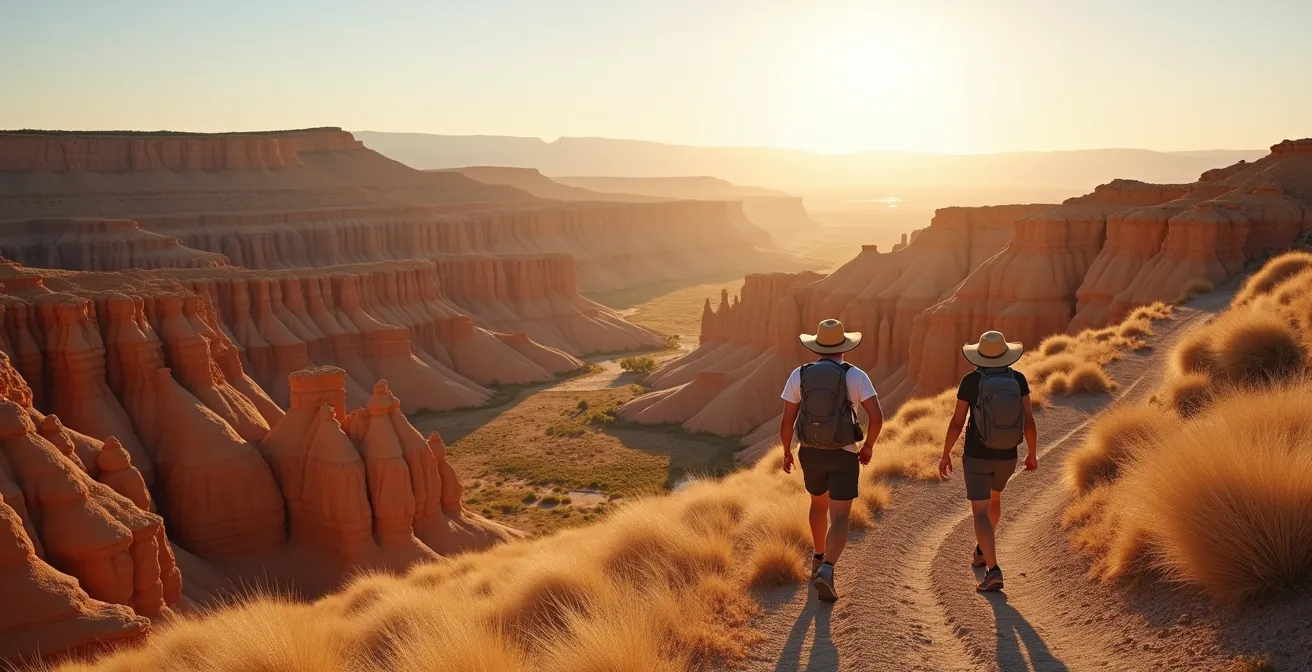
For many families, the word “Canada” conjures images of cool forests, mountain lakes, and snowy winters. This perception can be dangerously misleading when visiting the Alberta Badlands near Drumheller. When the forecast calls for 35°C, this is not a typical summer day at the park; it is an encounter with an extreme, semi-arid environment that behaves more like a desert. Standard advice like “wear a hat” and “drink water” barely scratches the surface of what is required to remain safe.
The real challenge lies in a thermal conspiracy, where the sun, the exposed rock, and the intense aridity work together to create conditions that can quickly overwhelm the unprepared. The landscape itself, from its heat-radiating bentonite clay to its lack of shade, becomes an antagonist. True safety in the Badlands isn’t about simply enduring the heat. It is about understanding and respecting a deceptive landscape where the temperature, geology, and wildlife pose specific, interconnected threats that demand a strategic, not a casual, approach.
This guide moves beyond the platitudes to provide a mission-critical briefing. We will dissect the specific dangers posed by the Badlands in extreme heat and outline the concrete actions required to navigate them safely. From identifying immediate threats on the trail to planning your entire day around the sun, this is your operational plan for a safe family expedition.
This article provides a structured approach to ensure your exploration of the Badlands is memorable for its beauty, not for a medical emergency. The following sections break down the essential knowledge you need to master this unique and challenging environment.
Summary: A Strategic Guide to Heat Safety in the Alberta Badlands
- Prairie Rattlesnakes: Where Are You Most Likely to Step on One?
- Golden Hour or Blue Hour: When Do the Badlands Reveal Their True Colours?
- Water Bladder vs Bottles: How to Carry 3 Litres per Person on Hikes?
- Wheat vs Cattle: Why Does the Landscape Change So Drastically East of Calgary?
- Tent or RV: Which Offers Better Protection Against Badlands Wind Storms?
- Dinosaur Provincial Park Camping: Why You Need to Book the “Comfort Camping” Early?
- Saskatoon vs Buckthorn: How to Identify the Edible Berry Correctly?
- Driving the Dinosaur Trail: How to Complete the North and South Loops?
Prairie Rattlesnakes: Where Are You Most Likely to Step on One?
In the intense 35°C heat of the Badlands, your primary assumption should be that every patch of shade harbours a potential threat. Prairie rattlesnakes, like all cold-blooded creatures, cannot regulate their own body temperature and are forced to seek refuge from the punishing sun. They are not sunbathing on open rocks; they are conserving energy in the very places a hiker might seek relief. This makes encounters not just possible, but probable for the unwary. The greatest risk is not in wide-open spaces, but along the edges of trails, under rock ledges, and within dense sagebrush—the only shaded real estate available.
According to Canadian Museum of Nature field research, at 35°C, snakes seek shade under ledges and in dense bushes, blending in perfectly with the terrain. Their camouflage is flawless against the muted tones of the bentonite clay and sandstone. You will not see them until you are dangerously close, which is why your ears, not your eyes, are your first line of defence. The distinct rattle is an explicit warning that you have breached their safety zone.
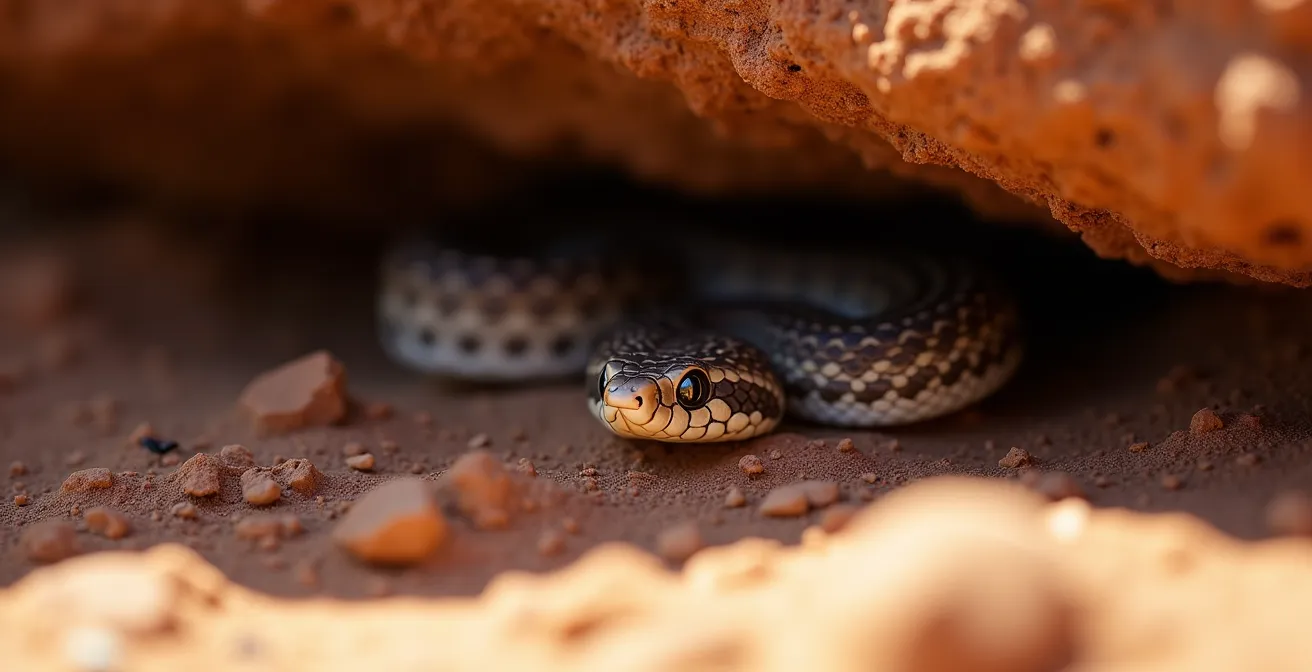
As the illustration above shows, a rattlesnake in shadow is nearly invisible. This is why it is imperative to stay on designated trails and to be extremely cautious when stepping over logs or rocks. Never put your hands or feet where you cannot see. Teach children this rule explicitly. The risk of a bite increases dramatically with off-trail exploration or when searching for a secluded spot to rest.
Critical Safety Protocol for Rattlesnake Encounters
- Stop immediately if you hear rattling – do not run or make sudden movements as this triggers the snake’s strike response.
- Visually locate the snake without moving your feet; they blend perfectly with the badlands terrain.
- Back away slowly while maintaining visual contact, ensuring you maintain at least 2 meters of distance.
- If bitten, remain as calm as possible to minimize venom circulation; remember that the increased heart rate from heat already poses a risk.
- Call the Alberta Fish and Wildlife emergency line immediately and proceed to the Drumheller Health Centre, which is equipped with antivenom.
Understanding the snake’s behaviour in heat is not about fear; it’s about strategic avoidance. By recognizing that shade is their sanctuary, you can modify your own behaviour to avoid intruding upon it.
Golden Hour or Blue Hour: When Do the Badlands Reveal Their True Colours?
The “golden hour,” the period shortly after sunrise or before sunset, is often touted as the best time for photography. In the Alberta Badlands, this advice comes with a serious caveat. While the light is undeniably spectacular, painting the hoodoos and coulees in dramatic hues, the heat is deceptively persistent. An evening hike to catch the sunset is not an escape from the day’s heat; it is an extension of it. Your body is already fatigued and dehydrated from the day, making you more susceptible to heat-related illness even as the sun dips lower.
The core issue is thermal radiation. The rock and clay of the Badlands spend the entire day absorbing solar energy. As the sun sets, they begin radiating this stored heat back into the environment. This means that while the direct sunlight is less intense, the ambient temperature remains dangerously high. In fact, during Alberta summers, the golden hour can last until 10 PM with temperatures still at 25-30°C. For a family from a cooler climate, 28°C might sound pleasant, but combined with the radiant heat and the day’s accumulated fatigue, it is a recipe for heat exhaustion.
A safer, though less conventional, strategy is to embrace the “blue hour”—the period just before sunrise. An early start, around 5:30 or 6:00 AM, offers several critical advantages. The ground has had the entire night to cool, bringing ambient temperatures to their lowest point. The air is calmer, the wildlife is more active, and you have the trails largely to yourself. You can complete a significant hike and be back at a safe, cool location like the Royal Tyrrell Museum or an air-conditioned vehicle before the oppressive heat of midday begins. This approach requires discipline but transforms your experience from one of endurance to one of enjoyment.
Choosing when to explore is as critical as choosing where. Prioritizing pre-dawn and early morning activity over evening excursions is a key strategic shift for staying safe in the extreme heat of the Badlands.
Water Bladder vs Bottles: How to Carry 3 Litres per Person on Hikes?
In the Badlands’ arid environment at 35°C, the rule is non-negotiable: carry a minimum of three litres of water per person, even for short hikes. The question is not *if* you should carry it, but *how*. The choice between a hydration bladder (like a CamelBak) and traditional water bottles is a matter of tactical advantage, as each performs differently under extreme heat. Relying on a single method can lead to system failure, where your water becomes too hot to drink or you run out unexpectedly. The goal is not just hydration, but effective thermal management of your water supply.
Case Study: Dinosaur Provincial Park Water Scarcity
The case of Dinosaur Provincial Park underscores the critical importance of being self-sufficient. The park’s visitor centre provides the only reliable source of potable water in the entire protected area. Rangers consistently report that natural water sources like the Red Deer River contain high levels of alkalinity and dissolved minerals, making them unsafe for consumption even with portable filters. Following multiple heat-related evacuations, the park had to implement emergency water caches at key trail junctions in the summer of 2023, a clear indicator that visitors routinely underestimate their water needs.
The optimal solution is often a hybrid system that leverages the strengths of both bladders and bottles. A large 2-litre bladder provides easy, hands-free access for consistent sipping, which is crucial for preventing dehydration. However, it will warm up quickly. This is supplemented by a 1-litre insulated bottle, which can be partially frozen beforehand. This bottle serves two purposes: it acts as a “cold pack” against your back, and it provides a source of genuinely cold water late in the hike, which can be a significant morale and physiological boost.
This comparative table breaks down the performance of different hydration systems in the specific context of a 35°C Badlands hike.
| System Type | Heat Performance | Capacity | Pros in 35°C | Cons in Badlands |
|---|---|---|---|---|
| Insulated Bladder | Water hot within 1 hour | 3L standard | Hands-free drinking | Black material absorbs heat |
| Frozen Bladder (50%) | Cool for 2-3 hours | 1.5L usable initially | Extended cooling | Limited initial access |
| Insulated Bottles | Cool for 4-6 hours | Multiple 1L units | Temperature control | Weight distribution |
| Hybrid System | Optimal performance | 2L bladder + 1L bottle | Redundancy | Maximum weight |
Ultimately, carrying capacity and redundancy are your best defences against dehydration. Never rely on finding water on the trail. Your life depends on what you carry on your back.
Wheat vs Cattle: Why Does the Landscape Change So Drastically East of Calgary?
The drive east from Calgary towards Drumheller presents a dramatic lesson in microclimates. The landscape shifts abruptly from vast, irrigated wheat fields to the rugged, seemingly barren cattle country of the Badlands. This is not just a change in agricultural practice; it is a fundamental change in the thermal properties of the environment. Understanding this transition is key to appreciating why the Badlands get so dangerously hot. The flat, dark soil of wheat and canola fields acts as a massive solar collector, creating what is essentially a “hot plate” effect with zero shade coverage.
As you enter the Badlands, the topography fragments into a maze of coulees and canyons. While this creates some shade, it also traps air, preventing the cooling effect of prairie winds. The light-coloured bentonite clay reflects sunlight, while darker shale and ironstone deposits absorb it, creating a complex and intense thermal environment. According to Travel Alberta research, these wheat farming areas create ‘hot plates’ with absolutely no shade, pre-heating the air that eventually settles into the Badlands valleys.
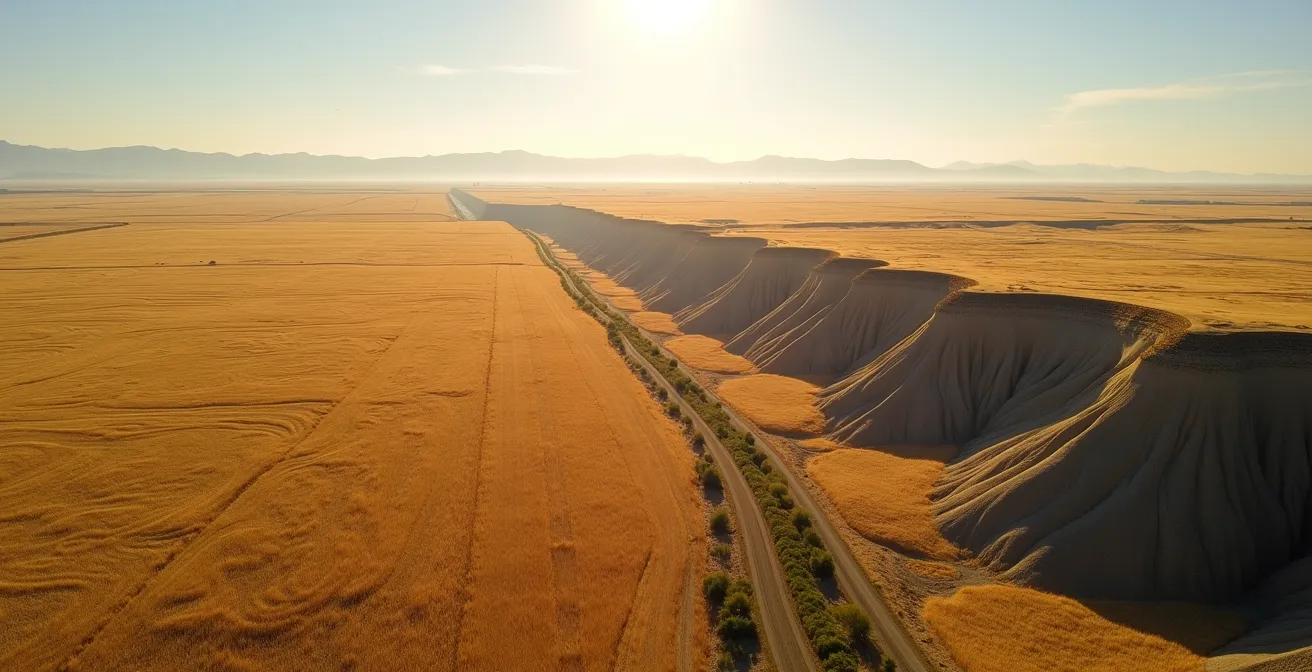
This landscape is also a patchwork of private and public land. The fences you see are not suggestions. For a visitor seeking a shortcut or a patch of shade under a distant cottonwood tree, the temptation to cross a fence can be high. This is a critical mistake, both legally and for safety. As the Alberta Parks Authority makes clear, this is not open-access land.
Most of this landscape is private property. Trespassing on farms or ranches to find a shortcut or shade is illegal under Alberta’s Petty Trespass Act.
– Alberta Parks Authority, Canadian Badlands Safety Guidelines
The visible change in the landscape is a direct warning of the invisible change in environmental risk. Respect the fences, stay on public land, and understand that you are entering a natural oven shaped by millennia of geology and weather.
Tent or RV: Which Offers Better Protection Against Badlands Wind Storms?
While the sun is the most obvious threat in the Badlands, the wind is a powerful and often underestimated force. The open landscape offers no resistance to developing weather systems, and conditions can change with terrifying speed. In summer, this often manifests as violent squall lines or derechos, which can produce destructive, straight-line winds and even tornadoes. When these storms hit, your choice of shelter—a tent or an RV—becomes a critical factor in your safety.
An RV, with its hard-sided structure, offers superior protection from wind, rain, and hail. It is a solid refuge during a sudden storm. However, its large profile makes it vulnerable to being pushed by extreme winds, especially if parked parallel to the wind’s direction. The key is to position the RV perpendicular to the prevailing winds (typically from the northwest in Alberta) to minimize the surface area exposed. A tent, on the other hand, is fundamentally more vulnerable. The combination of fierce winds and the Badlands’ notoriously hard-baked clay can lead to catastrophic failure if the tent is not anchored correctly. Standard tent pegs are often useless in this terrain.
The danger is not theoretical. According to official government warnings, summer derechos in Alberta can produce squall lines with winds exceeding 100 km/h. A family tent is not designed to withstand such forces without specialized anchoring. This involves using heavy-duty stakes (like MSR Groundhogs) driven deep into the clay, or creating “deadman anchors” by burying logs or rocks in sandier areas. Without these measures, a tent can be shredded or blown away in minutes. Regardless of your shelter, downloading the Alberta Emergency Alert app and monitoring Environment Canada radar are non-negotiable safety protocols.
Your shelter is your primary defence when the weather turns. Choosing the right one and knowing how to secure it against the specific threats of the Badlands is a fundamental aspect of your survival plan.
Dinosaur Provincial Park Camping: Why You Need to Book the “Comfort Camping” Early?
For families visiting Dinosaur Provincial Park in the peak of summer, securing the right kind of accommodation is a strategic move for heat safety. While standard tenting is an option, the park’s “Comfort Camping” units offer a significant tactical advantage. These are not luxury lodgings; they are essential heat refuges. These permanent, walled canvas tents are built on wooden platforms, providing a critical air gap that insulates from the hot ground. Most importantly, they offer guaranteed shade and a cool, private space to retreat to during the peak heat of the day, from 1:00 PM to 4:00 PM, something a standard nylon tent simply cannot provide.
The value of these units is no secret. Demand far outstrips supply, and securing a spot requires forward planning and quick action. The booking system operates on a 90-day rolling window, and competition is fierce. It is not an exaggeration to say that you have minutes, not days, to book.
Case Study: The 3-Minute Sellout
An analysis of the Reserve.AlbertaParks.ca booking system for the summer of 2024 reveals the intense demand. For prime weekends in July and August, the entire inventory of Comfort Camping units consistently sold out within three minutes of the booking window opening at 9:00 AM Mountain Time. These units are highly sought after because they provide a haven from the relentless sun that a standard tent, which can turn into a sauna, cannot offer. Some units even feature battery-powered fans, a small but significant luxury in 35°C heat. This data proves that waiting to book is not a viable strategy.
If you miss out on the Comfort Camping lottery, all is not lost, but you must have a backup plan. Do not assume you can simply show up and find a spot. The following locations provide air-conditioned alternatives within a reasonable distance:
- Brooks (30 minutes away): The Heritage Inn and other hotels offer reliable air-conditioned rooms.
- County of Newell Private Campgrounds: Tillebrook Provincial Park is a popular alternative.
- Patricia B&Bs: Small local bed-and-breakfasts can often have last-minute availability.
- Steveville Campground: A lesser-known option upstream on the Red Deer River.
In the Badlands’ summer, your accommodation is more than a place to sleep; it’s a critical piece of safety equipment. Securing a cool refuge for the hottest part of the day is the most important reservation you will make.
Saskatoon vs Buckthorn: How to Identify the Edible Berry Correctly?
The Badlands landscape, while seemingly arid, supports a variety of hardy plants, including several berry-producing shrubs. For a family hiking with curious children, the temptation to sample these wild fruits can be strong. This is where a simple mistake in identification can have severe consequences, turning a pleasant hike into a medical emergency. The key is to distinguish the safe, edible Saskatoon berry from its dangerous look-alike, the Common Buckthorn.
Saskatoon berries (Amelanchier alnifolia) are a delicious and safe native fruit, prized for their sweet, nutty flavour. They are an important traditional food source and are perfectly safe to eat in moderation. Common Buckthorn (Rhamnus cathartica), however, is an invasive species whose berries are toxic. Consuming them causes severe gastrointestinal distress, including cramping and diarrhea. In an environment where you are already battling dehydration, this is incredibly dangerous. As Alberta Health Services warns, Buckthorn acts as a violent laxative, causing severe dehydration at a time when your body can least afford to lose fluids.
The only way to stay safe is through 100% positive identification. The rule is simple: if you are not absolutely certain, do not eat it. This table provides a clear visual guide to differentiate between the two species. Review it carefully with your family before you even step on a trail.
| Feature | Saskatoon Berry (Safe) | Buckthorn (Dangerous) |
|---|---|---|
| Berry arrangement | Small clusters | Along stem length |
| Stem texture | Smooth, no thorns | Often thorny |
| Berry bottom | Distinct crown | No crown |
| Ripening time | Early July in Alberta | Late August |
| Leaf shape | Oval, serrated edges | Elongated, smooth edges |
Foraging can be a rewarding activity in the right context, but in a survival situation, the risk of error is too great. The safest and most responsible action is to enjoy the wild berries with your eyes only.
Key Takeaways
- The primary threats in the Badlands heat are interconnected: dehydration, heat stroke, venomous snakes seeking shade, and sudden, violent weather.
- A successful visit requires a strategic shift in mindset, treating the trip as an expedition into an extreme environment, not a casual park visit.
- Your most critical assets are knowledge of the local environment, a meticulously planned daily schedule to avoid peak heat, and redundant safety systems for water and shelter.
Driving the Dinosaur Trail: How to Complete the North and South Loops?
The Dinosaur Trail is a popular 48-km scenic loop that provides a fantastic overview of the Drumheller Valley’s unique landscape. However, completing it safely in 35°C heat requires more than just a full tank of gas; it requires a strategic itinerary that treats your air-conditioned vehicle as both transport and a mobile refuge. The combination of heat, steep grades, and gravel road sections puts significant stress on a vehicle’s engine, cooling system, and tires. A breakdown here is not an inconvenience; it is a serious emergency.
As veteran guide Linda Miller notes in National Geographic, the environment itself is a mechanical hazard. The advice from experts is clear and should be heeded.
The combination of high ambient heat, steep grades on the trail, and gravel roads puts significant stress on vehicles, increasing the risk of overheating or blowout.
– Linda Miller, National Geographic – Canadian Badlands Guide
The optimal strategy is to divide the trail and use the hottest part of the day for an indoor activity. The following itinerary is optimized for safety and enjoyment:
- 6:00 AM – Pre-Trip Vehicle Check: Before you leave, check your tire pressure (heat increases pressure), coolant levels, and ensure your air conditioning is functioning perfectly.
- 7:00 AM – Start North Loop: Begin your day early by driving the North Loop, which includes the iconic Bleriot Ferry river crossing. The morning air will be at its coolest.
- 10:00 AM – Horsethief Canyon: Arrive at the stunning Horsethief Canyon viewpoint before the heat becomes oppressive. Take your photos and enjoy the view from the safety of the parking area.
- 12:00 PM – 4:00 PM – Heat Refuge: Dedicate the hottest part of the day to the world-class, fully air-conditioned Royal Tyrrell Museum. This is your primary heat refuge.
- 4:30 PM – Begin South Loop: As the heat begins to subside slightly, start the South Loop, heading towards the famous Hoodoos Trail.
- 6:00 PM – Last Chance Saloon: Make a stop in the historic ghost town of Wayne for cold drinks at the Last Chance Saloon.
- 7:30 PM – Complete the Loop: Finish your day at the East Coulee School Museum as the evening light begins to set in.
By structuring your drive around the heat, you transform the Dinosaur Trail from a potential ordeal into the magnificent scenic drive it is meant to be. Your vehicle is your lifeline; ensure it is prepared for the mission.