
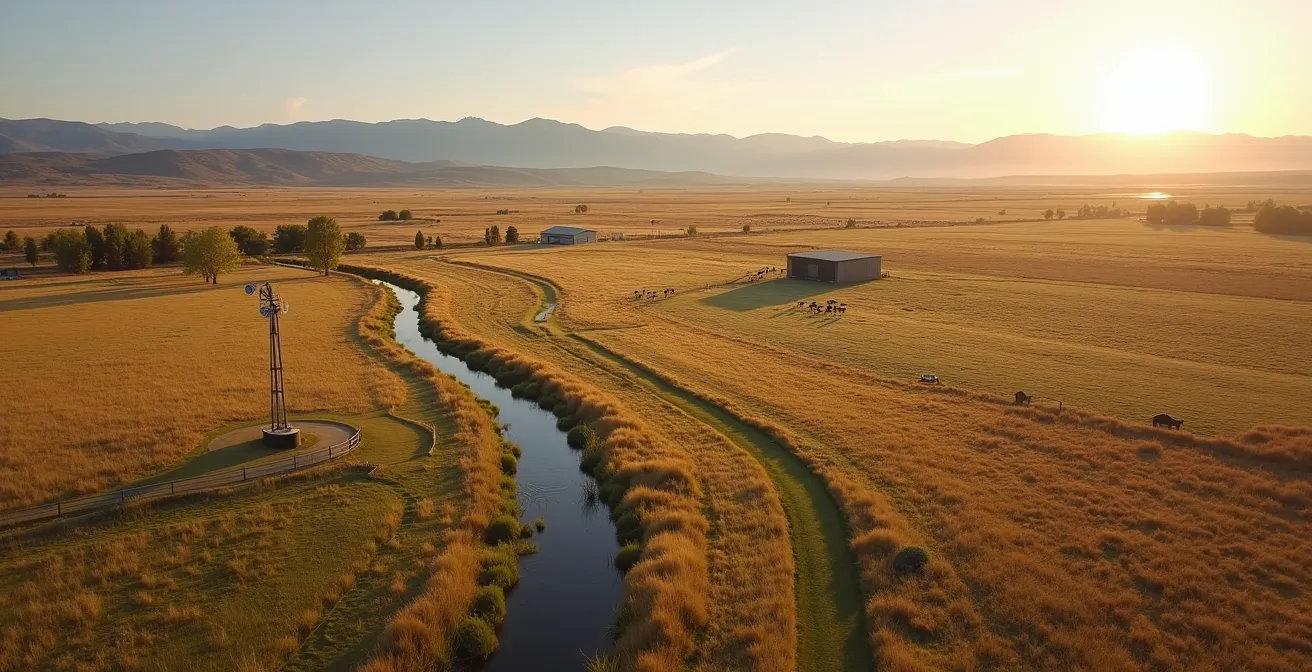
Well-managed cattle grazing in Alberta isn’t just for producing beef; it’s a powerful form of ecological engineering that actively restores grassland health, stores carbon, and protects biodiversity.
- Rotational grazing systems mimic natural patterns, using short periods of intense grazing followed by long recovery times to stimulate deep root growth and build soil.
- This practice enhances the land’s ability to act as a carbon sink, improves water filtration, and creates resilient habitats for native wildlife.
Recommendation: When traveling through Alberta’s foothills, look for the signs of rotational grazing—like temporary electric fences and diverse grass heights—to see a working ecosystem in action.
For the environmentally conscious traveler, the vast cattle ranches of the Alberta foothills can present a complex picture. On one hand, they represent a cherished cultural heritage and a landscape of rolling beauty. On the other, they raise legitimate questions about the environmental impact of beef production, from greenhouse gas emissions to water usage. It’s easy to assume that any form of agriculture represents a net loss for the environment. Many discussions focus on simply reducing herd sizes or abandoning ranching altogether, overlooking a more nuanced and powerful solution being pioneered on the ground.
But what if the conventional wisdom is incomplete? What if, under the right management, those herds of cattle could be the key to not just preserving, but actively regenerating the grasslands they inhabit? The answer lies in a practice that transforms ranching from simple agriculture into a form of applied ecology: rotational grazing. This article moves beyond the surface-level debate to explore the scientific mechanisms at play. We will examine how Alberta ranchers are becoming ecosystem engineers, using cattle as a tool to manage water cycles, build carbon-rich soil, and maintain the very landscapes that both wildlife and people depend on. This is the story of how a well-managed pasture can be one of our best defenses for a healthy prairie ecosystem.
For those who prefer a condensed format, the following video offers a primer on the key environmental metrics in Canadian beef production, setting the stage for the specific practices we will explore.
To understand this complex interplay between livestock and land, this article breaks down the core components of regenerative ranching. We will explore how specific techniques address critical environmental challenges, from protecting waterways to coexisting with predators and combating climate change, offering a comprehensive view of ranching’s ecological role.
Summary: How Rotational Grazing is Redefining Alberta’s Landscapes
- Solar Pumps and Riparian Zones: How Cows Drink Without Damaging Rivers?
- Range Riders vs Traps: How Ranches Manage Wolves Without Killing Them?
- Grass-Fed Logic: Can Cattle Actually Help Trap Carbon in the Soil?
- Cows or Condos: Why Ranching is the Best Defense Against Urban Sprawl?
- Why Are There So Many Fences Along Highway 22?
- Clear Cuts vs Views: Understanding the Visual Impact of Logging Near Parks
- Why Are There Fences and Bridges Over Highway 1 in Banff?
- AAA vs Prime: How to Choose the Best Steak at an Alberta Butcher?
Solar Pumps and Riparian Zones: How Cows Drink Without Damaging Rivers?
One of the most significant environmental concerns with livestock is their impact on water sources. A riparian zone—the lush, green area of vegetation bordering a river or stream—is a critical habitat for biodiversity and acts as a natural filter for the watershed. When cattle have unrestricted access to these areas for drinking, their hooves can erode the banks, stir up sediment, and introduce excess nutrients into the water, degrading the hydrological function of the entire system. This is where ranchers act as water-system engineers.
Progressive Alberta ranchers now use off-site watering systems to prevent this damage. Instead of allowing cattle direct access to sensitive waterways, they pump water to troughs located away from the banks. Often, these systems are powered by solar panels, creating a self-sufficient solution that protects the environment. This simple change has a profound effect: it keeps the cattle out of the water, allowing the riparian vegetation to thrive. Healthy root systems stabilize the banks, prevent erosion, and maintain clean, cool water for fish and other aquatic species. The results are measurable; since 1996, the non-profit organization Cows and Fish has completed over 2670 riparian health assessment sites across Alberta, providing a scientific basis for these management improvements.
Practical examples of this are widespread. In southern Alberta’s Milk River watershed, the MULTISAR program collaborated with landowners to install solar pumps and portable watering units. This not only protected the riparian zones but also improved grazing distribution by drawing cattle to underutilized areas of the pasture. By strategically placing water, a rancher can manage where and how intensely the land is grazed, turning a potential liability into a tool for landscape management.
Range Riders vs Traps: How Ranches Manage Wolves Without Killing Them?
Coexistence with large predators like wolves and grizzly bears is a major challenge for ranchers in the Alberta foothills. The historical response was often lethal control, but a growing understanding of ecosystem dynamics has led to more sophisticated, non-lethal strategies. This approach treats the ranch not as a fortress against nature, but as an integrated part of a wild landscape. The key principle is using human presence and strategic deterrence to modify predator behavior, rather than eliminating the predators themselves.
The modern-day range rider is the embodiment of this philosophy. These individuals spend their days on horseback or in trucks, moving through the herd and the landscape. Their constant, unpredictable presence is often enough to deter opportunistic predators like wolves, which prefer to avoid human contact. A range rider is an active observer, monitoring cattle for signs of stress and the landscape for predator activity. This isn’t just about watching cattle; it’s about understanding wildlife behavior and breaking the patterns that lead to depredation. For a wolf pack, a herd that is frequently attended by a human is a much harder and riskier target than wild prey.
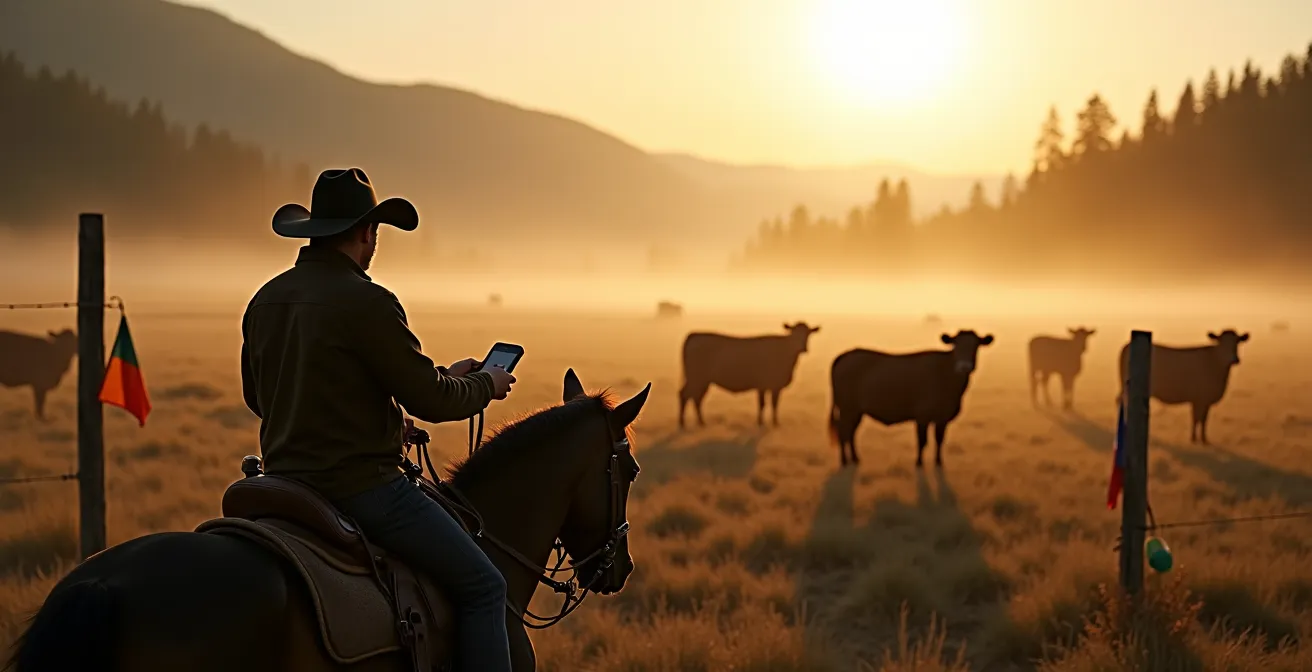
This human presence is often supplemented with other tools. Fladry, a type of fencing with fluttering flags that are unfamiliar and frightening to wolves, can be used to protect pastures, especially during calving season. By actively managing the interaction between livestock and wildlife, ranchers are performing a critical ecosystem service. They maintain the viability of their operation while allowing apex predators to fulfill their natural role in the ecosystem, contributing to a more complete and resilient food web. It’s a labor-intensive approach that requires deep knowledge of the land, but it’s a testament to a management style that seeks balance over eradication.
Grass-Fed Logic: Can Cattle Actually Help Trap Carbon in the Soil?
The conversation around cattle and climate change is often dominated by methane emissions. While this is a valid concern, it overlooks a much larger, and potentially game-changing, piece of the puzzle: the soil. Grasslands are one of the planet’s most important carbon reservoirs, and their ability to store carbon is directly linked to their health. This is where rotational grazing transforms cattle from a perceived climate liability into a potential climate solution, by turning pastures into active soil carbon sinks.
Here’s how it works: in a rotational system, a large number of cattle graze a small pasture (a paddock) for a short period. This intensive grazing mimics the historical behavior of vast bison herds. The cattle graze the grasses down, then are moved to a fresh paddock, leaving the first to rest for an extended period. This “biotic disturbance” followed by a long recovery has a profound effect underground. The grazed plants respond by shedding some of their roots, which decompose and become soil organic matter. During the long rest period, the plants regrow, sending roots deeper into the soil. This repeated cycle of grazing and recovery continuously adds carbon to the soil profile, effectively pulling it out of the atmosphere and storing it securely underground.
The potential is enormous. A University of Alberta research project projected a potential for 32.5 megatonnes of additional carbon storage in Alberta’s prairie soil through improved land management. Further research comparing adaptive multi-paddock (AMP) grazing to conventional grazing across 60 ranches in the prairies confirmed that AMP systems led to greater carbon sequestration in the topsoil. This process doesn’t just store carbon; it builds healthier, more drought-resilient soil that can absorb more water, further enhancing the entire ecosystem.
Cows or Condos: Why Ranching is the Best Defense Against Urban Sprawl?
The rolling grasslands of the Alberta foothills are under constant threat, but not just from poor agricultural practices. One of the most permanent and destructive threats is land conversion—the process of turning native prairie or pastureland into housing developments, acreages, or industrial parks. Once a grassland is paved over, its ecological function is lost forever. In this context, a well-managed cattle ranch serves as a powerful, and perhaps the most effective, bulwark against irreversible habitat loss.
Ranching keeps vast, contiguous tracts of land intact and ecologically functional. While a pasture may be managed for cattle, it remains a living ecosystem. It provides critical habitat for a multitude of species, from grassland birds and pollinators to deer, elk, and badgers. These large, unfragmented landscapes are essential for wildlife movement and genetic diversity. When a ranch is sold for development, this “working landscape” is fractured into a patchwork of roads, fences, and buildings, creating barriers that wildlife cannot cross and eliminating the habitat they depend upon. With only about 11.5 million hectares of native prairie grassland remaining in Canada, protecting these large private holdings is a conservation imperative.
The benefits of keeping these lands as working ranches, especially those using rotational grazing, are stark when compared to the alternatives. The following table illustrates the ecological advantages of rotational grazing over both continuous grazing and, by extension, permanent development.
| Metric | Rotational Grazing | Continuous Grazing |
|---|---|---|
| Soil Health | Improved structure and fertility | Potential degradation |
| Carbon Sequestration | Enhanced through deeper roots | Limited potential |
| Biodiversity | Increased plant and animal diversity | Reduced diversity |
| Water Infiltration | Improved retention | Reduced capacity |
| Erosion Control | Better ground cover | Higher erosion risk |
By making ranching economically and ecologically sustainable, rotational grazing gives landowners a viable alternative to selling their land for development. For the eco-conscious traveler, supporting these ranches means supporting the preservation of the very landscapes they have come to admire.
Why Are There So Many Fences Along Highway 22?
Driving down Alberta’s scenic Highway 22, the “Cowboy Trail,” one of the most common sights is fencing. To the casual observer, it might all look the same—a simple method to keep cows off the road. But to a trained eye, those fences tell a complex story about land management, ownership, and ecology. Learning to read them can transform a scenic drive into a lesson in ecosystem engineering.
The heavy-duty, multi-strand barbed wire fences you see typically mark the permanent boundaries between different ranches or public lands. Within those boundaries, however, you might notice much lighter, often single-strand, electric fences. These are the key signature of a rotational grazing system. These temporary fences are used to create smaller paddocks, allowing ranchers to control where their cattle graze and for how long. Seeing these fences, often alongside a stark contrast in grass height between one paddock and the next, is a direct visual cue that you are looking at a rancher who is actively managing their land for health and productivity.
Despite its clear benefits, this intensive management style is still the exception rather than the rule. According to the Canadian Forage and Grassland Association, active rotational grazing management is at about five per cent in Canada. This makes spotting the signs of it even more significant, as it indicates a rancher at the forefront of sustainable agriculture. As you drive, you can become an active observer by looking for these indicators.
Action Plan: Reading the Landscape from Highway 22
- Temporary Fences: Look for thin, single-strand electric fences on temporary posts. These are used to create the paddocks for a rotational system.
- Grass Height Variation: Notice sharp lines where tall, dense grass (a resting paddock) meets shorter, recently grazed grass. This contrast is the hallmark of rotation.
- Water Troughs: Spot water troughs and tanks located in the middle of a pasture, away from any creeks or ponds. This indicates an off-site watering system protecting riparian areas.
- Herd Density: See a large number of cattle grouped together in a relatively small area. This high-density, short-duration grazing is fundamental to the practice.
- Solar Panels: Identify small solar panel arrays near water troughs, which power the pumps for off-site watering, showcasing a commitment to sustainable infrastructure.
Clear Cuts vs Views: Understanding the Visual Impact of Logging Near Parks
As you travel near the boundaries of Alberta’s national and provincial parks, the landscape can change dramatically. The pristine protected areas give way to a mosaic of land uses, two of the most prominent being forestry and ranching. For a traveler, the visual impact is immediate and stark. A clear-cut logging operation leaves a scarred landscape of stumps, disturbed soil, and erosion-prone slopes that can take decades, if not centuries, to recover its ecological function and aesthetic appeal.
In contrast, a well-managed rangeland, even one actively used for grazing cattle, maintains its essential character as a grassland ecosystem. The contours of the land remain, the soil is held in place by a permanent cover of grasses and forbs, and the view remains one of a continuous, living landscape. This visual difference is a powerful metaphor for the underlying ecological realities. While forestry is a resource-extraction industry that fundamentally alters the ecosystem, regenerative ranching is a management practice that works within the existing ecosystem’s framework.
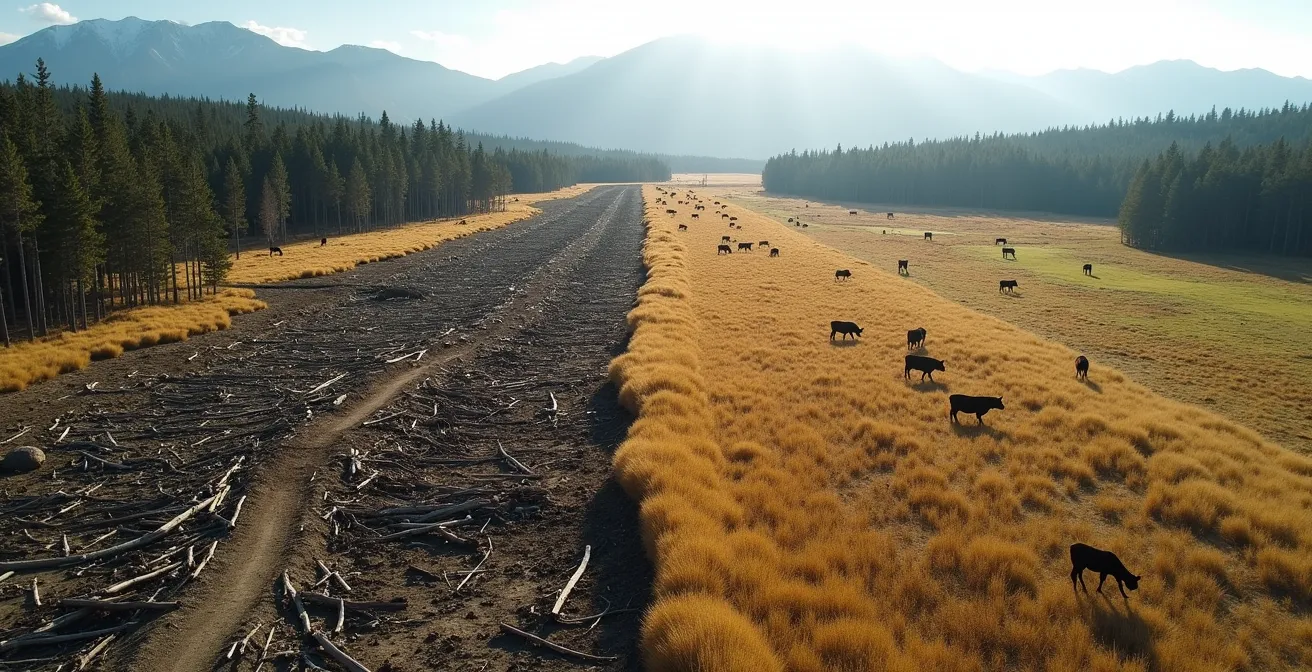
This is not to say that ranching has no impact, but the nature of that impact is fundamentally different. Rotational grazing creates a cycle of temporary disturbance and long recovery, which enhances the health of the grassland. Furthermore, the beef industry has made significant strides in efficiency, reducing its overall footprint. Research from the Canadian beef industry shows it produced the same amount of beef in 2011 compared to 1981 with 15% less greenhouse gas emissions. This efficiency, combined with the land-preserving nature of ranching, makes it a far more sustainable neighbour to protected areas than industries that require permanent landscape alteration.
Why Are There Fences and Bridges Over Highway 1 in Banff?
The wildlife overpasses and extensive fencing along the Trans-Canada Highway in Banff National Park are world-renowned symbols of conservation. They are designed to address a critical issue: habitat fragmentation. When a major highway cuts through a landscape, it creates a deadly barrier that animals are hesitant or unable to cross, isolating populations and leading to vehicle collisions. These structures are an engineering solution to maintain landscape connectivity.
While these iconic structures are inside the park, the principle they represent is directly connected to the ranches outside its borders. The effectiveness of a wildlife corridor or overpass depends on having large, functional habitats on either side of it. A bridge is useless if it leads from a park to a subdivision. This is where Alberta’s large ranches play an indispensable, often overlooked, role. They provide the vast, unfragmented landscapes that connect protected areas like Banff to the broader foothills ecosystem. As fifth-generation Alberta rancher Graham Overguard states, “The grasslands we have need to be respected and managed properly, and the best way to do that is by having cattle graze.”
Ranch infrastructure, when thoughtfully designed, can even enhance this connectivity. For example, Soderglen Ranches, an award-winning operation south of Calgary, uses extensive pipelines to service portable water troughs. This allows them to rotationally graze their cattle while keeping them away from natural water sources, which in turn preserves those areas for wildlife. By maintaining vast open spaces and managing them in a way that supports biodiversity, these ranches act as vital buffer zones and corridors around protected areas. They ensure that the wildlife leaving Banff has a healthy, connected landscape to move through, making the investment in those famous overpasses truly meaningful.
Key Takeaways
- Regenerative ranching is an active form of “ecosystem engineering” that uses cattle to improve soil health, water cycles, and biodiversity.
- Rotational grazing is a key tool that builds soil organic matter, turning grasslands into effective carbon sinks.
- By keeping large landscapes intact, sustainable ranching is one of the most effective defenses against permanent habitat loss from urban sprawl and development.
AAA vs Prime: How to Choose the Best Steak at an Alberta Butcher?
After exploring the complex ecological role of ranching, the journey for the eco-conscious traveler often culminates in a simple, tangible choice: what to buy at the local butcher shop. The connection between the health of the landscape and the quality of the beef is direct and profound. The same practices that lead to healthy soil, clean water, and thriving biodiversity also produce healthier animals and, ultimately, a superior product.
When you choose beef from a ranch that employs rotational grazing, you are supporting an entire system of ecological benefits. The varied diet of natural grasses and forbs, combined with a low-stress life moving through healthy pastures, contributes to the flavour and nutritional profile of the meat. This is often reflected in the quality grades like Canada AAA or Prime, which are based on marbling—the intramuscular fat that gives steak its flavour and tenderness. Healthy, well-managed animals are more likely to achieve these higher grades. While “grass-fed” labels can be a good starting point, the real story is in the management behind that label.
The sustainability of this choice is also backed by industry-wide improvements. Thanks to better genetics, nutrition, and management practices, efficiency gains in Canadian beef production mean that it took 29% less breeding stock to produce the same amount of beef in 2011 compared to 1981. This continual improvement, coupled with the land stewardship of regenerative ranching, makes choosing local, well-managed beef a powerful vote for a healthy Albertan landscape. The rich taste of a great Alberta steak is, in many ways, the taste of a healthy ecosystem.
By asking your butcher about their sources and choosing beef from local ranches committed to these sustainable practices, you complete the cycle. You not only enjoy one of Alberta’s finest products but also become a direct partner in preserving the grasslands for generations to come.