

In summary:
- Your survival depends on a 3-second assessment, not a leisurely checklist. Focus on the shoulder hump and locomotive signature.
- Bear spray is your primary tool, but only if you have practiced with an inert can to build muscle memory for a high-stress deployment.
- A grizzly encounter is typically defensive; stand your ground, then play dead if contact is made. A black bear encounter can be predatory; fight back aggressively.
- In Alberta’s mountain towns during spring, a mother elk protecting her calf is a more frequent and aggressive danger than a bear.
- Making noise with your voice—not bells—is the most effective way to prevent a surprise encounter on the trail.
You’re on a trail in Kananaskis Country. The air is crisp. Then, movement. Fifty metres ahead, a large, dark shape emerges from the trees. It’s a bear. Your mind races through the common advice: “Black bears can be brown,” “Grizzlies are bigger.” These fragments of information are dangerously incomplete. In the Alberta wilderness, the difference between a grizzly and a black bear isn’t an academic curiosity; it’s the critical data point that dictates your immediate, life-or-death response. The colour of its fur is the last thing you should be thinking about.
Most guides offer a static checklist: look for the shoulder hump, the face profile, the claw length. While correct, this approach fails to account for the reality of an encounter: a dynamic, high-stress event where you have mere seconds to act. The key is not just knowing the features, but training your brain to recognize a holistic picture—the animal’s form, its behavioral context, and its unique locomotive signature. Is it a powerful, lumbering gait driven by a muscular shoulder hump, or the more fluid, four-cornered movement of a black bear?
This guide abandons the passive checklist. It’s a biologist’s field manual for the 3-second assessment. We will calibrate your most important safety tool—your mind—to instantly perform a threat triage. We will cover the crucial pre-hike preparation, how to read the environmental cues that signal a bear’s presence long before you see it, and precisely how to react based on the species you’ve identified. Because when you’re face to face with one of Alberta’s apex predators, the test is pass/fail. There is no partial credit.
This article provides a structured approach to bear safety, from pre-hike preparation to post-encounter reporting. Explore the sections below to master each critical component of staying safe in bear country.
Summary: Grizzly vs Black Bear: How to Identify the Difference in Seconds?
- inert Cans: Why You Must Practice Using Bear Spray Before Hiking?
- Scat and Digs: How to Recognize Fresh Bear Signs on the Trail?
- The Power of 4:How to Explore the Badlands safely when temperatures hit 35°C?
- Stand Your Ground or Play Dead: How to React to Different Bear Behaviors?
- Radio or App: How to Report a Bear Sighting to Park Wardens?
- May and June Danger: Why Are Mother Elk More Aggressive Than Bears?
- Is Solo Hiking in Alberta Safe for Women Travelers in September?
- Bear Spray vs Bells: What Actually Keeps You Safe on Short Nature Walks?
inert Cans: Why You Must Practice Using Bear Spray Before Hiking?
Bear spray is not a magical talisman; it is a tool that is only as effective as its user. Carrying a can clipped to your pack is useless if you can’t deploy it in the two seconds it takes for a charging bear to cover 30 metres. The critical error most hikers make is assuming they will have time to read the instructions during an encounter. In reality, your fine motor skills will evaporate under the flood of adrenaline. The only thing that works is muscle memory built through repetition.
This is where inert practice canisters are non-negotiable. Before you set foot on a trail, you must practice drawing the can from its holster, removing the safety clip with your thumb, and depressing the trigger. Do it ten times. Then do it with your eyes closed. This practice is what ensures you can perform the action under extreme duress. You can purchase bear spray and inert cans at authorized retailers across Alberta, including Mountain Equipment Co-op, Cabela’s, and Canadian Tire in cities like Calgary and Edmonton. Always ensure the canister weighs at least 225g and immediately remove the plastic zip tie from the safety clip after purchase; it will render the spray useless in an emergency.
Some hikers doubt the spray’s effectiveness in Alberta’s famously windy and cold conditions. However, research conducted in the Rockies confirms its reliability. One study found that even at -23°C, the spray reached over 4 metres. In a 35 km/h headwind, it still achieved a 2-metre range—the average distance of deployment in real incidents. Its efficacy is proven; data from Parks Canada shows bear spray is effective in over 90% of cases where it is deployed. Your job is to ensure you can be part of that 90% through dedicated practice.
Without practice, a can of bear spray is just dead weight. With practice, it is the single most effective deterrent you can carry.
Scat and Digs: How to Recognize Fresh Bear Signs on the Trail?
The best way to survive a bear encounter is to avoid it entirely. This requires shifting your awareness from simply looking for bears to actively reading the environmental cues they leave behind. The trail itself is a story, and learning to interpret fresh signs of bear activity allows you to heighten your alert level or choose a different path. Two of the most definitive signs are scat and digs. Bear scat’s appearance changes based on diet; in Alberta, look for piles containing berries, grasses, or remnants of a carcass. The fresher it is, the more moist and odorous it will be.
Digs are an even more obvious sign, particularly of grizzly presence. A grizzly bear’s powerful shoulder muscles and long claws are adapted for excavation. They will tear apart the ground in search of roots, bulbs, and ground squirrels, leaving behind overturned soil and exposed roots. Black bears, with their shorter claws adapted for climbing, do not create such extensive damage; their claw marks are more commonly found on tree trunks. Recognizing the difference is a key part of your environmental assessment.

The image above clearly contrasts the deep, powerful excavation of a grizzly with the more superficial vertical scratches a black bear leaves on trees. But the most important question is: how fresh is the sign? A track from yesterday is history; a track from ten minutes ago is a warning. You must become adept at judging freshness to assess immediate risk.
Your 5-Point Checklist for Assessing Fresh Bear Sign:
- Check track edges in mud: Fresh tracks have sharp, well-defined edges; older tracks are rounded and blurred.
- Look for water accumulation: In wet areas, fresh prints are still dry or slowly filling with water; older prints are full.
- Examine surrounding vegetation: Freshly disturbed or broken plants will still show green or be moist at the break points.
- Note weather conditions: Any tracks made since the last rainfall or snowfall are definitively recent.
- Smell for musky odor: A strong, musky bear scent lingers for hours at fresh bedding sites or on large carcasses.
Your senses are your first line of defense. Use them to read the landscape, and you may never need to use your bear spray.
The Power of 4:How to Explore the Badlands safely when temperatures hit 35°C?
While the Rocky Mountains are prime bear habitat, the unique environment of the Alberta Badlands presents its own set of challenges, especially during extreme heat. When temperatures soar to 35°C, wildlife behaviour shifts dramatically. Animals, including cougars and bears, concentrate near the few available water sources, such as the Red Deer River. This funnels both wildlife and hikers into the same corridors, increasing the probability of an encounter. Hiking during these conditions requires a specific strategy.
The first rule is to avoid hiking during the peak heat of the day. Plan your explorations for dawn and dusk. However, be aware that these are crepuscular hours, when animal activity is naturally at its highest. This makes your behaviour even more critical. The single most effective passive safety measure you can take is to travel in a group. A solo hiker or a pair can be mistaken for prey. A larger group is more detectable and more intimidating.
There is a “magic number” when it comes to group size and bear safety. Statistically, no one has ever been seriously injured by a bear in a group of four or more. As a result, Parks Canada strongly recommends hiking in a tight group of four or more people. “Tight” is the operative word; the group must stay close enough to be perceived as a single large unit. A group spread out over 100 metres of trail is just a series of solo hikers. In the high-risk conditions of a Badlands heatwave, the “Power of 4” is your most reliable defense.
This simple rule—sticking together in a group of four—transforms you from a potential target into a noisy, formidable unit that most wildlife will actively avoid.
Stand Your Ground or Play Dead: How to React to Different Bear Behaviors?
This is the moment of truth. A bear is on the trail ahead. Your 3-second assessment begins now. Forget colour. Look at the form. Is there a prominent shoulder hump between the neck and back? Is the face profile long and straight like a dog’s (black bear), or short and broad with a “dished” profile (grizzly)? Does it move with a powerful, rolling gait from the shoulders, or a more fluid, four-cornered stride? This identification is vital because it dictates your next move. As one expert puts it:
On a trail in Kananaskis, the 3 seconds you take to spot the shoulder hump determines whether you stand tall or drop to the ground. It’s the most important test you’ll ever take.
– Alberta Parks Bear Management Specialist, Alberta BearSmart Program Guide
Nearly all grizzly bear attacks are defensive. The bear sees you as a threat to its cubs, its food source, or its personal space. Your goal is to show you are not a threat. Stand your ground, talk to it in a calm, firm voice, and get your bear spray ready. Do not run. If it charges, deploy your spray. If it makes contact and knocks you down, play dead. Lie flat on your stomach, protect the back of your neck with your hands, and spread your legs to make it harder for the bear to flip you over. Remain still until you are certain it has left.
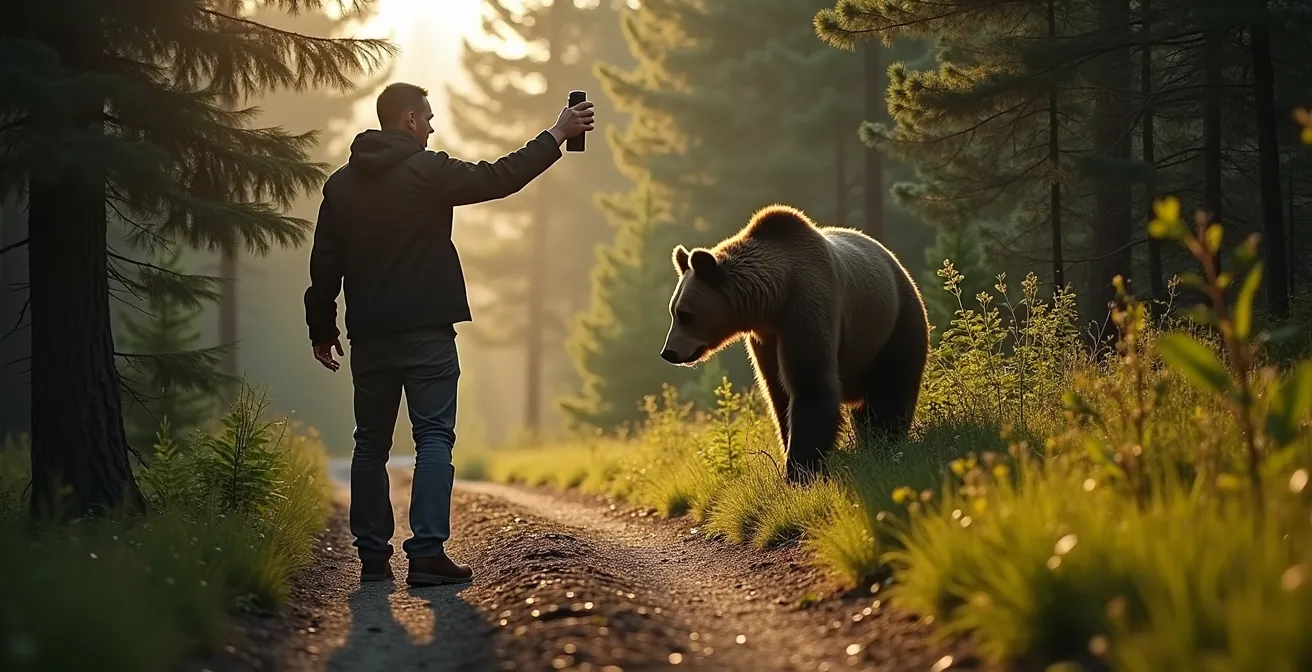
A black bear encounter is different. While most are not aggressive, a rare attack is more likely to be predatory. In this case, never play dead. You must fight for your life. Make yourself look as large as possible, yell, and use any object you can—rocks, sticks, your trekking poles—to fight back. Target the bear’s face and muzzle. This is especially true for food-conditioned bears often found near townsites like Banff and Jasper. The response protocols are diametrically opposed and species-dependent.
This table summarizes the critical actions based on the type of encounter.
| Encounter Type | Action Protocol |
|---|---|
| Defensive Grizzly (Most Common) | Stand ground, talk calmly, ready spray. If contact is made, play dead (face down, protect neck). |
| Predatory Black Bear (Rare but possible) | NEVER play dead. Fight back aggressively. Target face and muzzle. Make noise and appear large. |
Your correct reaction in these crucial seconds is determined entirely by your ability to differentiate the species and the nature of its behaviour.
Radio or App: How to Report a Bear Sighting to Park Wardens?
Your responsibility in bear country doesn’t end when an encounter is over. Reporting your sighting is a critical action that contributes to the safety of all hikers who will use the trail after you. An accurate and timely report allows Park Wardens to make informed decisions, such as posting warnings or implementing trail closures to prevent further human-wildlife conflict. Whether you’re in a national park like Banff or Jasper, or provincial land like Kananaskis, there is a clear protocol for reporting.
In national parks, the number to call is the Banff, Yoho, or Kootenay dispatch. In Kananaskis Country, it’s the Kananaskis Emergency Services. Program these numbers into your phone before you leave. If you are in the backcountry without cell service, a satellite messenger like a Garmin inReach or Zoleo is an invaluable tool for both personal safety and reporting. When you make the report, structure your information clearly to provide maximum value. The most effective framework is the “5 W’s”.
Being prepared to provide this specific information saves valuable time and allows wardens to assess the situation’s urgency and location with precision. Simply stating “I saw a bear on the trail” is not helpful. Providing GPS coordinates or a specific trail marker number is immensely valuable. A vague report is an unactionable report. Your goal is to be a reliable data source for the professionals managing wildlife in the area.
Action Plan: The 5 W’s for an Effective Sighting Report
- WHO: Provide your name and a contact number where you can be reached for follow-up questions.
- WHAT: Describe the species (grizzly or black bear), its colour, if cubs were present, and its behaviour (e.g., foraging, defensive, curious).
- WHERE: Give the most precise location possible. Use GPS coordinates, a trail name with a specific marker number, or a clear landmark.
- WHEN: State the exact time of the sighting and how long ago it occurred.
- WHICH WAY: Note the direction the bear was heading when you last saw it.
By providing a clear, concise, and detailed report, you transition from a passive trail user to an active steward of a safer backcountry for everyone.
May and June Danger: Why Are Mother Elk More Aggressive Than Bears?
When visitors think of dangerous wildlife in Alberta’s mountain parks, their minds immediately go to bears. However, especially within the townsites of Banff and Jasper, another animal poses a more frequent and predictable threat during the spring: the cow elk. In late May and June, mother elk give birth to their calves. For the first few weeks, the calves are weak and vulnerable, and their mothers enter a state of extreme defensive aggression.
Unlike a bear, which will generally try to avoid humans, a protective mother elk will proactively defend a perimeter around her hidden calf. This territory can be a lawn on Banff Avenue, a park in Jasper, or the shrubbery right outside your hotel. Many unsuspecting visitors are charged, kicked, and seriously injured each year simply by walking too close. In fact, aggressive elk encounters in the townsites significantly outnumber bear encounters during this calving season. It is a statistical reality that the most likely large animal to charge you in Banff is an elk, not a bear.
Recognizing the warning signs is crucial. A defensive elk will lower her head, flatten her ears, grind her teeth, and stare intently at you. This is not a bluff. It is the immediate precursor to a charge. If you see these signs, you must give the animal a very wide berth—at least 30 metres. Never get between a mother and her calf. Be especially vigilant when walking around blind corners or through areas with dense shrubs, even in the middle of town. The danger is real, and underestimating a mother elk is a painful mistake that too many visitors make each spring.
In the complex ecosystem of the Rockies, threat assessment goes beyond bears. Recognizing the seasonal danger posed by elk is a hallmark of a truly savvy and safe visitor.
Is Solo Hiking in Alberta Safe for Women Travelers in September?
The question of solo hiking safety, particularly for women, is a valid one. Alberta’s trails are generally safe, but hiking alone requires a higher level of preparation, awareness, and risk mitigation. This is especially true in September. While the golden larches and crisp air make it a beautiful time to hike, it is also a period of intense wildlife activity. September marks the peak of hyperphagia, a biological state where bears are driven to feed for up to 20 hours a day to build fat reserves for winter hibernation.
This urgent need for calories means bears are on the move constantly, covering large territories in search of food. The chances of an encounter are statistically higher. According to wildlife experts, September is a peak period for bear activity as they prepare for hibernation. This doesn’t mean solo hiking is off-limits, but it does mean your safety protocols must be flawless. Choosing your trail wisely is the first step. Opt for popular, heavily-trafficked trails like Larch Valley in Banff or the Valley of the Five Lakes in Jasper, where the constant human presence makes a surprise encounter less likely.
For solo women travelers, connecting with local resources can add a layer of community and safety. Groups like the Alberta Women’s Outdoor Community on social media are excellent for finding hiking partners or getting up-to-date trail advice. Regardless, the non-negotiables for any solo hiker are:
- Leave a detailed trip plan: Give someone your exact route, your intended return time, and your emergency contacts.
- Carry a satellite messenger: Devices like a Garmin inReach or Zoleo are essential for communication in areas without cell service, which includes most of Alberta’s backcountry.
- Time your hikes carefully: Avoid hiking at dawn or dusk, when wildlife activity is at its peak.
These measures, combined with making regular noise and carrying accessible bear spray, make solo hiking a manageable risk rather than a reckless gamble.
With meticulous planning and unwavering adherence to safety protocols, solo hiking in Alberta can be a deeply rewarding experience.
Key Takeaways
- The grizzly’s shoulder hump is the most reliable identifier; its powerful muscle mass dictates its movement and digging ability.
- Bear spray is a proven tool, but only practice with an inert can builds the critical muscle memory needed for a high-stress encounter.
- Knowing the correct, species-specific response—playing dead for a defensive grizzly vs. fighting back against a predatory black bear—is a life-or-death distinction.
Bear Spray vs Bells: What Actually Keeps You Safe on Short Nature Walks?
On any popular trail in the Rockies, from Johnston Canyon to Maligne Lake, you will hear them: the faint, tinkling sound of bear bells attached to a hiker’s pack. This is one of the most pervasive myths in bear safety. The logic seems sound—make noise to avoid surprising a bear. The problem is that bear bells are simply not effective. Their sound is high-pitched, does not travel far, and is easily masked by the noise of a rushing stream or a windy day. More importantly, bears do not associate the gentle, repetitive sound with humans.
In some cases, the tinkling might even arouse a bear’s curiosity, drawing it in to investigate the strange noise. Wildlife specialists are unanimous on this point. In the words of the experts who manage these parks:
Bear bells are not effective. The human voice is proven more effective at alerting bears to your presence.
– Parks Canada Wildlife Specialists, Parks Canada Bear Safety Guidelines
The solution is simpler and requires no equipment: use your voice. Talking, singing, or periodically shouting “Hey Bear!” is far more effective. The human voice is distinct in the natural environment and carries much further than a bell. This simple action clearly announces your presence as a person, allowing a bear to identify you and, in most cases, move away long before you are aware of it. On a short nature walk or a long backcountry trek, the protocol is the same.
Adopt the “Hey Bear!” noise protocol as a regular habit:
- Shout “Hey Bear!” or talk loudly every 30-60 seconds.
- Increase the frequency when approaching blind corners, dense vegetation, or noisy streams.
- In a group, maintain a conversation. The goal is to make consistent, human-centric noise.
Your primary safety tools are your voice for prevention and your bear spray for an encounter. Leave the bells in the gift shop; they provide a false sense of security that can be more dangerous than silence.
Effective bear safety is an active practice, not a passive accessory. Your voice is your best tool for prevention—use it.