
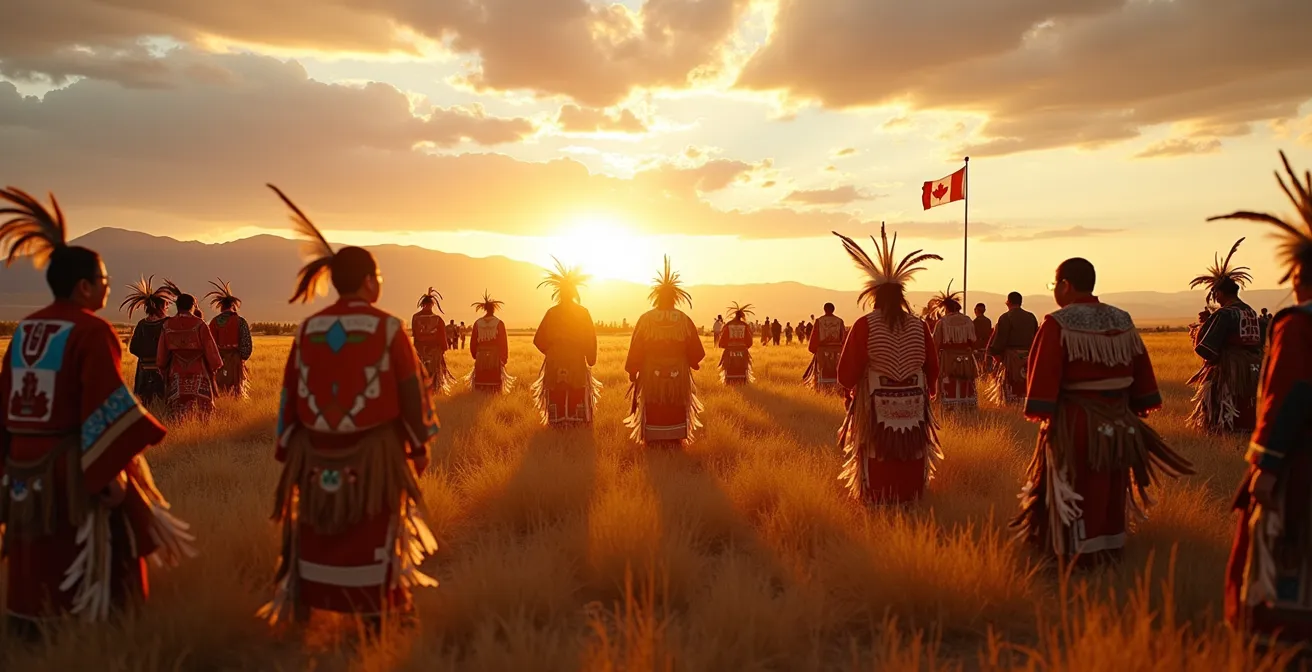
Absolutely, yes! The most common concern for visitors is the fear of being disrespectful, but powwows are welcoming events open to all. The key isn’t just to follow rules, but to understand the heart behind them. This guide moves beyond simple etiquette to explain the ‘why’—the cultural significance of the regalia, the drum, and the dances—transforming you from a hesitant spectator into a knowledgeable and welcome guest who can participate with confidence and respect.
Have you ever been driving through the Alberta prairies on a summer weekend and heard it? A distant, rhythmic pulse that seems to resonate with the land itself—the sound of a powwow drum. For many non-Indigenous people, this sound brings a mix of awe and uncertainty. You’re drawn to the vibrant energy, the stunning colours, and the powerful music, but a voice in your head asks, “Am I welcome here? Am I intruding on a private cultural event?”
It’s a common and respectful question. Many travel guides offer simple advice like “be respectful” or “ask before taking photos.” While true, this advice barely scratches the surface and often leaves you feeling more anxious. You’re given a list of rules without understanding the reasons, which can make you feel like you’re walking on eggshells. But what if the goal wasn’t just to avoid mistakes, but to genuinely connect with the experience?
This is where our perspective shifts. As an organizer, I want you to know that you are not an intruder; you are a guest. The true key to attending a powwow is moving from being a passive spectator to a respectful participant. It’s about understanding that every element, from the intricate beadwork to the beat of the drum, is part of a living tradition, not a performance. This guide is your invitation to look deeper, to understand the heart behind the protocols, and to feel the genuine welcome that awaits you.
Throughout this guide, we’ll walk you through the essential elements of an Alberta powwow. By understanding the meaning and spirit behind each tradition, you’ll gain the confidence to not only attend but to appreciate the event on a much deeper level.
Summary: Your Guide to Attending a Powwow in Alberta
- Costume vs Regalia: Why Words Matter When Describing Dance Outfits?
- Why is the Drum Called the Heartbeat of the Nation?
- Stand and Remove Hats: Why is the Grand Entry So Sacred?
- When Can You Join the Dance Circle as a Visitor?
- Fancy Dance vs Grass Dance: How to Tell the Styles Apart?
- Blackfoot Crossing: How to Engage with Interpreters Without Being Awkward?
- Made in Alberta: How to Ensure Your Souvenir Isn’t Mass-Produced Abroad?
- Can You Take Photos on a Reserve? Rules for Visiting Indigenous Lands
Costume vs Regalia: Why Words Matter When Describing Dance Outfits?
One of the first things that will capture your eye at a powwow is the breathtaking diversity of the dancers’ outfits. However, the most important first step in showing respect is through your vocabulary. These are not “costumes”; they are “regalia.” A costume is something you wear to pretend to be someone else. Regalia is a deeply personal and spiritual expression of who you are, your family, your heritage, and your spirit.
Each piece of regalia tells a story. It may include heirlooms passed down through generations, gifts received in honour, or elements earned through personal achievement. The intricate beadwork, feathers, and ribbons are imbued with meaning, prayer, and identity. To understand the depth of this artistry, consider that traditional craftsmanship demonstrates that a single piece of intricate beadwork can require over 200+ hours of dedicated work. Calling it a costume diminishes this incredible investment of time, spirit, and cultural knowledge.
So, how can you show your appreciation? Focus on sincere, specific compliments. Instead of a general “nice costume,” try one of these approaches:
- Compliment specific elements: “The beadwork on your cuffs is beautiful,” or “The colours in your regalia are so powerful.”
- Use respectful language: Always use the word “regalia” to show you understand its significance.
- Ask for permission before photographing someone in their regalia. You are asking to capture a part of their identity, not just their clothing.
- Never, ever touch a dancer’s regalia without explicit permission. These are sacred and personal items.
By understanding that you are looking at a living, breathing expression of identity, you move from being a simple observer to a respectful witness of culture.
Why is the Drum Called the Heartbeat of the Nation?
At the physical and spiritual centre of every powwow is the drum. You will see several “drum groups” surrounding large, round drums, their powerful voices rising in unison with the rhythmic beat. The drum is not just a musical instrument; it is a sacred entity, often referred to as the Heartbeat of the Nation. Its steady, resonant pulse connects the dancers to the rhythm of Mother Earth and unifies everyone present in the celebration.
The drum is treated with immense respect. It is considered a living, male entity, and there are specific protocols surrounding it. You may notice offerings like tobacco left on or near the drum. The singers who sit at the drum are not just performers; they are caretakers of songs that have been passed down through generations, carrying stories, prayers, and history. They pour their spirit and energy into the drum to give the dancers strength.
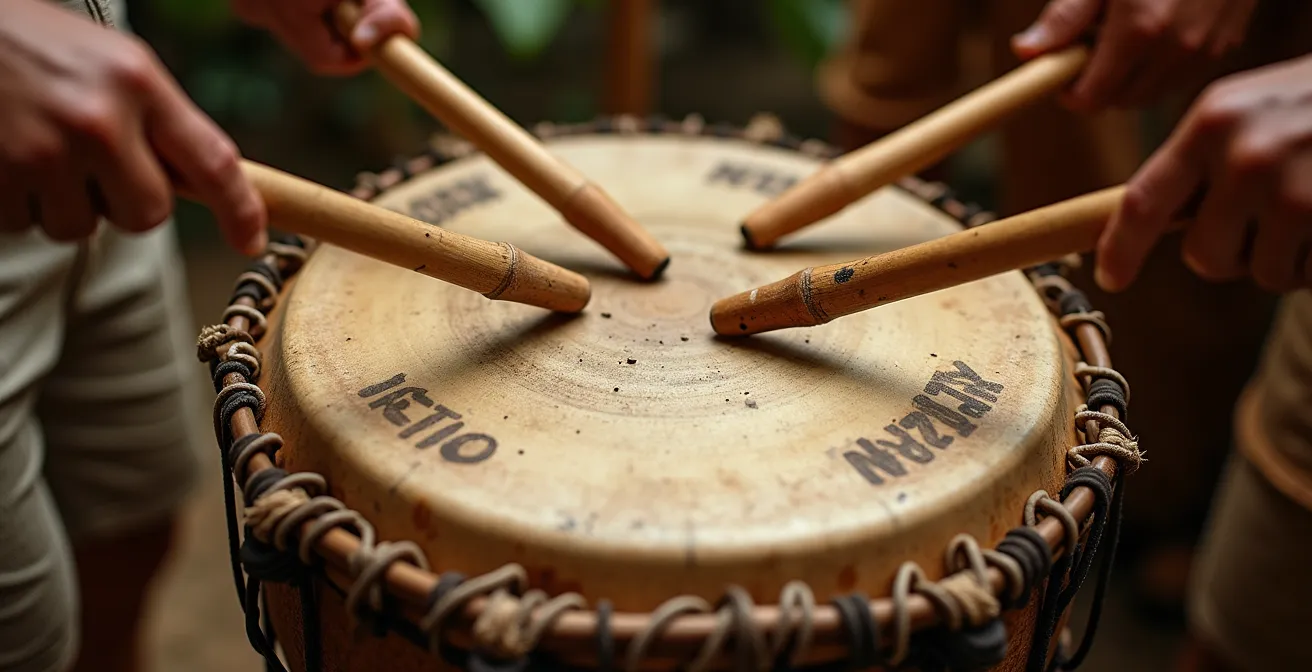
This tradition is vibrant and alive across Alberta. For example, the story of Young Spirit, a drum group from Maskwacis, Alberta, shows how this tradition thrives. Formed by a group of friends in 2001, they have become a proud voice of Western Canadian Plains Cree culture, travelling thousands of miles to share their music and maintain community connections. Their journey exemplifies how drum groups are crucial for maintaining cultural traditions and building bonds across generations.
Case Study: Young Spirit Drum Group – Alberta’s Rising Stars
Young Spirit was formed in 2001 at a pow-wow in Hobbema (now Maskwacis), Alberta, representing Western Canadian Plains Cree culture. Originally a group of friends, they have become a proud voice of traditional music, traveling thousands of miles and maintaining strong connections throughout the powwow circuit. Their story exemplifies how drum groups maintain cultural traditions while building community across generations.
Listening with this understanding changes the experience entirely, connecting you to the collective spirit of everyone in the arbor.
Stand and Remove Hats: Why is the Grand Entry So Sacred?
If you only witness one part of a powwow, make it the Grand Entry. This is the official start of the powwow, and it is a profoundly sacred and moving ceremony, much like a collective prayer that brings the entire community together. Arriving after the Grand Entry has begun is seen as arriving at church after the service has started. That’s why it’s crucial to check the schedule, often found on the powwow’s social media page, and arrive early. Grand Entries typically happen once in the early afternoon (around 1 PM) and again in the evening (around 7 PM).
When the Master of Ceremonies (MC) announces the Grand Entry, you will be asked to stand and remove your hats. This is a universal sign of respect. Photography is often forbidden during this time, so listen carefully to the MC’s instructions. You are not just watching a parade; you are witnessing a sacred procession that honours spiritual symbols, nations, and wisdom keepers.
The order of the procession is deeply meaningful. It begins with Eagle Staff bearers, carrying the flags of the Indigenous Nations, which are held in the highest esteem. They are followed by flags representing Canada, Alberta, and other treaty nations, and then by Indigenous veterans, who are highly honoured for their service. Following them are Elders, community dignitaries, and finally, all the dancers, organized by their dance style. This hierarchical order reinforces respect for spirituality, nationhood, service, and wisdom. With over 20 powwows held annually across Alberta, you have many opportunities to witness this powerful ceremony.
By standing in respectful silence, you are no longer just a spectator; you are participating in a moment of communal reverence.
When Can You Join the Dance Circle as a Visitor?
As you watch the dancers move in a kaleidoscope of colour and motion, you might feel a pull to join in. For many visitors, the biggest question is, “Can I dance too?” The answer is a resounding yes, at the right time! This opportunity for respectful participation comes during what is called an “Intertribal” dance.
The MC will clearly announce, “This is an Intertribal! Everyone is welcome to come and join us in the circle.” This is your direct and open invitation. As Colette Derworiz noted in the Canadian Rockies Annual, Intertribals are a core part of the powwow’s inclusive spirit. This is a moment of communal celebration, not a performance or competition. There are no specific steps you need to know; the goal is simply to be present and move with the rhythm of the drum.
They are open to everyone, including non-Aboriginal people from any culture.
– Colette Derworiz, Canadian Rockies Annual Volume 3 – The Powwow Trail
When you hear the call, don’t be shy. Here’s how to join in respectfully:
- Enter the dance circle (the arbor) from the eastern entrance if it’s marked, or simply follow the lead of other dancers.
- Always move in a clockwise direction around the circle, keeping with the beat of the drum.
- Keep your movements modest and respectful. You are participating, not performing. A simple two-step or walking to the beat is perfect.
- You will notice many women wear a shawl for Intertribals. This is a sign of respect, and you can often purchase beautiful shawls from the vendors onsite.
- Families are encouraged to dance together, so bring your children into the circle with you!
Participating in an Intertribal is one of the most powerful ways to move from guest to participant, sharing in the joy and energy of the community.
Fancy Dance vs Grass Dance: How to Tell the Styles Apart?
Once the powwow is in full swing, you’ll be treated to a stunning variety of dance styles, each with its own history, regalia, and movement. For a newcomer, it can be a beautiful but confusing blur. Learning to distinguish a few key styles can dramatically deepen your appreciation of the dancers’ skill and the stories they tell with their bodies.
Two of the most dynamic and popular men’s styles are the Grass Dance and the Fancy Dance. The Grass Dance is a fluid, swaying style with origins in the Plains traditions, where dancers would flatten the tall prairie grass to prepare a ceremonial space. Their regalia is characterized by long, flowing yarn or fringe that sways as they move, mimicking grass in the wind. The movement is smooth and controlled, staying low to the ground.
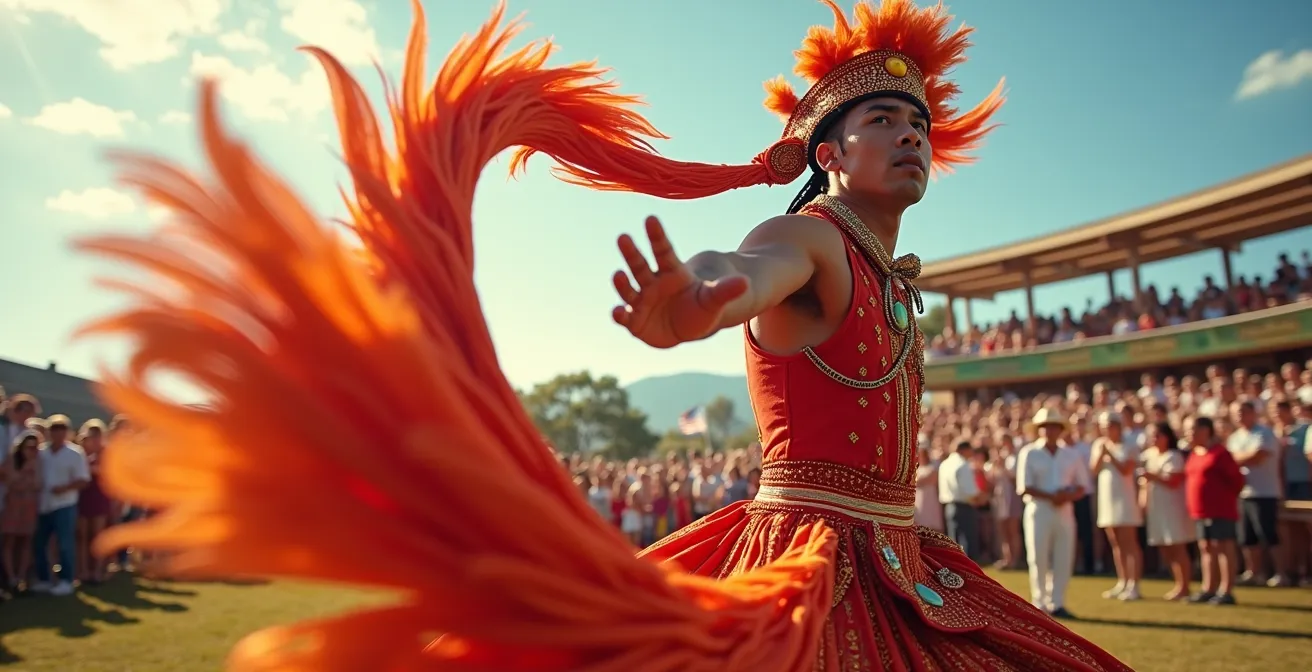
In contrast, the Fancy Dance is an explosion of energy, speed, and colour. It’s a more modern style that evolved in the early 20th century as an athletic and exciting exhibition. The regalia is vibrant, featuring two large feather bustles—one on the upper back and one at the base of the spine. The dance itself is fast-paced, featuring intricate footwork, acrobatic spins, and sudden stops, all perfectly synchronized with the fastest beats from the drum. The following table breaks down these and other common styles you might see at an Alberta powwow, including the Jingle Dress healing dance and the unique Blackfoot Chicken Dance.
This comparative guide can help you identify the different styles you’ll see. The information is drawn from authoritative sources like The Canadian Encyclopedia’s work on powwows.
| Dance Style | Origin | Visual Characteristics | Rhythm & Movement |
|---|---|---|---|
| Grass Dance | Plains traditions – dancers would flatten grass for ceremonies | Flowing fringe representing prairie grass, earth-tone colors | Fluid, swaying motions mimicking grass in wind, moderate tempo |
| Fancy Dance | Early 20th century, evolved as athletic exhibition | Bright colors, double bustles, elaborate feather work | Fast, athletic, spinning movements, quick footwork |
| Jingle Dress | Anishinaabe origin, healing dance | Dress adorned with metal cones that create jingling sounds | Light stepping, bouncing movements, healing prayer dance |
| Chicken Dance | Blackfoot tradition unique to Southern Alberta | Movements mimic prairie chicken mating display | Low crouching, pecking motions, distinctive head movements |
Recognizing the different styles turns watching into an engaging activity, allowing you to admire the unique skill each dancer brings to the circle.
Blackfoot Crossing: How to Engage with Interpreters Without Being Awkward?
Many visitors feel a little hesitant when it comes to asking questions. You want to learn, but you don’t want to be intrusive or say the wrong thing. This is especially true at designated cultural sites like Blackfoot Crossing Historical Park, a national historic site of the Siksika Nation in Alberta. Here, and at many powwows, you will find cultural interpreters whose role is to share their knowledge with you.
As Indigenous Tourism Alberta highlights, these interpreters are there to help. At Blackfoot Crossing, for example, “Dance and craft demonstrations occur frequently, and museum tours guided by Siksika interpreters can be booked in advance.” Engaging with them is not an interruption; it’s the entire point of their role. The key is to approach these interactions with humility and an open heart. Remember, you are there to listen and learn, not to debate or compare.
Start interactions with gratitude, such as, “Thank you for sharing your culture with us.” Focus on open-ended questions about culture and history rather than personal or intrusive ones. A great question is, “Could you tell me more about the significance of this design?” A poor question is, “How much Native are you?” One is about shared culture; the other is invasive. Following a clear plan can help make these interactions meaningful for everyone involved.
Your Action Plan for Respectful Engagement
- Begin with Gratitude: Always start interactions with a warm “Thank you for sharing your knowledge” or a similar expression of appreciation.
- Ask Open-Ended Questions: Instead of “yes/no” questions, ask things like, “Could you tell me more about the story behind this dance?” to invite a deeper conversation.
- Distinguish Roles: Understand the difference between a staff interpreter (an employee there to educate) and an Elder or Knowledge Keeper (a highly respected community member with special status).
- Offer Tobacco to Elders: If you have a specific, deep question for an Elder, it is a sign of great respect to offer a gift of tobacco (usually in a small cloth pouch) beforehand.
- Avoid Personal Questions: Focus on culture, history, and traditions. Avoid questions about blood quantum, income, or other personal matters.
Approaching with respect and genuine curiosity will open doors to incredible learning and create a positive experience for both you and the person sharing their heritage.
Key Takeaways
- Words are powerful: Using “regalia” instead of “costume” shows you understand its sacred and personal nature.
- Participation is encouraged: Listen for the MC’s call for an “Intertribal”—this is your open invitation to join the dance circle.
- Your support matters: Purchasing authentic, locally made art from Indigenous vendors directly supports artists and the continuation of living traditions.
Made in Alberta: How to Ensure Your Souvenir Isn’t Mass-Produced Abroad?
Bringing home a souvenir is a wonderful way to remember your experience, and at a powwow, it’s also a vital way to support Indigenous artists and their families directly. Your purchase is more than a transaction; it is an act of economic reconciliation that helps sustain living traditions. However, the market is unfortunately flooded with “Native-inspired” items that are mass-produced abroad. Buying these fakes not only takes money away from the community but also perpetuates harmful stereotypes.
So, how can you be sure your purchase is authentic? The best way is to buy directly from the artist at their booth in the powwow market. You can talk to them, hear the story behind their work, and know that your money is going straight to them. Places like the gift shop at Blackfoot Crossing Historical Park also guarantee authenticity, ensuring all items are made by Siksika Nation artisans. Organizations like Indigenous Tourism Alberta further help by promoting businesses that are at least 51% Indigenous-owned, giving you confidence in your purchase.
When you’re browsing the vendors, there are several clear indicators to look for. Authentic art has a feel of uniqueness; you’ll see slight variations between pieces because they are handmade. The price will reflect the hours of skilled work and quality of materials, like real hide, bone, or porcupine quills, not plastic. Most importantly, an authentic artist will be able to tell you their Nation affiliation and the story behind their work.
Case Study: Supporting Authentic Indigenous Artists in Alberta
At Blackfoot Crossing Historical Park’s gift shop, visitors can purchase locally made crafts and products directly supporting the Siksika Nation. The park ensures all items are authentic, with many created by community artisans. Similarly, Indigenous Tourism Alberta promotes businesses that are at least 51% Indigenous-owned, providing travelers with confidence that their purchases directly benefit Indigenous communities and preserve traditional art forms.
| Authentic Indicators | Red Flags for Fakes |
|---|---|
| Artist present or named with Nation affiliation | No artist information available |
| Slight variations between pieces | Dozens of identical items |
| Traditional materials (hide, bone, natural beads) | Plastic components, synthetic materials |
| Price reflects hours of skilled work | Unnaturally low prices for ‘handmade’ items |
| Stories and cultural context provided | Generic ‘Native-inspired’ labels |
| Available at cultural centers, powwows, Indigenous-owned shops | Mass retail stores, tourist traps |
Your purchase becomes a meaningful connection to the artist and a direct contribution to the vitality of Indigenous culture.
Can You Take Photos on a Reserve? Rules for Visiting Indigenous Lands
The final area of anxiety for many visitors revolves around photography and boundaries. Can you take pictures? Where can you go? It’s important to remember that a First Nation Reserve is not a public park; it is a community with private homes and communal lands. While the powwow grounds are open to you as a guest, the surrounding area is not a tourist attraction.
Think of it like visiting any neighbourhood: you wouldn’t wander into someone’s private backyard to take a photo. Main roads on a reserve may be public, but venturing off them without permission is trespassing. It’s a matter of respecting sovereignty and privacy. The scale of these lands is vast; understanding that Treaty 7 alone covers 50,000 square kilometers of traditional territory in Southern Alberta helps contextualize that this is a nation’s land, not just a venue.
When it comes to photography at the powwow itself, the rule is simple: always ask for permission before taking a picture of a person. This is especially true for Elders and children. A dancer may have just finished a physically and spiritually demanding dance and may not want their photo taken. Or they may be happy to pose for you! You will never know unless you ask. The MC will also make announcements when all photography is strictly forbidden, such as during honour songs, prayers, or specific ceremonies. Put your camera away during these times without exception.
A wonderful and respectful alternative to taking your own photos is to purchase prints, art cards, or postcards from local Indigenous photographers vending at the powwow. These artists have the trust of the community and have captured stunning images with full consent. By buying their work, you get a beautiful, professional memento while financially supporting an Indigenous artist and honouring cultural protocols.
Now that you understand the heart behind the celebration, your next step is to experience it. We invite you to find a local powwow, listen to the heartbeat of the drum, and be a part of this beautiful living tradition with confidence and an open heart.