
In summary:
- Authenticity isn’t a “Made in Canada” sticker; it’s the story and relationship behind the piece.
- Supporting Indigenous artists means engaging respectfully with a living culture, not just buying an object.
- In Alberta, understanding the context of Treaty 7, place names, and cultural events is key to ethical purchasing.
- Your role is not just to be a consumer, but a respectful guest and ally in cultural revitalization.
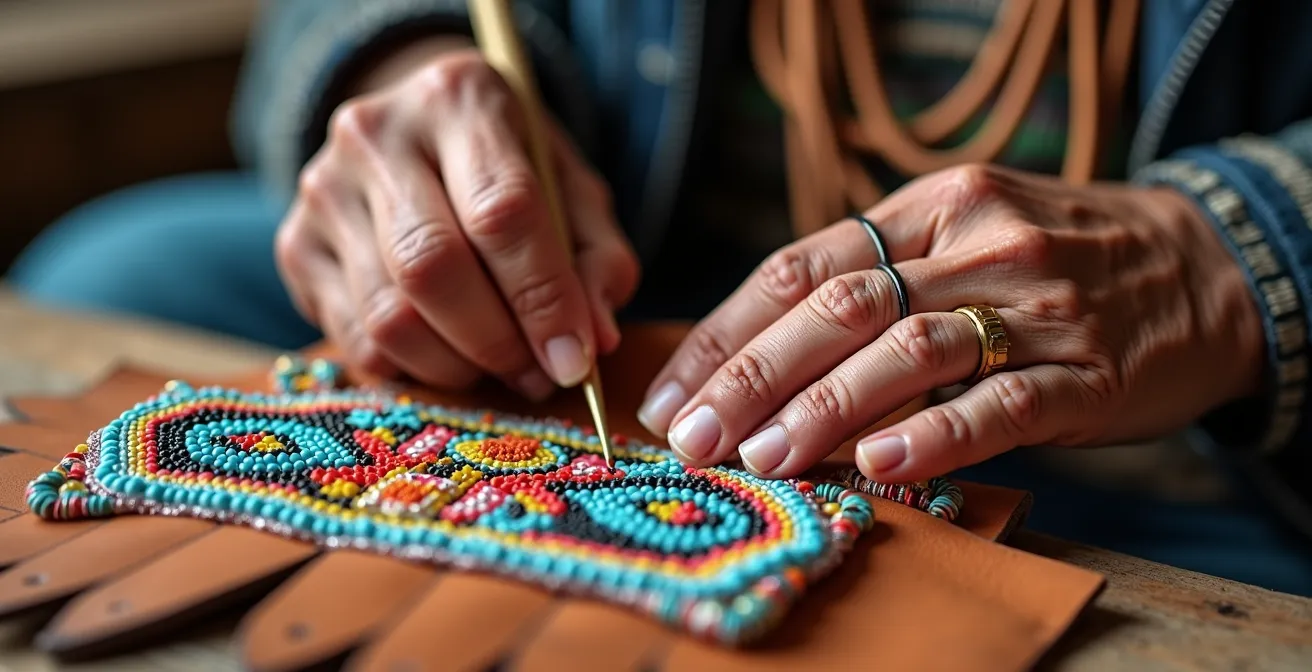
You’ve seen them in a bustling airport shop or a quaint mountain town boutique: a beautifully beaded pair of earrings, a carved wooden figure, a colourful blanket with “Indigenous-style” patterns. A part of you is drawn to its beauty, but another part hesitates. Is this real? Who made this? Is buying this an act of appreciation or appropriation? This uncertainty is a common experience for visitors to Alberta who want to do the right thing but lack the tools to navigate the complex world of Indigenous art.
The standard advice—”look for a signature” or “buy from a reputable gallery”—often falls short. It treats these powerful cultural expressions as mere products to be verified. It misses the entire point. The challenge isn’t just distinguishing an authentic object from a mass-produced souvenir made overseas. The real gap is bridging a tourist’s perception with the deep, living history of the Treaty 7 land you are on. It’s about understanding that these are not just crafts; they are stories, lineage, and resilience made manifest.
But what if the key wasn’t learning to be a better art detective, but becoming a more respectful guest? This guide proposes a fundamental shift: authenticity is not a label on an object; it is an experience of respectful engagement with the living culture and stories of the land. We believe that by learning to see the context, not just the craft, you transform from a consumer into a genuine supporter of Indigenous artists and their communities. Your purchase becomes a relationship, not just a transaction.
This journey will take us through the specific cultural landscape of Alberta. We will explore the profound meaning of a ribbon skirt, the difference between a guest ranch and an Indigenous worldview, the hidden stories in place names, and the proper etiquette for attending a powwow. By the end, you will not only know how to identify and purchase authentic art, but you will understand *why* it matters so deeply.
To guide you on this path of understanding, this article is structured to answer your most pressing questions and provide clear, actionable insights into Alberta’s vibrant Indigenous cultures.
Table of Contents: A Journey into Alberta’s Living Indigenous Cultures
- Ribbon Skirts and Photography: What is Respectful at a Cultural Site?
- Working Ranch vs Guest Ranch: Which Experience Matches Your “Yellowstone” Dream?
- Ukrainians in Alberta: Why Are Pierogies a Staple on Rural Menus?
- Glenbow or Royal Alberta: Which Museum Tells the Story You Want to Hear?
- Okotoks or Wetaskiwin: What Do These Indigenous Place Names Actually Mean?
- Blackfoot Crossing: How to Engage with Interpreters Without Being Awkward?
- Blackfoot Legends: What Do Hoodoos Represent in Indigenous Stories?
- Can Non-Indigenous People Attend a Powwow in Alberta?
Ribbon Skirts and Photography: What is Respectful at a Cultural Site?
A ribbon skirt is not a costume or a fashion item; it is a profound statement of identity and resilience. For many Indigenous women, creating and wearing a ribbon skirt is an act of reclaiming culture and spirit. It is, in the powerful words of the Ribbon Skirt Project, a form of cultural armor against generations of assimilationist policies. Each skirt, often handmade, tells a personal story through its colours and design. Its growing presence is a symbol of strength, with recent statistics revealing that there are more than 754 Indigenous employees who self-identified as women, non-binary or Two-Spirit in the RCMP, who now have the option to wear it as part of their ceremonial dress.
This sacred nature demands a different kind of respect, especially when it comes to photography. A visitor’s desire for a beautiful photo can unintentionally feel extractive, reducing a person’s sacred regalia to a tourist snapshot. The key is to shift your mindset from “taking” a picture to “receiving” a story. Before you raise your camera, raise your curiosity. Engage in conversation. Ask about the meaning of the colours, but only after you have established a respectful connection. At deeply sacred sites like Writing-on-Stone/Áísínai’pi, there are times, especially during ceremonies, when all cameras must be put away. True respect is knowing when the memory you keep should be in your heart, not on your memory card.
National Impact: The Story of Isabella Kulak
In January 2024, Canada recognized National Ribbon Skirt Day, a direct result of the courage of ten-year-old Isabella Kulak from Cote First Nation. After she was shamed for wearing her handmade ribbon skirt to a formal day at her school, her family shared the story on social media. The post ignited a powerful wave of support across the country, with Indigenous women proudly wearing their own skirts in solidarity. This single event highlighted the deep importance of cultural identity and turned a personal moment of hurt into a national movement of education and pride.
Your Guide to Respectful Photography at Sacred Sites
- Recognize Personal Reclamation: Acknowledge that a ribbon skirt is not public property. It is a powerful piece of cultural armor and a personal story.
- Prioritize Ceremony over Cameras: Understand that at sacred sites, especially during ceremonies, the priority is spiritual observance. Put your camera away without being asked.
- Choose Story over Snapshot: Instead of immediately asking for a photo, engage in genuine conversation. Seek to receive a story, not just extract an image.
- Find Alternative Memories: If photography is inappropriate, support the artist by purchasing postcards or prints they offer. Alternatively, write down your feelings and observations to preserve the memory.
- Ask with Respect: If you have built a connection and feel it is appropriate, you can ask about the personal meaning behind the ribbons. Frame the question as a desire to learn, not just to capture.
Working Ranch vs Guest Ranch: Which Experience Matches Your “Yellowstone” Dream?
The sweeping vistas of Alberta and the enduring myth of the cowboy, popularized by shows like “Yellowstone,” draw many visitors in search of a ranch experience. However, a critical distinction exists between a typical guest ranch and an Indigenous-led tourism experience. While both may offer stunning landscapes and horsemanship, their underlying worldviews are fundamentally different. A standard guest ranch often presents a settler-colonial narrative of “taming the West,” focusing on cowboy skills as a form of mastering the land.
An Indigenous-owned ranch or horsemanship experience, by contrast, is rooted in a relationship with the land that is thousands of years old. It’s an opportunity to understand the horse’s spiritual significance and to see the prairie not as a resource to be conquered, but as a relative to be respected. It’s about learning the land-based knowledge that has sustained peoples here since time immemorial. The goal isn’t to live out a cinematic fantasy, but to connect with a living culture in a way that is authentic and reciprocal. As experts in the field have noted, this is the ultimate form of authentic travel.
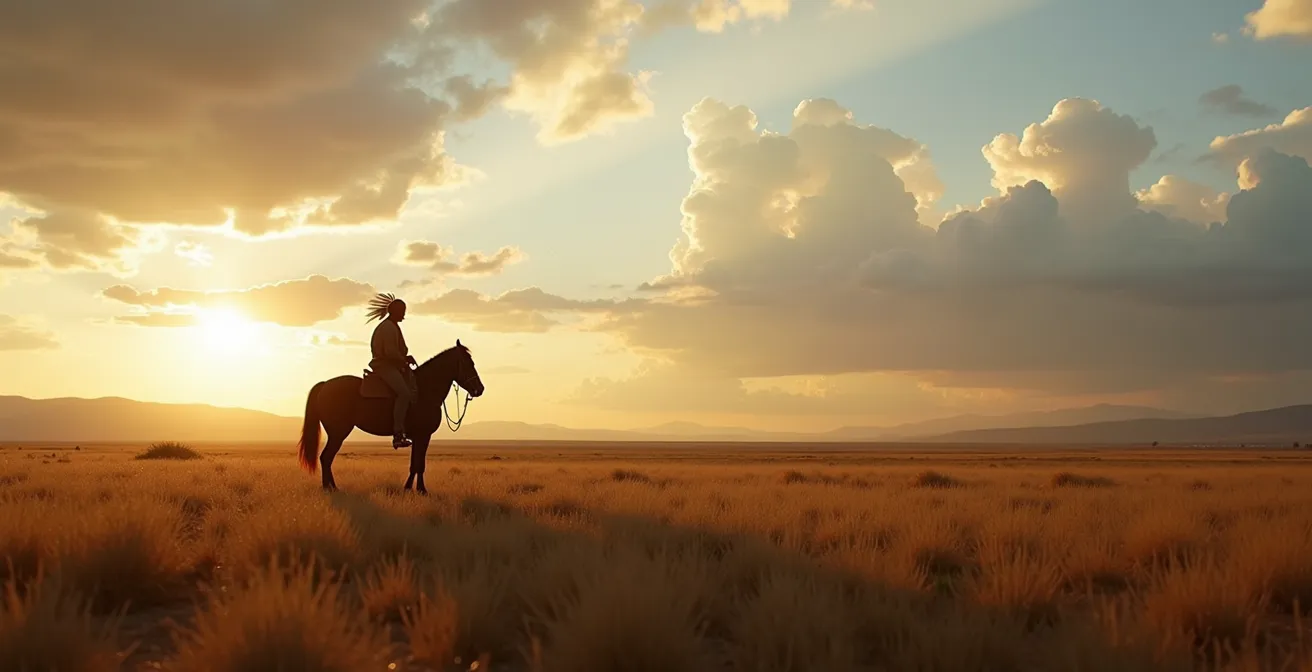
This perspective transforms the experience from a simple holiday into a meaningful cultural exchange. When you choose to ride with an Indigenous guide, you are not just a client; you are a student. You learn how the shape of a valley influenced a historic buffalo jump, how a certain plant is used for medicine, and how the stars guide you across the plains. It is an invitation to see Alberta through a lens that predates its current name.
Indigenous-owned tourism as the ultimate ‘authentic’ experience…a way to connect with the land through an Indigenous worldview, not a settler-colonial fantasy.
– Indigenous Tourism Alberta, Supporting Indigenous Artists Across Alberta
Ukrainians in Alberta: Why Are Pierogies a Staple on Rural Menus?
Finding pierogies and cabbage rolls on the menu of a small-town diner in the heart of Blackfoot or Cree territory can be surprising. It seems like a cultural anomaly, but it is in fact a deep-rooted testament to Alberta’s unique history of settlement and coexistence. The massive wave of Ukrainian immigration to the prairies in the late 19th and early 20th centuries brought two distinct cultures into close contact. Both Indigenous peoples and Ukrainian settlers had profound connections to the land, advanced agricultural knowledge, and a strong emphasis on community and family.
In many cases, it was Indigenous communities who taught the new arrivals how to survive and thrive in the harsh prairie environment, sharing knowledge about local plants, hunting, and weather patterns. This relationship of mutual aid and shared experience created a unique cultural mosaic. The pierogi on a rural menu isn’t just a food item; it’s a story-embedded object, a delicious symbol of this shared history. To understand this, one can visit places like the Ukrainian Cultural Heritage Village, which works to interpret these early settler-Indigenous interactions.
This cultural blending is a crucial part of the authentic Albertan story. It’s a reminder that culture is not static. When you see Ukrainian and Indigenous cuisines coexisting on a menu, or visit Vegreville’s famous Pysanka (Easter egg), you are witnessing the result of a complex history of adaptation and exchange. Seeking out these family-recipe pierogies at a local diner is, in its own way, a form of engaging with Alberta’s history. It’s an acknowledgment that the story of this land is written not only in stone and art but also in the food that brings people together.
Glenbow or Royal Alberta: Which Museum Tells the Story You Want to Hear?
For decades, museums were often seen as colonial institutions—places where Indigenous artifacts were displayed as relics of a dying culture, their stories told by non-Indigenous curators. Today, a profound transformation is underway. Spurred by the Truth and Reconciliation Commission’s 94 calls to action outlined by the Truth and Reconciliation Commission, major institutions like Calgary’s Glenbow Museum and Edmonton’s Royal Alberta Museum are actively working towards decolonization and reconciliation. This means they are no longer just telling stories *about* Indigenous people; they are creating spaces for Indigenous people to tell their *own* stories.
So, which museum should you visit? The answer depends on the story you want to hear. The Glenbow is undergoing a massive renovation with a renewed focus on community collaboration and Indigenous perspectives at its core. The Royal Alberta Museum features a large, permanent Human History Hall with significant Indigenous content developed in consultation with communities across the province. Both are moving towards a model of respectful engagement. The best choice is to research their current exhibitions and see which ones feature Indigenous curators, artists, or community partnerships. This is the new marker of authenticity.
A powerful, local example of this shift is the City of Calgary’s initiative to hire Jessica McMann, an Alberta-based Cree curator and artist, to its public art team. Her role, and that of other Indigenous team members, is to ensure the stories and perspectives of Treaty 7 Nations, the Métis Nation of Alberta, and all Indigenous peoples are accurately and respectfully represented in the city’s public art collection. This move from consultation to direct leadership is a critical step in ensuring that the art you see in public spaces is a true reflection of the land’s original peoples, not a filtered interpretation.
Okotoks or Wetaskiwin: What Do These Indigenous Place Names Actually Mean?
The names on the map of Alberta are a living library of Indigenous history and worldview. Places like Calgary, Edmonton, and Red Deer are settler names, but they are surrounded by names that hold much older stories. Okotoks, Wetaskiwin, Medicine Hat—these are not just random syllables. They are Anglicized versions of Indigenous words, each carrying a specific, land-based story. To learn their meaning is to begin to understand the territory from an Indigenous perspective. An “okotok” in the Blackfoot language refers to a large rock, specifically the one left on the prairie by the trickster Napi.
Understanding these names is a fundamental act of respect. It acknowledges the history that existed long before the province of Alberta was created. When you travel to “Wetaskiwin,” knowing it comes from the Cree “wîtaskîwin-ispatinâw,” meaning “the hills where peace was made,” transforms your visit. You are no longer just in a town; you are at the site of a historic peace treaty between the Cree and Blackfoot. The landscape itself becomes a history book. This is the essence of connecting with a living culture—the stories are embedded in the land itself.
The following table, based on information provided by cultural experts at Travel Alberta, offers a glimpse into the stories behind some of Alberta’s place names. It serves as a starting point for seeing the province not just as a map of roads and towns, but as a tapestry of sacred stories and historical memory.
| Place Name | Indigenous Origin | Literal Meaning | Cultural Story |
|---|---|---|---|
| Okotoks | Blackfoot (Siksika) | Big Rock | Story of Napi and the rock |
| Wetaskiwin | Cree | The Hills Where Peace Was Made | Historic peace treaty site between Cree and Blackfoot |
| Medicine Hat | Blackfoot | Saamis (Medicine Man’s Hat) | Sacred headdress lost in battle |
| Waterton | Blackfoot | Paahtómahksikimi (Inner Sacred Lake) | Sacred sites throughout the park |
Blackfoot Crossing: How to Engage with Interpreters Without Being Awkward?
Visiting a site like Blackfoot Crossing Historical Park, a National Heritage Site on the Siksika Nation, is an unparalleled opportunity for learning. The Indigenous interpreters there are not historical re-enactors or service staff; they are professional cultural educators, knowledge keepers, and storytellers sharing the history of their own people on their own land. Engaging with them can feel intimidating for some visitors, who fear saying the wrong thing. The key to avoiding awkwardness is to approach the interaction with humility and genuine curiosity.
The most respectful thing you can do is listen. Attentive listening shows more respect than a constant barrage of questions. Embrace moments of comfortable silence; they are often when the most profound understanding can occur. When you do ask questions, aim for ones that open up conversation rather than demand a simple fact. Instead of “What did they eat?” try “What does it mean to you to share this history here on this land?” This invites a personal connection, not a textbook answer. Remember, you are a guest in their home, and the goal is a respectful engagement, not a data-gathering mission.
To help guide your interactions, consider these examples of thoughtful questions and practices:
- Instead of focusing only on the past, ask: “What aspects of traditional Blackfoot architecture are most misunderstood today?”
- To show you value their personal connection, ask: “How has your family’s connection to these stories influenced you?”
- Frame your questions from a place of learning: “What is the most important thing for a visitor like me to understand about Siksika history?”
- Avoid questions about traumatic history unless the interpreter opens the door. Let them guide the narrative.
By framing your visit as an opportunity to learn from a professional, you shift the dynamic from a tourist transaction to a meaningful human exchange. This is the heart of authentic cultural tourism.
Blackfoot Legends: What Do Hoodoos Represent in Indigenous Stories?
To a geologist, the hoodoos of the Alberta badlands are fascinating sandstone formations created by erosion. To the Blackfoot people, they are giants, frozen in time. According to legend, these were once intruders who were turned to stone by the spirits as a warning to those who would disrespect the sacred land. This dual understanding—the scientific and the sacred—is at the heart of an Indigenous worldview. The land is not an inanimate object; it is alive, full of stories, spirits, and lessons.
Art becomes the bridge that allows us to access this deeper understanding. As the Calgary Public Art Team notes, showcasing art by Indigenous artists is a powerful “way of understanding and learning about the people who have lived in this region since time immemorial.” An artist can translate the sacred story of a hoodoo or the spiritual energy of a mountain onto a canvas, making the unseen visible. This is why buying authentic Indigenous art is so much more than a decorative act; it is an act of listening to the land through the artist’s eyes. It is acquiring a piece of a story-embedded worldview.
Consider the work of Alex Janvier, an internationally renowned Denesųłiné artist from Cold Lake First Nations. His flowing, abstract murals, recognized with the Order of Canada and the Governor General’s Award, are vibrant expressions of Indigenous spirituality and connection to the land. In the 1970s, he partnered with architect Peter Hemingway, who considered Janvier’s murals to be the very heart of the buildings they were in. This collaboration shows a profound respect for art as a central, living element of a space, not just an afterthought. When you see such art, you are seeing the land’s story made manifest.
Key Takeaways
- Authentic Indigenous art is a ‘story-embedded object’; its value lies in the culture, history, and artist it represents, not just its aesthetic.
- Shift your mindset from being a ‘consumer’ to a ‘respectful guest’. The goal is connection and understanding, not just a transaction.
- Your support matters. Purchasing directly from Treaty 7 artists or through Indigenous-led markets is a direct contribution to cultural revitalization and economic sovereignty.
Can Non-Indigenous People Attend a Powwow in Alberta?
The answer is a clear and resounding yes. A powwow is a celebration of life and culture, and guests are welcome. However, it’s crucial to remember that you are attending a community and family gathering, not a performance staged for tourists. The experience is an invitation to witness a living culture in action, and the best way to honour that invitation is by being a good guest. This begins with understanding that the event has its own sacred protocols that must be respected by all in attendance.
Events like the Indigenous Artist Market Collective in Banff and Lake Louise, which can feature more than 70 First Nations, Metis, and Inuit artists, are fantastic and welcoming entry points. They often combine market stalls with dance and drum performances, allowing for easy and respectful interaction. When you visit a vendor, start a conversation with “Could you tell me about this design?” rather than “How much is this?” It opens the door to the story behind the art, which is where the true value lies. A powwow is one of the best places to buy authentic art directly from the person who made it, ensuring your money supports the artist and their family directly.
Being a respectful guest means being observant and following the lead of others. The Master of Ceremonies (MC) is your guide; listen carefully to their instructions throughout the event. They will tell you when to stand, when to remove your hat, and when photography is not permitted. Honouring these simple rules is the most powerful way to show your respect and ensure that these vital cultural celebrations remain open and welcoming to all.
Your Checklist for Attending a Powwow Respectfully
- Honour the Eagle Staff: Always stand when an Eagle Staff is brought into the arena. This is a sacred item, akin to a flag, and demands the highest respect.
- Respect the Grand Entry: The Grand Entry is a sacred ceremony, not a parade. Stand, remove your hat, and do not take photos or videos.
- Support the Drummers: Drum groups are the heart of the powwow. It is customary to give cash gifts (a “money shake”) to show appreciation. Place the money directly on their drum when appropriate.
- Engage with Vendors Thoughtfully: Visit the vendor stalls to find beautiful, authentic art. Start conversations by asking about the story or technique behind a piece before asking about the price.
- Remember Your Role: You are a welcome guest at what is fundamentally a family and community event. Be humble, observant, and respectful. You are there to learn and appreciate, not to be the centre of attention.
Now that you have the tools to be a respectful guest and an informed supporter, the next step is to actively seek out these authentic experiences. Your journey into the heart of Alberta’s Indigenous culture begins with a single, respectful step.