
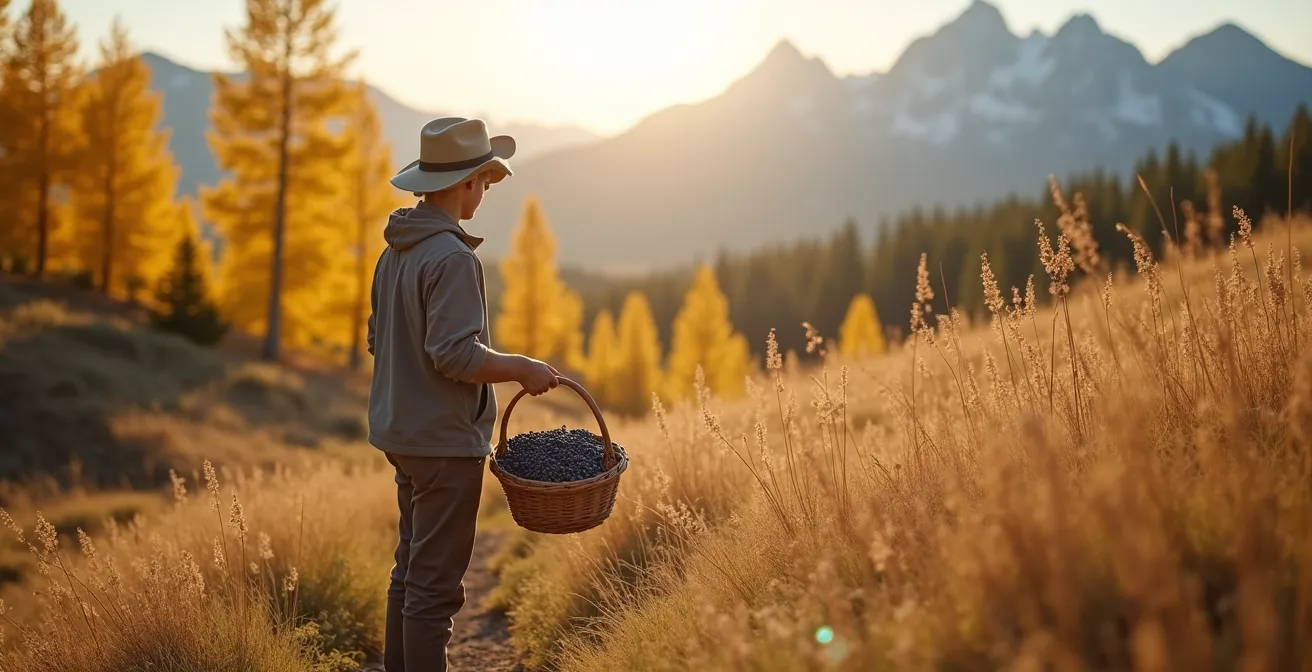
In summary:
- Properly identifying edible Saskatoon berries versus toxic look-alikes like Buckthorn is the most critical first step for any forager.
- Understanding the simple rules of both wild foraging and U-Pick farms in Alberta, a concept we call “Prairie Etiquette,” ensures a respectful and successful trip.
- Regional wildlife safety means knowing specific local risks; rattlesnakes, for instance, are only a concern in the far southeast corner of Alberta.
- Mastering your harvest includes not just picking but also proper transport and using the right thickeners to avoid a runny Saskatoon berry pie.
The warm Alberta sun of early July brings with it one of the prairies’ greatest simple pleasures: the annual Saskatoon berry harvest. For families, it’s a perfect opportunity to connect with nature, enjoy a fun and free activity, and come home with buckets of delicious fruit. The thought of endless pies, jams, and syrups is enough to get anyone excited. But for many, the initial enthusiasm is quickly followed by questions. How can you be absolutely sure you’re picking the right berry? What are the rules for picking on public land or at a farm? And what about wildlife encounters?
Most guides will simply list a few popular U-Pick farms, but that only scratches the surface. The real joy of foraging comes from building confidence in your own skills. It’s about more than just finding a location; it’s about understanding the ecosystem you’re stepping into. Concerns about poisonous berries or running into a bear are valid, but they are easily managed with the right knowledge. The key isn’t just to avoid danger, but to actively understand the landscape.
This guide takes a different approach. We believe the secret to a successful foraging trip isn’t just knowing *where* to go, but *how* to go with confidence. We’ll move beyond simple lists to teach you the principles of what we call Prairie Etiquette and Confident Identification. By mastering these, you can turn a simple berry-picking outing into a safe, fruitful, and memorable family tradition that you can repeat year after year.
Throughout this article, we will walk you through everything you need to know. We’ll start with the most crucial skill—correctly identifying the berries—before exploring the rules of U-Pick farms, local farmers markets, and essential safety tips tailored specifically for Alberta’s unique environment. Finally, we’ll even help you solve that age-old problem in the kitchen: how to make the perfect, non-runny Saskatoon berry pie.
Summary: Alberta’s Saskatoon Berry Foraging Guide
- Saskatoon vs Buckthorn: How to Identify the Edible Berry Correctly?
- Thickener or Not: How to Stop Your Saskatoon Pie from Being Runny?
- Blueberry vs Saskatoon: Which Berry Packs More Antioxidants?
- Freezing or Canning: What is the Best Way to Transport Berries Home?
- Weighing and Paying: What are the Rules at a U-Pick Berry Farm?
- Strathcona or Downtown: Which Farmers Market Requires the “Make It, Bake It, Grow It” Rule?
- Prairie Rattlesnakes: Where Are You Most Likely to Step on One?
- Advanced Solutions for the Perfect Saskatoon Pie Filling
Saskatoon vs. Buckthorn: How to Identify the Edible Berry Correctly?
Before you pick a single berry, the most important skill to master is confident identification. While Saskatoons (Amelanchier alnifolia) are abundant and delicious, there are look-alikes that can be harmful. The most common one to be aware of in prairie regions is the Common Buckthorn, whose berries are a strong laxative and can cause severe digestive upset. Rushing this step is not an option. True confidence comes from knowing the key differences, not just guessing.
The Saskatoon shrub has several distinct features that set it apart. The leaves are oval-shaped with a toothed or serrated edge, typically only on the top half of the leaf. In the spring, before the leaves are fully out, the shrub is covered in beautiful clusters of white, five-petaled flowers. The berries themselves grow in clusters and ripen from a reddish-purple to a deep, dark blue-black, often with a waxy, silver bloom on the skin. They are typically ready for picking in late June and July. By carefully checking these features, you can be certain you’ve found the right plant.
Your Identification Checklist: Confirming a Saskatoon Shrub
- Flower Check: Look for white flower clusters with 5-11 flowers, which appear in May/June before leaves fully develop.
- Leaf Analysis: Identify oval leaves with toothed edges and notice their downy-white appearance when first emerging from buds.
- Berry Ripeness: Check for berries that ripen from reddish-purple to a deep blue-black colour in June and July.
- Shrub Characteristics: Verify the shrub’s height (from 30cm to 6m) and note the gray older stems and reddish-brown young branches.
- Habitat Location: Find them in their preferred sunny habitats like coulees, riverbanks, and aspen groves.
It’s also helpful to understand that even within the Saskatoon family, there are variations. Cultivated varieties found at U-Pick farms have often been selected for larger, juicier fruit.
Case Study: Prairie Berry YYC Farm’s Educational Approach
Prairie Berry YYC, a farm near Calgary, cultivates three distinct varieties of Saskatoon berries. They provide detailed descriptions of each type, helping visitors learn to distinguish between different cultivated berries. This practice not only improves the picking experience at the farm but also helps families build their identification skills, making them safer and more knowledgeable foragers when they encounter wild varieties.
Thickener or Not: How to Stop Your Saskatoon Pie from Being Runny?
You’ve returned home with buckets of beautiful berries, and your first thought is of a warm, bubbling pie. But this is where many new Saskatoon bakers face a common disappointment: the runny filling. The problem isn’t your recipe; it’s the berry itself. Saskatoons have a very high water content and naturally low levels of pectin, the substance that makes jams and jellies set. In fact, research shows that Saskatoon berries contain about 79.6% water, which is released during baking.
Without help, that water turns your pie filling into a purple soup that spills out as soon as you cut the first slice. The solution is simple: you must use a thickening agent. There are several options available, each with its own properties that affect the final look and texture of your pie. Choosing the right one depends on the result you’re hoping to achieve, whether it’s a rustic, traditional pie or one with a crystal-clear, glossy filling.
This close-up shot perfectly captures the ideal consistency of a thickened Saskatoon berry filling. Note the glossy sheen and how the berries hold their shape within the rich, jewel-toned syrup, a result achieved by using an effective thickener like tapioca.
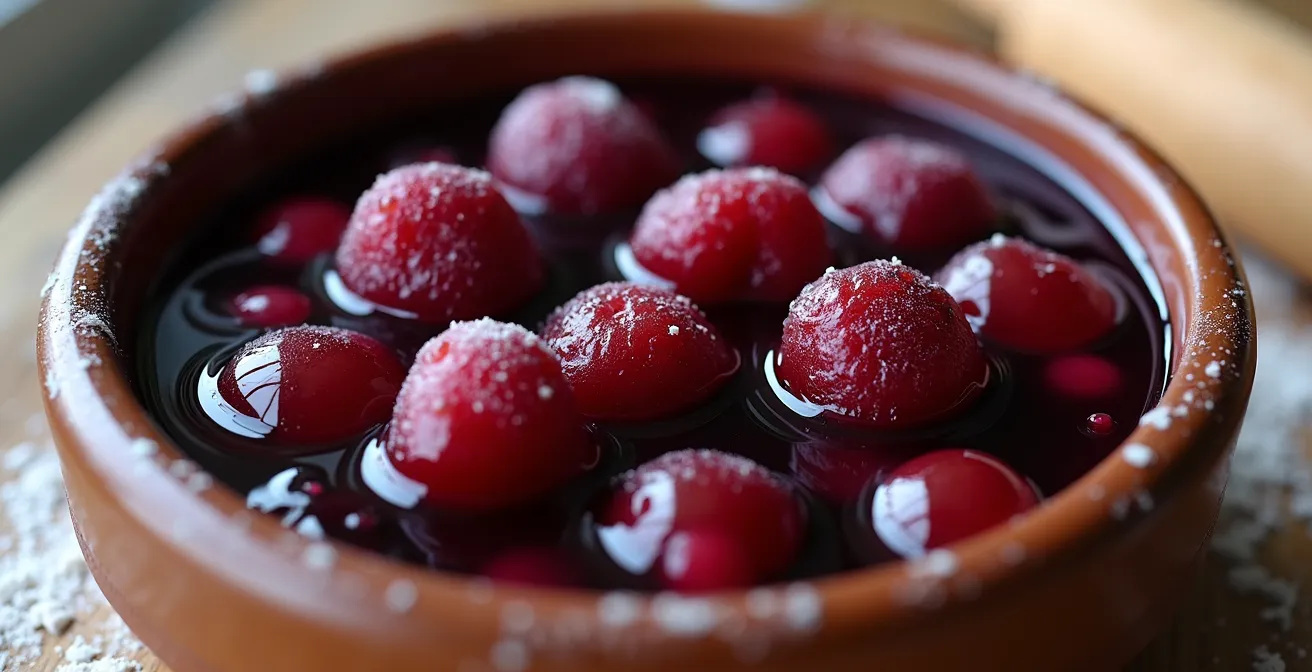
As you can see, the right thickener transforms the fruit from a loose collection of berries into a cohesive, luscious filling that holds its form. The following table breaks down the most common thickeners and how they perform, giving you a reliable guide for achieving pie perfection every time.
This handy comparison is based on extensive testing by home bakers and food experts. A comparative analysis of pie thickeners provides a clear path to success.
| Thickener Type | Amount per 4 cups berries | Result | Best Use |
|---|---|---|---|
| Cornstarch | 3-4 tablespoons | Cloudy appearance | Traditional pies |
| Tapioca (instant) | 3 tablespoons | Clear, glossy finish | Premium presentation |
| ClearJel | 3-4 tablespoons | Stable when frozen | Canning & freezing |
| Heritage flour | 4-5 tablespoons | Rustic, opaque | Traditional recipes |
Blueberry vs. Saskatoon: Which Berry Packs More Antioxidants?
While often compared to blueberries in taste and appearance, Saskatoon berries are technically more closely related to the apple family. More importantly, when it comes to nutrition, they are a true prairie powerhouse that stands in a category of its own. Many people are surprised to learn that these humble local berries are packed with an incredible amount of antioxidants, the compounds that help protect our bodies from cell damage.
The difference is not minor. While blueberries are rightly praised for their health benefits, Saskatoons are significantly more potent. In fact, Prairie Berries research demonstrates that Saskatoon berries have 4.5 times higher antioxidant levels than their more famous counterparts. This is largely due to their high concentration of anthocyanins, the pigments that give them their deep purple-blue colour. A scientific study on prairie-harvested fruits classified Saskatoons as “high anthocyanin berries,” with a specific compound found at levels far exceeding those in many other fruits.
Their impressive nutritional profile doesn’t stop there. They are a fantastic source of vitamins and minerals, making them an excellent snack to eat raw right off the bush. A medical review from a trusted health source highlights just how beneficial they are:
They have twice the amount of vitamin C and seven times the amount of calcium in blueberries.
– WebMD Medical Review, WebMD Diet & Nutrition
So, as your family is out there picking, encourage them to enjoy a few fresh berries. Not only are they delicious, but they are also one of the most nutrient-dense wild fruits you can find in Alberta, offering a powerful boost of fibre, calcium, and essential vitamins with every handful.
Freezing or Canning: What is the Best Way to Transport Berries Home?
Your picking adventure was a success, and your buckets are full. Now comes a crucial step that many people overlook: getting your harvest home and preserving its quality. Saskatoon berries are delicate. Piled high in a warm car on a July afternoon, they can quickly get crushed and start to lose their structure and freshness. The goal is to maintain harvest integrity from the field to your freezer.
While canning is a wonderful way to make jams and pie fillings, the single best method for preserving the berries whole is flash-freezing. This technique freezes each berry individually, preventing them from clumping together into a solid, icy mass. It ensures that when you want to bake a pie in the middle of winter, you can measure out what looks and feels like a scoop of fresh berries, not a block of frozen fruit. The process is simple and requires no special equipment beyond a cookie sheet and freezer bags.
Here is the most effective method for preserving your haul:
- Gently rinse and completely dry the berries, then spread them in a single layer on a cookie sheet.
- Place the sheet in the freezer for at least four hours, or until the berries are frozen solid individually.
- Transfer the frozen berries into a freezer bag or container, removing as much air as possible.
- For best results and to prevent freezer burn, consider using a vacuum sealer.
- Label the bag with the date and store in a deep freeze for up to one year.
This method is trusted by experts who rely on preserving the quality of their wild harvests for year-round use. Sheila Flaherty, an acclaimed Inuk chef, relies on this exact technique for the wild berries she forages:
To maintain the berries’ structure, I freeze them individually on a sheet pan and then I vacuum seal them for use throughout the year.
– Sheila Flaherty, Inuk chef from Iqaluit, Nunavut
Weighing and Paying: What are the Rules at a U-Pick Berry Farm?
For many families, a trip to a U-Pick farm is the gateway to the world of berry picking. It offers a safe, controlled environment with guaranteed fruit. While there, you’ll encounter a set of customs and rules we like to call Prairie Etiquette. This isn’t about rigid laws, but rather the unwritten code of conduct that ensures a smooth and fair experience for everyone, from the farmers to the families picking alongside you. The general process is straightforward: you typically check in, get your buckets weighed (or are given pre-weighed containers), head out to the designated rows, pick your fill, and then return to have your harvest weighed and pay for what you took.
However, every farm in Alberta operates a little differently. Some are bustling operations that run on a first-come, first-served basis, while others may require reservations, especially on peak weekends. Some charge a small entry fee to access the orchard, while most simply charge by the pound for the berries you pick. It’s always a good idea to check a farm’s website or social media before you go.
Watching your kids’ faces light up as they see their buckets fill up at a weighing station is one of the great joys of a U-Pick adventure. It’s a tangible reward for their hard work and a wonderful family photo opportunity.
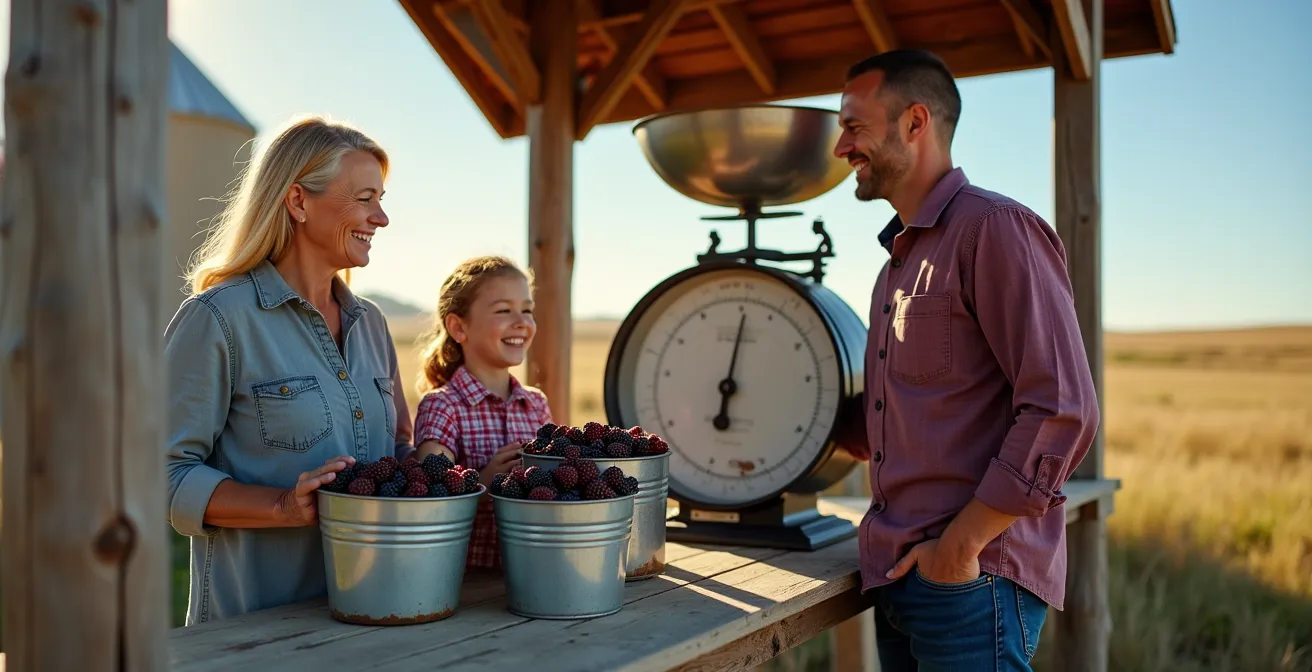
The differences between farms highlight why a quick check beforehand is so important. One farm’s relaxed policy might be another’s strict rule, and knowing in advance prevents any surprises.
Case Study: Comparing U-Pick Operations in Alberta
The operational styles of Alberta farms vary. For example, The Saskatoon Farm south of Calgary historically operates seven days a week during the season on a first-come, first-served basis, with no entry fee—customers simply pay for what they pick. In contrast, other farms might have different models or, like Solstice Berry Farm, may change their U-Pick operations over time, reinforcing the need to verify details before visiting.
Strathcona or Downtown: Which Farmers Market Requires the “Make It, Bake It, Grow It” Rule?
If you’d rather buy your Saskatoons directly from the source, Alberta’s farmers markets are a fantastic option, especially during the peak season of July and August. However, not all markets are created equal. To ensure you’re getting authentic, locally grown produce, it helps to understand the rules that govern the vendors. The gold standard for authenticity is the “Make It, Bake It, Grow It” policy. This rule, enforced by many Alberta Approved Farmers’ Markets like the one in Strathcona, requires that vendors sell only products they have produced themselves.
This policy is your best guarantee that the person selling you the berries is the same person who grew them. It means you can ask them specific questions about their farm, their growing practices, and when the berries were picked. In contrast, markets that don’t strictly enforce this rule may have resellers who buy produce wholesale and sell it at a markup. While the product might still be from Alberta, the direct connection to the farmer is lost. The Downtown Edmonton Farmers Market, for example, has its own set of vendor criteria that may differ.
Even at the best markets, the availability of fresh Saskatoons can vary weekly depending on the harvest. It’s always a smart move to call ahead or check the market’s social media channels to see which vendors will be there and if they expect to have berries. When you’re at the market, don’t be shy about engaging with the farmers. Here are a few simple questions you can ask to verify you’re getting the real deal:
- Look for any signs indicating the vendor is part of an “Alberta Approved Farmers’ Market.”
- Ask vendors directly: “Did you grow these berries on your own farm?”
- Inquire about the specific location of their farm within Alberta to learn more about the region.
- Visit during the peak harvest months of July and August for the freshest local berries.
Prairie Rattlesnakes: Where Are You Most Likely to Step on One?
For any family venturing into Alberta’s natural spaces, safety is the top priority. The thought of wildlife encounters, especially with creatures like bears or snakes, can be a source of anxiety. When it comes to foraging, the Prairie Rattlesnake often comes to mind. However, it’s crucial to replace general fear with specific, regional knowledge. The fantastic news for most foragers in Alberta is that you are extremely unlikely to ever encounter one.
Prairie Rattlesnakes have a very limited and specific habitat in the province. According to wildlife experts, their range is highly restricted. As Alberta wildlife guides confirm, rattlesnakes are restricted to the southeast corner only. This includes areas like Dinosaur Provincial Park, the Milk River Valley, and the region around Medicine Hat. If you are foraging for Saskatoons in popular areas like the Edmonton river valley, Kananaskis Country, or anywhere in the foothills and central Alberta, you are completely outside of their natural range. There are no rattlesnakes in these areas.
This geographical fact provides immense peace of mind. Instead of a vague worry about snakes, you can focus on the wildlife that is actually present in your chosen foraging spot. In the foothills and mountain parks, it’s more important to be bear aware: make noise, carry bear spray, and know how to use it. In many wooded areas across the province, the more realistic nuisance is the wood tick. After any outing, it’s good practice to do a thorough tick check on the whole family. Focusing on these relevant, manageable risks is far more effective than worrying about a threat that doesn’t exist in most of the province.
Key Takeaways
- Identification is your #1 skill: Never eat a berry you are not 100% certain is a Saskatoon. Learning the key features of the leaves, flowers, and growth habit is non-negotiable for safe foraging.
- Saskatoons are a local superfood: With significantly more antioxidants, vitamin C, and calcium than blueberries, these prairie berries are a nutritional powerhouse worth seeking out.
- Safety is about awareness, not fear: Understanding the specific, limited range of animals like rattlesnakes in Alberta allows you to focus on relevant precautions, like being bear-aware in the foothills.
Advanced Solutions for the Perfect Saskatoon Pie Filling
You’ve mastered the basics and understand that a thickener is essential for a great Saskatoon pie. But what if you want to elevate your baking and gain complete control over the final texture? For bakers aiming for perfection, there are a few advanced techniques that can help you troubleshoot any issues and guarantee a flawless, sliceable pie every single time. These methods focus on managing the berry’s high water content *before* it ever goes into the oven.
One of the most effective professional techniques is maceration. This simply means gently tossing your berries with sugar (and a little lemon juice) and letting them sit for about an hour. The sugar will draw a significant amount of juice out of the berries. You can then strain this juice into a saucepan, add your thickener (like cornstarch or tapioca), and cook it on the stovetop until it becomes a thick, glossy syrup. Once it’s cooled slightly, you pour it back over the berries and then add the entire mixture to your pie crust. This pre-cooking method ensures your filling is perfectly thickened before baking, eliminating any guesswork.
Another advanced tip is to combine thickeners to get the best of both worlds. For example, you can use cornstarch as the primary thickener for its strong setting power, but add a tablespoon of instant tapioca. The tapioca pearls will absorb excess juice and turn into clear, gelatinous specks, adding a beautiful glossy finish and extra insurance against a runny bottom crust. By experimenting with these methods, you move from simply following a recipe to truly understanding the science of baking with this wonderful prairie fruit.
Now that you are equipped with the knowledge to confidently identify, safely forage, and perfectly prepare your Saskatoon berries, the next step is to get outside and start your own family tradition. Plan your adventure, create lasting summer memories, and enjoy the delicious taste of the Alberta prairies.
Frequently Asked Questions About Prairie Foraging
Are Edmonton and Kananaskis Country safe from rattlesnakes?
Yes, these popular foraging areas are completely free of rattlesnakes, which are limited to southeastern Alberta regions like Dinosaur Provincial Park and Milk River Valley.
What wildlife should foragers watch for in Alberta?
Black bears in foothills areas, moose in wetlands, and wood ticks throughout wooded regions. Each requires different safety protocols during berry picking season.
Who should I contact in case of a rattlesnake encounter?
Contact Alberta Health Services immediately for medical emergencies, and the Report A Poacher line (1-800-642-3800) for wildlife management concerns.